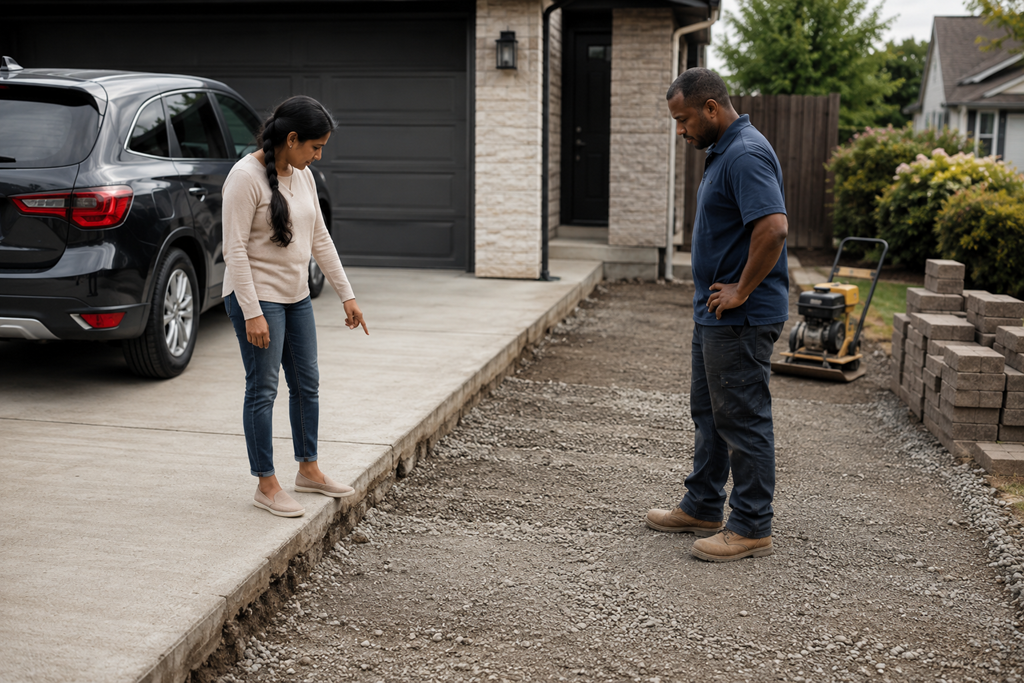
Base preparation matters because pavers are only as stable as the material beneath them. The finished surface may look level on installation day, but weak excavation, uneven compaction, poor drainage planning, or an undersized base can allow sections to settle, shift, rock, or hold water later. For Sacramento-area homeowners, understanding what is happening below the pavers is one of the best ways to compare estimates and avoid judging a project only by the visible surface.
It is easy to focus on paver color, pattern, shape, and price because those are the parts you can immediately see. The base is different. Much of the preparation disappears once the pavers are installed, even though it can strongly affect how the finished area performs.
That makes base preparation one of the most important—and easiest to overlook—parts of a paver installation estimate.
The Most Important Work May Disappear Beneath the Surface
A completed paver patio, walkway, or driveway usually presents a clean, finished surface. The excavation, grading, compacted material, edge preparation, and drainage planning beneath it are no longer visible.
This can create a misleading impression that the pavers themselves are doing most of the structural work. In reality, the surface depends on the layers below it to provide stable, even support.
Pavers placed over a properly prepared foundation are less likely to move independently when the area is walked on, driven over, exposed to water, or subjected to ordinary changes in the surrounding ground. The goal is not to prevent every possible change forever. It is to create a foundation suited to the property, the intended use, and the conditions around the project area.
That is why two installations using the same paver can perform differently. The visible material may be identical, while the preparation underneath is not.
Problems Often Appear Gradually Rather Than Immediately
Poor base preparation does not always create an obvious problem on installation day.
A newly completed surface may initially look straight and level. Over time, however, homeowners may begin noticing small changes:
- A chair or table starts to wobble in one area.
- Water repeatedly collects in a low section.
- Individual pavers begin rocking underfoot.
- A walkway develops an uneven edge.
- Pavers near a driveway entrance start separating or sinking.
- Sand repeatedly washes out of the same joints.
These symptoms do not automatically prove that the base was prepared incorrectly. Drainage changes, soil movement, roots, water leaks, heavy loads, and surrounding construction can also affect a paved area.
The useful insight is that a surface problem may begin below the surface. Replacing or repositioning a few visible pavers may improve the appearance temporarily without addressing the underlying reason the area moved.
Base Preparation Should Match How the Area Will Be Used
Not every paver project carries the same demands.
A small garden path used by pedestrians does not experience the same loads as a driveway. A patio supporting outdoor furniture has different requirements from a decorative border that receives little foot traffic. A side-yard walkway beside drainage equipment may need different planning from an open seating area.
Before comparing installation proposals, make sure each provider understands the intended use of the space. Relevant details may include:
- Whether vehicles will use the area
- The type and weight of outdoor furniture or equipment
- How frequently people will walk across it
- Whether water currently collects nearby
- How the paved area will connect with doors, gates, drains, lawns, or existing concrete
- Whether future outdoor construction may add weight or change drainage
A proposal that does not reflect the intended use may be difficult to evaluate, even when the total price appears attractive.
Drainage and Base Preparation Are Closely Connected
Water needs somewhere to go when it reaches a paved area.
The appearance of the finished slope, the preparation beneath the pavers, and the relationship between the new surface and the surrounding property all influence how water moves. The concern is not only water landing directly on the pavers. Runoff from roofs, irrigation, neighboring surfaces, planters, and higher sections of the yard may also affect the area.
Sacramento-area properties can experience long dry periods followed by seasonal rain. A project may therefore look fine during dry weather while still having drainage weaknesses that become visible when water reaches the surface.
Before installation, it is reasonable to ask how the provider has considered water movement around:
- The home’s foundation
- Door thresholds
- Low areas in the yard
- Existing drains
- Downspouts
- Irrigated landscaping
- Adjacent concrete or pavement
The answer does not need to sound highly technical. It should, however, demonstrate that the provider has examined how the new paver area fits into the property rather than treating it as an isolated rectangle.
“Base Included” Does Not Explain the Full Scope
An estimate may state that base preparation is included without explaining what that means for the specific project.
Preparation can involve evaluating the existing ground, removing unsuitable material, establishing the planned elevation, adding appropriate base material, compacting it in a controlled way, and checking the area before the pavers are placed. The exact approach can vary based on the site and the intended use.
Homeowners do not need to design the base themselves. They do need enough information to understand what each estimate includes.
A useful proposal should make it possible to distinguish between:
- Removing only the visible surface and performing more substantial excavation
- Reusing existing material and replacing it
- Preparing a pedestrian area and preparing a vehicle area
- Correcting drainage conditions and simply following the existing slope
- Including edge support and leaving it as a separate item
- Addressing soft or unstable areas and assuming the existing ground is suitable
Without that context, two prices may appear comparable even though they represent different scopes of work.
The Lowest Visible Price May Leave Important Questions Unanswered
Base preparation requires labor, equipment, material handling, and disposal. Because much of that work will eventually be covered, it can be tempting to view it as an area where costs can be reduced without affecting the finished appearance.
The problem is that an estimate with less preparation may still produce an attractive surface at first. The difference may only become apparent after the project has been used and exposed to changing conditions.
This does not mean that the highest estimate automatically includes the best preparation. Price alone does not prove quality in either direction.
A better comparison looks at what the provider observed, what conditions the estimate assumes, and how clearly the proposed preparation is described.
Questions That Can Make Estimates Easier to Compare
A few focused questions can reveal whether the base has been thoughtfully planned:
- What did you observe about the existing ground and drainage?
- How will the base preparation reflect the way this area will be used?
- What preparation is included in the quoted price?
- Are excavation, removed-material hauling, base material, compaction, and edge support included?
- What conditions could change the base-preparation scope after work begins?
- How will you address soft areas or unexpected material beneath the surface?
- How will the new elevation relate to doors, gates, drains, and nearby surfaces?
- Who will evaluate the base before the pavers are installed?
The goal is not to test a provider with technical questions. It is to find out whether the person preparing the estimate can explain the plan in understandable terms.
Clear answers also make it easier to compare providers based on scope rather than relying only on totals.
Vague Assumptions Can Lead to Disagreements Later
Some site conditions cannot be fully confirmed until excavation begins. A provider may encounter buried concrete, roots, unusually soft material, old construction debris, irrigation components, or other hidden conditions.
A responsible estimate may therefore include assumptions or explain how unexpected conditions will be handled. That is different from leaving the preparation completely undefined.
Be cautious when an estimate:
- Gives no description of the base or excavation
- Uses broad phrases without explaining what is included
- Does not distinguish between pedestrian and vehicle use
- Ignores visible drainage concerns
- Assumes every part of the project area has identical ground conditions
- Cannot explain what may create an additional charge
- Focuses almost entirely on paver appearance
Unclear wording does not always signal poor work, but it does create more room for mismatched expectations.
A Strong Surface Begins With an Appropriate Foundation
Base preparation matters because pavers cannot compensate for unstable support, poor elevation planning, or unresolved water movement beneath them.
Before choosing a Sacramento-area paver installer, look beyond the paver sample and the final pattern. Ask what will be removed, what will be placed underneath, how the area will be compacted and evaluated, and how the preparation reflects the way the space will actually be used.
The best comparison is not simply which provider offers the lowest price for the same visible paver. It is which proposal gives you the clearest understanding of the complete installation, including the work that will no longer be visible when the project is finished.