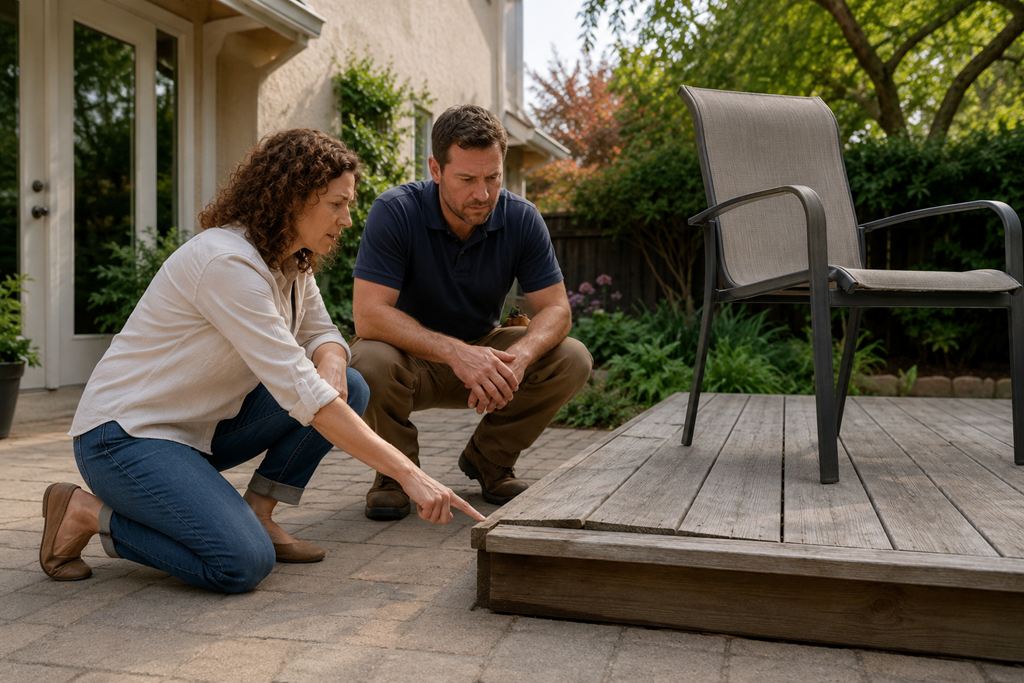
A soft spot on a deck is an area that feels unusually flexible, spongy, or unstable underfoot. Even when the surface still looks mostly normal, that change can point to weakened boards, moisture-related damage, or deterioration in the supporting material below. It does not automatically mean the entire deck needs replacement, but it is a condition worth having evaluated before regular use continues or a minor concern becomes more complicated.
Soft spots can be easy to dismiss because they do not always look dramatic. A homeowner may notice that one board gives slightly when stepped on, a patio chair seems less stable in one location, or a particular section feels different from the rest of the deck. Because the area may still appear intact, it can seem more like an annoyance than a meaningful change.
The important detail is not how dramatic the spot looks. It is that part of the deck is no longer responding the same way as the surrounding structure.
A Soft Feeling Is a Symptom, Not a Diagnosis
A soft area does not reveal its cause by itself. The problem may be limited to one surface board, but it could also involve moisture exposure, loosened connections, deterioration around fasteners, or weakened supporting material underneath.
That distinction matters because two soft spots that feel similar may require very different responses. One may involve replacing an isolated board. Another may require looking more closely at the structure below or correcting the condition that allowed moisture to remain in the area.
Trying to identify the cause by appearance alone can be misleading. A qualified deck professional can evaluate the affected area and explain whether the concern appears limited, whether nearby materials may also be involved, and what additional inspection may be appropriate.
A Small Area Can Still Provide Useful Information
Homeowners sometimes assume that a concern is unimportant because it affects only one small section. However, a localized soft spot can be the first noticeable sign that something has changed.
The area does not need to be large to deserve attention. Deck components work together, and weakness in one location may affect how weight is distributed through the surrounding boards or supports. The significance often depends on where the spot is located, what caused it, and whether the condition is continuing to develop.
A soft spot that is easy to step around is also easy to postpone. Over time, household members may unconsciously change where they walk or position furniture without addressing why the area feels different.
Recognizing the change early does not mean assuming the worst. It simply creates an opportunity to understand the condition before deciding what type of response is reasonable.
The Location of the Soft Spot Can Change the Conversation
Where the softness appears can be just as important as how it feels.
An affected board in the open center of a deck may raise different questions than softness near:
- A stairway or landing
- A railing post
- The doorway leading onto the deck
- The connection between the deck and the home
- A planter, outdoor rug, or storage container
- A drainage outlet or roof runoff area
- A shaded corner that remains damp longer than surrounding surfaces
These locations can help a professional understand whether the problem may be associated with concentrated weight, trapped moisture, drainage patterns, movement, or another condition.
Sacramento-area decks can experience long periods of sun and dry weather followed by seasonal rain. Irrigation overspray, shaded areas, planters, and objects that hold moisture against the surface can also create uneven exposure across the same deck. That does not establish the cause of a soft spot, but it is useful context to share during an evaluation.
A Normal-Looking Surface Can Hide Changes Below
Deck stains, coatings, and surface materials can sometimes remain visually consistent even when the material below has changed. A board may retain its color while becoming weaker around a fastener, along an edge, or underneath the visible surface.
The same principle applies to decks made with composite surface boards. The visible decking may not be the source of the softness. Movement can sometimes be related to spacing, fastening, or the supporting structure beneath it.
This is why a soft spot should not automatically be labeled as rot—and why it should not automatically be dismissed as a loose board. The sensation tells you that something is different, but an inspection is needed to determine what that difference means.
Repeatedly stepping, bouncing, or placing additional weight on the area is not a reliable way to judge its condition. If the spot feels noticeably unstable, limiting use of that section until it can be evaluated is a more sensible approach.
Waiting Can Reduce the Number of Straightforward Options
Some deck concerns remain isolated. Others expand because the condition that caused them continues.
For example, replacing a board may not fully address the problem if water continues to collect in the same area. Similarly, surface repairs may not resolve movement caused by weakened material below.
An earlier evaluation may make it easier to separate the affected area from the parts of the deck that remain sound. It may also help the homeowner understand whether the project involves a focused repair, a larger section, or further investigation before a reliable scope can be determined.
This does not mean every soft spot requires major work. It means postponing the evaluation can allow uncertainty to grow along with the condition.
A Useful Inspection Should Explain More Than the Visible Damage
A helpful professional evaluation should give the homeowner a clearer picture of both the problem and the proposed response.
The provider should be able to explain:
- What appears to be causing the softness
- Whether the concern is limited to the surface or may extend below it
- Which surrounding areas were examined
- Whether moisture, drainage, or repeated exposure may be contributing
- Whether the proposed work is a focused repair or part of a broader replacement
- What could cause the scope to change once damaged material is uncovered
Some conditions cannot be fully seen until a board or covering is removed. A clear estimate should distinguish between what the provider can currently observe and what remains uncertain.
That difference is important when comparing local deck repair quotes. One estimate may appear more detailed or more expensive because it accounts for possible underlying damage, while another may cover only the visible surface board. Comparing the scope—not just the total—is often the better way to understand what each provider is proposing.
Questions to Ask Before Approving Deck Repair Work
A few focused questions can make the conversation more useful:
- What evidence suggests the soft spot is limited or more extensive?
- Is the surface board the problem, or is the support underneath involved?
- Could water or drainage be contributing to the condition?
- Were nearby stairs, railings, connections, and boards checked?
- Does the estimate include correcting the cause or only replacing damaged material?
- What findings could change the proposed repair after work begins?
The answers should be understandable without relying on vague warnings or pressure. A qualified provider should be willing to explain what is known, what is uncertain, and why the recommended scope fits the observed condition.
The Goal Is a Right-Sized Response
A soft spot should not automatically lead to the conclusion that an entire deck is failing. It also should not be treated as a harmless quirk simply because the surrounding surface looks normal.
The more useful response is to recognize it as evidence that one part of the deck has changed. A professional evaluation can help determine whether the concern is isolated, whether a moisture source or structural issue is involved, and whether repair or broader replacement is worth discussing.
For Sacramento-area homeowners, understanding that distinction before comparing estimates can lead to a better-defined project and fewer surprises after work begins.