Storage problems often drive kitchen remodeling decisions because they affect far more than where dishes and groceries fit. When everyday items have no practical home, countertops become holding areas, cabinets are difficult to reach, and simple tasks require moving things from one place to another. For many Sacramento-area homeowners, the frustration is not just “too little storage.” It is storage that does not match how the kitchen is actually used.
A kitchen can have many cabinets and still feel crowded. The problem may be that shelves are too deep, drawers are too narrow, frequently used items are stored far from where they are needed, or large appliances occupy most of the available counter space.
Over time, these small frustrations can make the entire kitchen feel less functional. That is why storage often becomes one of the first issues homeowners want to discuss when considering a remodel.
Storage Problems Usually Show Up as Daily Friction
Kitchen storage problems are not always obvious at first. They often appear as repeated inconveniences that gradually become part of the household routine.
A homeowner may need to remove several pans to reach the one stored at the back of a cabinet. Groceries may be kept in another room because the pantry is full. Small appliances may remain on the counter because lifting them from a low cabinet is inconvenient. Serving dishes may be stored in a garage, hallway closet, or laundry area.
None of these situations necessarily means a kitchen needs to be remodeled. However, they can reveal that the existing storage no longer supports the household’s daily needs.
The most useful question is not simply, “Do we need more cabinets?”
A better question is, “Why are the cabinets we already have not working for us?”
The Real Problem May Be Access Rather Than Capacity
Homeowners sometimes assume that storage problems can only be solved by adding more space. In many kitchens, however, the amount of storage is only part of the issue.
A cabinet may technically hold many items but still be difficult to use. Deep shelves can hide groceries and cookware. High cabinets may become storage for things that are rarely touched. Narrow doors can make it difficult to see or reach what is inside. Corner cabinets may contain substantial space that remains largely inaccessible.
This creates an important distinction between total storage and usable storage.
Total storage describes how much cabinet and pantry space exists. Usable storage describes how easily household members can see, reach, organize, and return the items they use.
A kitchen remodel that adds cabinets without addressing accessibility may increase the cabinet count while leaving the original frustration largely unchanged.
Countertop Clutter Is Often a Storage Signal
Crowded countertops are commonly treated as an organization problem. Sometimes they are. A household may simply need to remove items that are no longer used or group similar supplies more effectively.
In other cases, countertop clutter is evidence that the kitchen lacks practical storage.
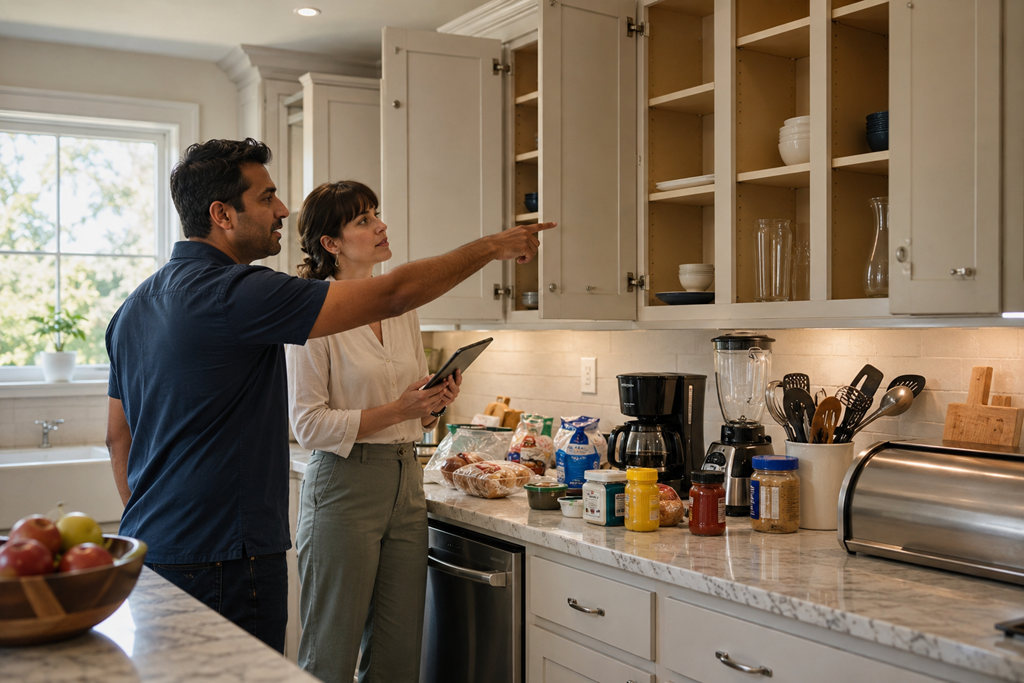
A coffee maker may remain beside the sink because there is no appropriate appliance area. Cooking utensils may stay in containers near the stove because the nearest drawers are too small. Groceries may accumulate on the counter because pantry shelves are difficult to access or already occupied by oversized items.
This does not mean every visible object should be hidden. Frequently used items may reasonably remain available. The concern is whether the countertop has become the kitchen’s default storage area because the cabinets do not provide a workable alternative.
During a remodeling consultation, explaining which items continually end up on the counter can be more useful than simply asking for “more storage.”
Household Changes Can Make an Older Layout Feel Less Practical
A kitchen that once worked reasonably well may become frustrating as the household changes.
More people may be preparing meals. Family members may begin buying groceries in different quantities. Someone may start using additional countertop appliances. A homeowner may need storage that is easier to reach than it was in the past. Entertaining, meal preparation, or work schedules may also change how often the kitchen is used.
The cabinets may not have become smaller, but the household’s relationship with the kitchen has changed.
Recognizing this can help Sacramento-area homeowners describe the problem more accurately when speaking with a kitchen remodeling professional. Instead of focusing only on the age or appearance of the cabinets, they can explain how the current layout no longer supports the way the household lives.
Organization Helps, but It Cannot Change Fixed Cabinet Geometry
Before considering a larger project, some homeowners experiment with baskets, shelf inserts, turntables, drawer dividers, or freestanding storage. These solutions may be useful when the primary problem is that items are poorly grouped or difficult to see.
Organizational products have limits, however.
They cannot make a narrow cabinet opening wider. They cannot move a pantry closer to the main preparation area. They cannot eliminate a door collision, change an inaccessible corner, or create a practical location for an appliance that has nowhere to go.
A remodel may become worth discussing when the persistent problem is built into the cabinet dimensions, placement, or overall kitchen layout rather than the way items are arranged.
That distinction can prevent homeowners from repeatedly purchasing organizers for a problem that organization alone cannot solve.
More Cabinets Can Still Be the Wrong Answer
It is easy to evaluate a remodeling proposal by looking at how many cabinets it adds. More storage can be valuable, but cabinet quantity should not be considered by itself.
Additional cabinets may reduce natural light, narrow a walkway, remove useful counter space, or place frequently used items farther from where they are needed. A tall pantry may provide substantial capacity but become inconvenient if its shelves are too deep. An island may add drawers while also making movement through the kitchen more difficult.
The strongest storage plan is not necessarily the one with the most cabinetry. It is the one that gives important items a practical home without creating new problems elsewhere.
This is why homeowners should understand the tradeoffs behind proposed storage changes before approving a remodeling scope.
Start With the Items That Have No Good Home
One practical way to prepare for a consultation is to notice which items are consistently misplaced, difficult to reach, or stored outside the kitchen.
These may include:
- Cookware that must be stacked several layers deep
- Appliances that permanently occupy preparation space
- Groceries stored in another room
- Trash, recycling, or cleaning supplies that interfere with other cabinets
- Serving pieces that are rarely used because they are difficult to retrieve
This is not meant to become a complete household inventory. The goal is to identify the recurring storage problems that affect everyday use.
Specific examples give a remodeling professional more useful information than a general request for additional cabinets. They also help the homeowner evaluate whether a proposed design actually addresses the original concern.
Questions That Can Clarify a Storage-Focused Remodel
Before comparing kitchen remodeling proposals, homeowners may want to ask:
- Which changes create genuinely usable storage rather than simply adding cabinet volume?
- Where would frequently used cookware, groceries, appliances, and waste containers be stored?
- Are any new cabinets likely to be difficult to reach or see into?
- Will added storage reduce counter space, natural light, or comfortable movement?
- Which existing storage problems would remain after the proposed work?
Clear answers should connect the design to the household’s real routines. If a provider mainly discusses cabinet styles and finishes without asking what the homeowner needs to store, the storage plan may not yet be sufficiently developed.
Let the Storage Problem Help Define the Project
Storage frustration can make a kitchen feel as though it needs a complete transformation. Sometimes a broader remodel is appropriate. In other cases, the most meaningful improvements may come from targeted cabinet changes, a better pantry configuration, more accessible drawers, or a revised work area.
The important step is identifying the exact source of the frustration before deciding how large the project should become.
For Sacramento-area homeowners, storage problems can provide useful direction rather than simply adding pressure to remodel. When homeowners can explain what does not fit, what is difficult to reach, and where daily routines break down, they are better prepared to compare proposals and recognize whether a kitchen remodeling plan solves the problem that started the conversation.