Shade can reduce how much electricity a home solar system produces, but the effect depends on more than whether a roof is “sunny” or “shaded.” The timing, location, duration, and cause of the shade all matter. A small shadow that crosses part of the array during productive daylight hours can be more important than a larger shadow that appears briefly when solar production is already low.
For Sacramento-area homeowners, this means a roof does not necessarily need uninterrupted sunlight all day to be considered for solar. It does mean that existing and future shade patterns should be evaluated carefully before system size, panel placement, and expected production are presented as settled decisions.
Shade Is a Pattern, Not a Simple Yes-or-No Condition
Homeowners sometimes look at their roof from the driveway and decide that it is either sunny enough or too shaded for solar. That quick impression may not show what is actually happening.
A roof can receive strong sunlight for most of the day while still experiencing a recurring shadow from a chimney, vent, neighboring structure, or tree canopy. Another roof may appear shaded early in the morning but receive open sunlight during the hours when the system is expected to produce more energy.
The important question is not simply, “Is there shade?”
A more useful question is, “Where does the shade fall, how long does it remain there, and when does it occur?”
That distinction helps explain why two homes with similar-looking trees or rooflines may receive very different solar recommendations.
The Time of Day Can Change the Significance of a Shadow
Not every shaded hour has the same effect on expected production.
A long shadow that reaches the roof near sunrise or late in the day may have less influence than a shadow that repeatedly crosses the panels during stronger daylight hours. A qualified solar professional should consider these patterns rather than relying on a single observation taken during an estimate.
Seasonal changes can also affect what the roof experiences. The sun’s position changes throughout the year, and deciduous trees may create different shade patterns when they are full of leaves than when their branches are bare.
This does not automatically make the property unsuitable for solar. It means the production estimate should account for realistic conditions rather than treating one sunny afternoon as proof of year-round performance.
A Small Shadow May Affect More Than One Visible Area
One of the easiest misunderstandings is assuming that shade over a small part of one panel can only reduce output from that small area.
Solar panels are connected through electrical equipment, and the way a system is designed can influence how localized shade affects the rest of the array. In some configurations, a shaded module may influence output beyond that single module. Other designs use module-level equipment intended to limit how much one shaded area affects the other panels.
That equipment can help manage partial-shade conditions, but it does not make shade disappear. A panel receiving less sunlight still has less solar energy available to convert.
The practical takeaway is that homeowners should not accept a vague assurance that certain equipment “solves” shade. The provider should be able to explain what the proposed design can mitigate, what it cannot eliminate, and how the expected loss was reflected in the production estimate.
Trees, Chimneys, and Roof Features Create Different Questions
Shade from a mature tree is different from shade created by a fixed chimney or an upper roof section.
Tree shade can change as branches grow, leaves fill in, or landscaping is altered. A fixed roof feature creates a more predictable shadow, but its position may still change by time of day and season. A neighboring building may create another pattern that the homeowner cannot directly control.
These differences matter because they influence how the system might be positioned and what assumptions appear in the proposal.
A homeowner should not feel pressured to remove a healthy tree merely because some shade exists. In many cases, the first step is understanding the actual production impact and whether thoughtful panel placement can reduce it. Tree trimming or removal is a separate property decision that may involve safety, appearance, privacy, cooling benefits, and long-term maintenance.
A solar proposal should help clarify those tradeoffs rather than treating every obstruction as an automatic reason for major property changes.
Strong Sacramento Sun Does Not Cancel Out Recurring Shade
Sacramento-area properties may receive substantial sun exposure, but bright conditions around a roof do not mean every panel is receiving direct sunlight.
A shaded panel does not benefit simply because the surrounding yard, driveway, or other roof sections are brightly lit. Reflected and indirect light may still reach the panel, but it generally does not replace the production available from direct sunlight.
This is why casual statements such as “There is plenty of sun here” are not enough. The homeowner needs an estimate based on the specific roof surfaces where the panels would actually be installed.
The strongest proposal is not necessarily the one that places the greatest number of panels on the roof. It is the one that explains why the selected locations make sense and how shade was included in the expected performance.
Shade Analysis Should Be Visible in the Proposal
A homeowner does not need to become a solar engineer to ask for a clear explanation.
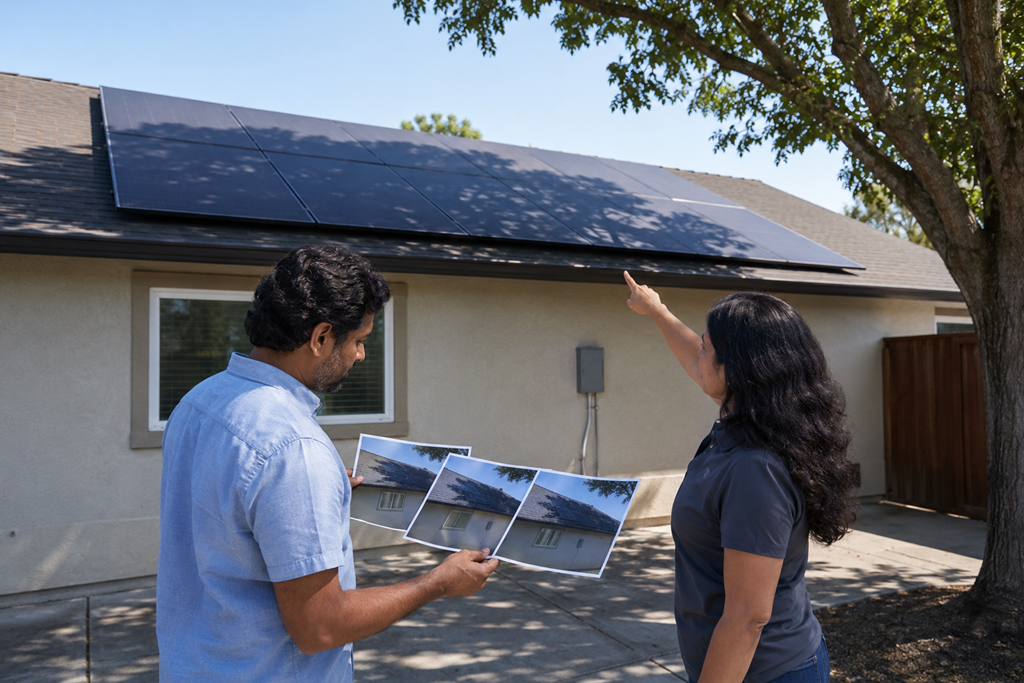
The provider should be able to identify the main shade sources, explain which proposed panels may be affected, and describe how the production forecast accounts for those conditions. The explanation might include roof measurements, shade-analysis tools, site photographs, system-design software, or comparisons between possible panel locations.
The exact presentation can vary. What matters is that the conclusion is understandable.
Be cautious when a provider dismisses visible shade without explanation, guarantees that shade will have no effect, or gives a production number without discussing the trees and roof features surrounding the proposed array.
The opposite can also be a concern. A provider should not use ordinary, limited shade as a reason to pressure a homeowner into unnecessary property work or more expensive equipment without showing how those changes would improve the design.
Questions That Can Make a Solar Estimate More Useful
When comparing Sacramento-area solar providers, a few focused questions can reveal how carefully each proposal was prepared:
- Which parts of the proposed array are expected to receive shade?
- During what parts of the day or year is that shade most relevant?
- How was the expected production loss calculated?
- Would another panel layout reduce the effect?
- What does the proposed equipment mitigate, and what shade-related loss may remain?
- Are future tree growth or nearby structures included in the assumptions?
The provider should be able to answer in plain language. A homeowner should not be expected to accept a complicated technical explanation that never connects back to expected system performance.
It may also be helpful to compare whether different providers identified the same shade sources. Large differences do not automatically mean one estimate is wrong, but they are a reason to ask how each provider reached its conclusion.
A Realistic Estimate Is More Valuable Than a Perfect-Looking Roof Plan
Shade does not always prevent a home from benefiting from solar. It may change how many panels make sense, where they should be placed, which equipment is appropriate, or how much electricity the system can reasonably be expected to produce.
The goal of evaluating shade is not to make the roof appear problem-free. It is to create an honest picture of how the proposed system is likely to perform under normal conditions.
Before committing to a Sacramento-area solar installation, look for a provider who treats shade as a measurable design factor rather than a minor detail to dismiss or a problem to exaggerate. When the shadow patterns, assumptions, and expected tradeoffs are explained clearly, comparing solar proposals becomes much more meaningful.