Tree work can look simple from the ground: a branch is dead, a limb is hanging low, or a tree seems to need “just a little trimming.” In reality, even a small-looking job can involve unstable wood, hidden tension, heavy falling sections, nearby structures, power lines, and equipment that becomes dangerous when used above ground or around moving branches.
This difference between appearance and reality is what makes tree work easy to underestimate. A homeowner may see one branch that needs to come down. A tree professional may see the branch’s weight, the condition of its attachment, the direction it could move, the objects beneath it, and the limited space available for completing the work safely.
Understanding that difference can help Sacramento-area homeowners make better decisions before attempting the work themselves or comparing local tree service providers.
A Branch Can Be Much Heavier Than It Appears
A branch viewed from a window, patio, or driveway may not look especially large. Its true size can be difficult to judge when it is surrounded by foliage or positioned high in the canopy.
Branches also contain more weight than their appearance may suggest. Leaves, smaller limbs, and moisture inside the wood all contribute to the load. Once a branch begins moving, its weight can become difficult to control.
This is one reason a job described as removing “only one branch” may still require careful planning. The number of branches does not necessarily determine the difficulty of the work. One large branch over a roof, fence, vehicle area, walkway, or neighboring property may involve more risk than several smaller branches in an open space.
Wood Does Not Always Move in an Obvious Direction
A branch may appear ready to fall straight toward the ground, but trees do not always behave that predictably.
A limb may be supporting another branch, resting against nearby growth, or held under internal pressure. Cracks and weak attachment points may also be hidden by bark, leaves, or the viewing angle from below.
When part of a branch is released, the remaining wood may shift, swing, split, roll, or settle differently than expected. The trunk and surrounding branches can also move as weight is redistributed.
Homeowners do not need to identify these forces themselves. The useful takeaway is that visible shape alone does not reveal how a branch will behave once work begins.
The Area Beneath the Tree Changes the Difficulty
The same branch can present very different challenges depending on where the tree is growing.
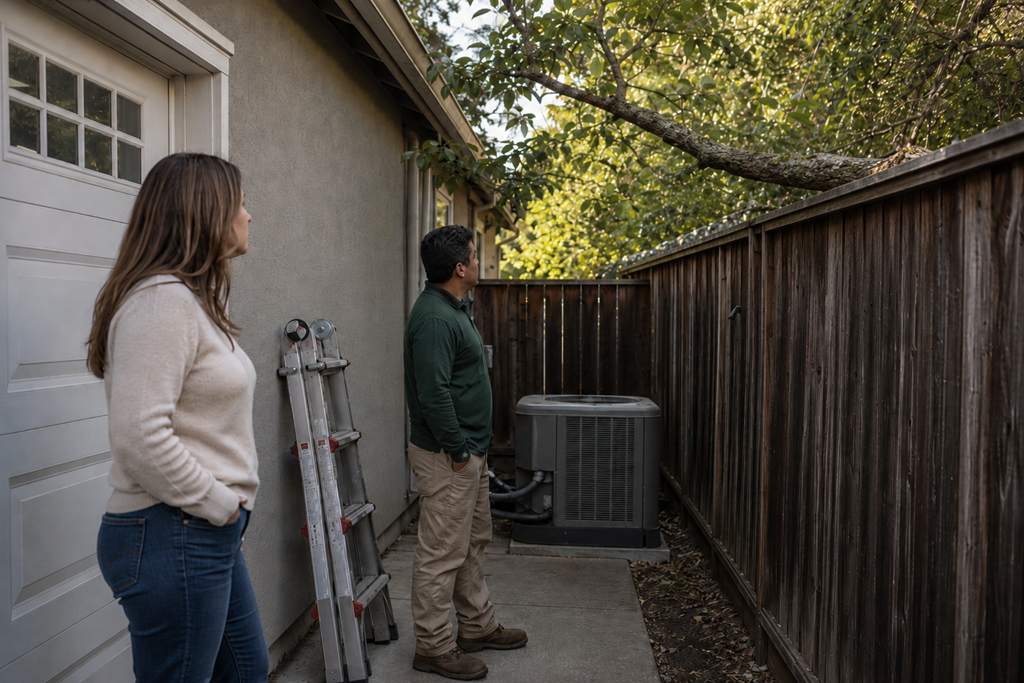
A branch over an open lawn may allow more room for planning than one extending above a garage, patio cover, swimming pool, fence, driveway, outdoor equipment, or narrow side yard. Nearby landscaping and neighboring property can further reduce the available working space.
The route people normally take through the area matters as well. A branch over a front walkway, parking space, play area, business entrance, or shared driveway may require the work area to be controlled before anything is moved.
When comparing estimates, it can be helpful to notice whether the provider is evaluating the entire area or looking only at the branch. A thoughtful assessment should consider what is beside, below, and beyond the tree.
Height Changes an Ordinary Task
Cutting a small piece of wood at ground level is not the same as dealing with similar wood above the ground.
Height affects balance, access, visibility, equipment use, and the ability to move away from a shifting branch. A ladder does not remove these problems. In some situations, it can add another unstable element beneath moving wood.
The work may become more complicated when a person must reach away from a stable position, work through dense foliage, or operate equipment while maintaining balance. Even a low branch can create an awkward working angle if it crosses a roofline, fence, or other obstruction.
This is why judging tree work only by whether a branch appears reachable can be misleading. Reachability is not the same as controllability.
Dead or Damaged Wood Can Be Unpredictable
Dead branches are often assumed to be easier to remove because they no longer have living foliage. However, dead or decaying wood may be brittle, weakened, or less reliable than healthy wood.
A damaged branch can break farther back than expected. A hollow or decayed section may not support weight normally. Bark can also hide deterioration beneath the surface.
Storm damage creates another layer of uncertainty. A branch that remains lodged in the canopy may look stable after the weather has passed, even though it is being held in place by only a small connection or neighboring limbs.
The absence of movement does not necessarily mean the branch is secure. It may simply mean that nothing has disturbed it yet.
Familiar Tools Can Create a False Sense of Simplicity
Many homeowners own ladders, hand saws, pole tools, or powered cutting equipment. Familiarity with a tool can make the overall job feel more manageable than it is.
The larger concern is not simply whether someone knows how to operate the tool. It is whether the person can predict and control what the tree will do while the tool is being used.
Cutting equipment also requires attention at the same moment the user may need to watch shifting wood, maintain footing, protect nearby property, and keep other people away. Combining these demands can quickly turn an ordinary-looking task into a difficult situation.
A professional evaluation is not only about bringing stronger equipment. It is about deciding how the work should be approached before cutting begins.
A Small Job May Still Require a Detailed Plan
Professional tree work often involves planning that is not obvious to someone watching from the ground.
Before starting, a provider may need to assess:
- The condition of the branch and its attachment
- The direction and amount of weight being supported
- Nearby structures, landscaping, vehicles, and access routes
- Whether other branches could move during the work
- How the work area will be kept clear
- What equipment and crew positioning the site may require
This does not mean every tree concern will become a major project. Some work is relatively straightforward. The point is that the difficulty should be determined through an on-site assessment rather than assumed from the branch’s appearance.
Warning Signs That the Work Deserves Professional Evaluation
Certain situations should make a homeowner especially cautious about treating the job as routine.
These may include a branch that is cracked, hanging, lodged in another part of the tree, or positioned above an area people use. Similar caution is reasonable when the tree is close to a structure, utility line, fence, neighboring property, pool, or narrow access area.
Changes near the base of the tree can also matter. Lifted soil, newly exposed roots, a developing lean, or movement after wind or heavy rain may involve more than a single branch.
Homeowners do not need to diagnose the cause. Noticing that the condition has changed—and avoiding the area beneath unstable-looking wood—can provide useful information when arranging an evaluation.
What to Ask Before Hiring a Tree Service Provider
A clear conversation before work begins can reveal how thoroughly a provider has considered the job.
Useful questions may include:
- What makes this particular job straightforward or difficult?
- How will the surrounding property be protected?
- How will people be kept outside the work area?
- Who will perform the work, and what experience do they have with similar conditions?
- Does the written estimate explain which branches or tree sections are included?
- Are cleanup, hauling, and protection of nearby surfaces included?
- Could the scope change if hidden decay or damage is discovered?
The answers should help you understand the proposed approach without requiring you to master technical tree-work terminology.
Be cautious when someone dismisses visible concerns without inspecting the tree, gives a vague scope, pressures you to decide immediately, or cannot explain how nearby property and people will be protected.
The Lowest Estimate May Not Describe the Same Work
Tree service estimates can appear to cover the same task while including different levels of planning, access, cleanup, equipment, and property protection.
One estimate may include removal of the full damaged section and hauling of the debris. Another may cover only a partial cut or leave cleanup to the homeowner. One provider may account for restricted access or nearby structures, while another may not address them clearly.
Before comparing totals, compare what each provider intends to do.
A more detailed estimate does not automatically mean it is the best choice, but it gives you something specific to evaluate. Vague wording makes it harder to understand what will happen and what could result in an added charge or unfinished expectation.
Tree Work Should Be Judged by the Conditions, Not Its Appearance
The most important distinction is between a job that looks small and a job that is actually controlled.
A single branch can involve substantial weight, hidden weakness, unpredictable movement, limited access, and valuable property beneath it. These factors may not be visible from a patio, window, or driveway.
For Sacramento-area homeowners, the practical next step is not to assume every tree concern requires extensive work. It is to avoid judging the job by appearance alone. A qualified tree professional should be able to assess the tree, explain the site-specific concerns, describe the proposed scope, and answer reasonable questions before work begins.
That understanding can make it easier to compare providers and choose an approach based on the actual conditions around the tree rather than how simple the task first appears.