Weight capacity matters before garage cabinets are installed because the cabinet must safely support the actual items you plan to store, not just look suitable on the wall. A system that works well for lightweight bins may perform very differently when it holds power tools, automotive supplies, bulk household products, or other dense items in everyday use.
This issue is easy to miss during the planning stage. Homeowners often compare cabinet dimensions, finishes, door styles, and prices while assuming that any garage cabinet described as durable will hold whatever fits inside it. The real question is not simply whether an item fits. It is whether the shelf, drawer, cabinet structure, mounting method, and surrounding wall can support the intended load together.
Cabinet Size Does Not Reveal Its Strength
A large cabinet can provide plenty of interior space without being designed for especially heavy storage. A smaller cabinet with reinforced shelves or stronger drawer hardware may support more weight than a wider cabinet that appears more substantial.
This is why exterior dimensions alone are not enough when Sacramento-area homeowners compare garage cabinet systems. Two cabinets can look nearly identical while having different shelf materials, support spacing, drawer slides, back panels, fasteners, and installation requirements.
Descriptions such as “strong,” “commercial-style,” or “heavy-duty” may sound reassuring, but they do not explain how the cabinet is expected to perform under a specific load. A useful comparison should include measurable capacity information and an explanation of what that information applies to.
Every Part of the Cabinet System Has Its Own Limit
Garage cabinet capacity is not always represented by one number. Different parts of the system may have separate limits, including:
- Individual shelves
- Drawers and drawer slides
- The cabinet body
- Wall-mounting rails or brackets
- Base supports or adjustable feet
- Fasteners and attachment points
The lowest practical limit may determine how the cabinet should be used. A strong cabinet box does not automatically make every shelf equally strong. A drawer may have a lower rating than the cabinet around it. A wall-mounted unit may depend heavily on how and where it is secured.
Capacity also can vary between cabinet sizes within the same product line. A wider shelf may not carry weight in the same way as a narrower shelf, even when the finish and material appear similar.
The goal is not to memorize every structural detail. It is to make sure the installer or cabinet provider can explain which limit applies to each storage area you are considering.
Heavy Storage Is Rarely Distributed Perfectly
Published capacity figures may assume that weight is spread evenly across a shelf or drawer. Real garage storage is often less orderly.
A row of lightweight household products may create a relatively even load. A compact tool case, automotive component, dense container, or piece of equipment can place much more weight in one small area. Several heavy objects may also become concentrated near the middle or front of a shelf.
That difference matters because an evenly distributed load does not affect a shelf in exactly the same way as one dense object placed at a single point.
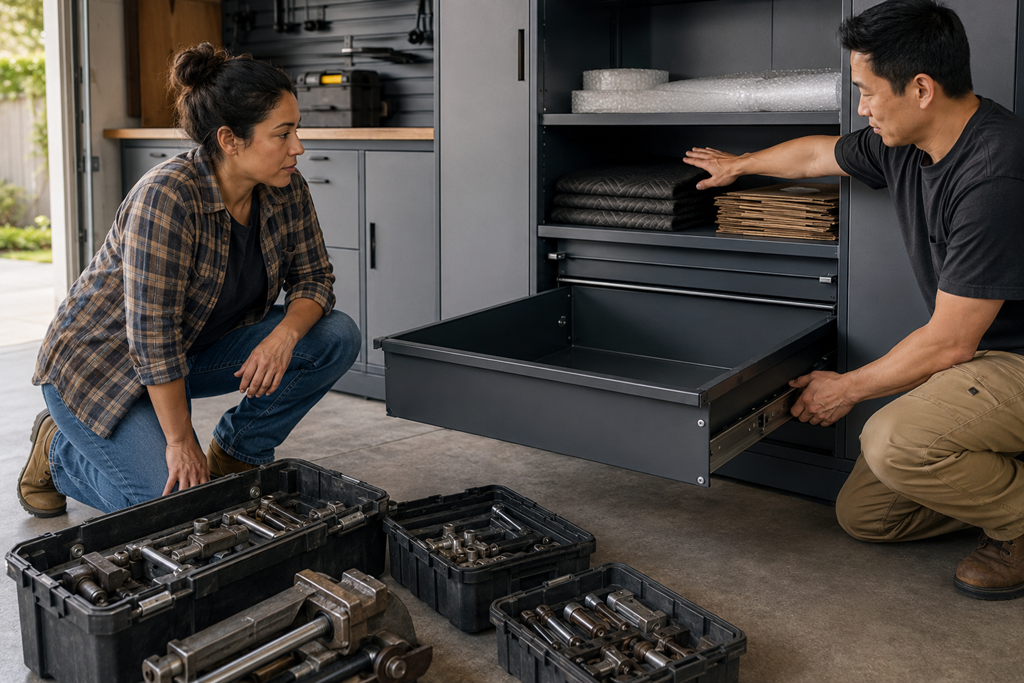
Homeowners do not need to calculate structural loads themselves. However, they should describe the kinds of items they expect to store so the provider can recommend an appropriate cabinet configuration. Showing the installer the actual equipment, containers, and tool cases is often more informative than simply saying the cabinets will hold “garage supplies.”
Everyday Use Adds More Than Stationary Weight
Garage cabinets are not loaded once and left untouched. Drawers are opened, bins are moved, tools are set down, and stored items gradually migrate from one area to another.
A shelf that begins with a few lightweight supplies may eventually become the convenient place for every dense item that lacks another home. A drawer intended for hand tools may slowly accumulate larger equipment and spare hardware. Seasonal items may be rearranged several times a year.
This is one reason planning capacity around the minimum expected load can create problems later. A cabinet system should reflect realistic use, including some allowance for how storage habits may change.
That does not mean every cabinet needs the highest available capacity. It means the capacity should match the role of that particular cabinet instead of relying on one general assumption for the entire garage.
Weight Capacity Can Change the Best Layout
Capacity is not only a product-selection issue. It can influence where different cabinets and storage zones should go.
Dense items may be better suited to lower shelves, base cabinets, or appropriately rated drawers. Lightweight seasonal belongings may work well in upper cabinets. Frequently used equipment may need a location that does not require lifting it from an awkward height.
A thoughtful garage cabinet plan may therefore use several storage types rather than forcing everything into identical cabinets. The layout can account for item weight, frequency of use, available wall conditions, parking clearance, and comfortable access.
This approach can also reduce the temptation to overload one convenient cabinet while other storage areas remain underused.
The Wall and Installation Method Matter Too
Wall-mounted cabinets depend on more than the cabinet material. Their performance also involves the mounting system and the condition of the wall where they will be installed.
Garage walls can differ in framing, surface material, previous modifications, and accessibility. An installer may need to evaluate where suitable attachment points are located and whether the proposed cabinet position supports the intended use.
A cabinet’s product rating should not be treated as a guarantee that it can be mounted anywhere with the same result. The rating may depend on specific installation conditions, hardware, support spacing, or approved mounting methods.
This is an area where vague communication should be questioned. A provider should be able to explain how the cabinets will be supported and whether the expected storage load is appropriate for the proposed installation.
“It Fits Inside” Is Not the Same as “It Belongs There”
One of the most common misunderstandings is assuming that any object that physically fits inside a cabinet is suitable for that cabinet.
A deep shelf may hold several heavy tool cases, but depth does not establish capacity. A wide drawer may accommodate a large collection of metal tools, but drawer space does not confirm that the slides were designed for that load. An upper cabinet may have enough room for dense containers while still being an inconvenient or unsuitable place to store them.
The better question is:
Was this storage space selected and installed for this kind of item?
That shift helps homeowners evaluate cabinets by intended use rather than appearance alone.
Questions to Ask Before Approving a Cabinet System
A few direct questions can make estimates and product comparisons more useful:
- What is the rated capacity of each shelf and drawer?
- Does the rating assume evenly distributed weight?
- Is there a separate limit for the entire cabinet?
- Does capacity change with cabinet width or shelf configuration?
- How will wall-mounted cabinets be secured at this location?
- Which cabinet areas are intended for the heaviest items?
- Are the capacity details included in the product specifications or project documents?
The answers should be specific enough to connect the cabinet design with what will actually be stored. A provider who only repeats broad terms such as “very strong” may not be giving you enough information to compare systems responsibly.
Start With the Items, Not the Empty Cabinets
Before requesting an estimate, identify the belongings that create the greatest storage demands.
You do not necessarily need to weigh every object. Instead, separate lightweight belongings from items that are unusually dense, bulky, or concentrated. Tool cases, shop equipment, automotive supplies, bulk products, and containers filled with metal hardware deserve more attention than empty coolers or folded outdoor cushions.
It can help to keep the heaviest items visible when a garage cabinet professional visits. This gives the provider an opportunity to see the size, quantity, and likely placement of the load rather than planning around a general description.
A cabinet system designed around the real inventory is more useful than one selected from an empty display.
Choose Capacity Around How the Garage Will Be Used
Garage cabinet weight capacity matters because storage performance depends on more than whether the doors close and the belongings fit. Shelves, drawers, cabinet structures, mounting components, and wall conditions must work together for the intended use.
Before comparing Sacramento-area garage cabinet installation estimates, explain what you plan to store and ask for capacity information that applies to the specific cabinets being proposed. That conversation can help you distinguish between a system that simply looks organized and one planned around the everyday demands of your garage.