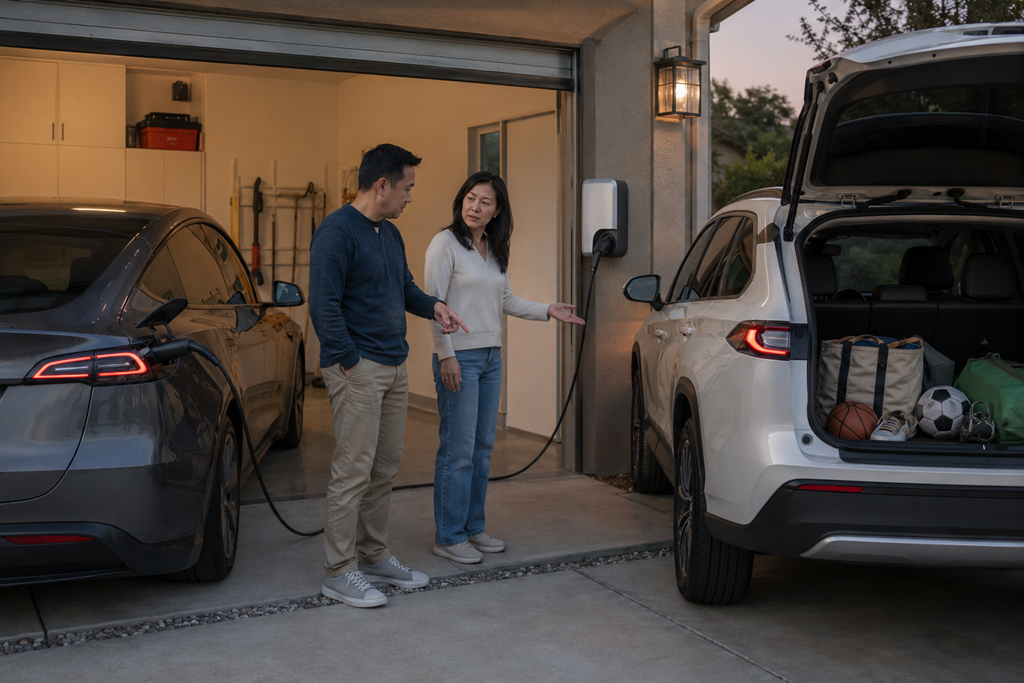
Your daily driving habits affect your EV charging needs more than the vehicle’s advertised range alone. The important questions are how far you usually drive, when the car returns home, how long it stays parked, whether your trips are predictable, and how much flexibility you want before the next departure. A household with short, regular commutes may need a very different charging setup from one with long, irregular travel days.
That distinction is easy to miss when people begin comparing home EV charging options. It can feel natural to focus on the vehicle’s maximum range or the charging equipment’s advertised speed. In everyday life, however, the more useful question is often simpler: how much driving do you need to replace during the hours when the vehicle is actually parked?
Understanding that pattern can help Sacramento-area homeowners and renters have a more productive conversation with an EV charging professional.
Your Routine Matters More Than One Big Range Number
An EV does not necessarily need to return to a full charge after every trip. Many drivers simply need to replace enough energy to support the next day’s normal travel.
Someone who drives a modest and consistent distance, returns home at roughly the same time, and leaves the vehicle parked overnight may have a wide charging window. Another driver might cover a similar weekly distance but complete most of it during two demanding days with little time between trips.
Their weekly mileage may be nearly identical, but their charging needs can feel very different.
This is why a vehicle’s maximum range does not tell the entire story. Range describes how far the vehicle may be able to travel under certain conditions. It does not describe how quickly a particular household needs to recover the energy it uses.
The Same Mileage Can Create Different Charging Needs
Consider two Sacramento residents who each drive approximately the same number of miles during a typical week.
One person commutes a short distance on weekdays and leaves the vehicle parked from early evening until morning. The other works irregular hours, combines work travel with family errands, and occasionally returns home shortly before leaving again.
The first driver may have plenty of time to recover from each day’s travel. The second may benefit from discussing a charging setup that can restore more driving capacity during a shorter parking window.
The difference is not simply how much they drive. It is how their driving is distributed.
Several patterns can influence that distribution:
- Driving a similar distance every weekday
- Clustering many errands into one or two days
- Making frequent short trips throughout the day
- Working changing or overnight shifts
- Taking recurring trips outside the immediate Sacramento area
- Sharing one charging location between multiple vehicles
Recognizing your pattern helps prevent you from choosing a setup based only on a rare road trip or an unusually busy day.
Parking Time Is Part of Your Charging Capacity
The amount of time your vehicle remains parked at home can matter almost as much as the distance you travel.
A car that sits in the driveway or garage for ten or twelve hours has a different opportunity to charge than one that is home for only a few hours between work shifts, school transportation, appointments, and evening activities.
This is sometimes reassuring for drivers with relatively modest daily mileage. They may assume that home charging needs to happen quickly because public fast charging is designed around speed. Home charging often works differently because the vehicle may remain parked for a much longer period.
On the other hand, a driver with limited overnight parking time may find that charging speed and equipment location deserve closer attention.
A qualified EV charging professional can help evaluate how your parking window relates to the charging options available at the property. That discussion may also include the home’s electrical capacity, the charger location, the distance to the parking area, and whether future household needs should be considered.
Predictability Can Be as Important as Distance
Predictable routines make it easier to plan around a slower or more limited charging setup.
When a vehicle travels approximately the same route each day and returns home at a consistent time, the driver can usually estimate how much charging is needed before the next departure. There is less uncertainty to account for.
Irregular driving creates a different concern. A person may unexpectedly need to visit several locations, make an additional family trip, or leave home again before the vehicle has been parked very long.
That does not automatically mean the household needs the fastest possible home charger. It means the provider should understand that flexibility matters to the driver.
The goal is not to prepare for every imaginable situation. It is to determine whether the usual charging window provides enough recovery for the household’s realistic routine, including a reasonable amount of variation.
Driving Conditions Can Change Energy Use
Two trips covering the same distance do not always use exactly the same amount of energy.
Freeway driving, repeated acceleration, heavy climate-control use, vehicle loading, and changes in elevation can affect consumption. Sacramento-area heat may also lead drivers to use air conditioning more heavily during part of the year.
This does not require homeowners to calculate every variable before speaking with a provider. It simply means that mileage should be treated as a starting point rather than a complete measurement.
Drivers who regularly travel at freeway speeds, carry equipment, visit the foothills, or make longer regional trips should mention those patterns during a charging consultation. The provider does not need a perfect travel record, but a realistic description of how the vehicle is used can lead to a more relevant recommendation.
Household Schedules Can Create Their Own Charging Pressure
Charging needs can become more complicated when several drivers or vehicles share the property.
A household with one EV may have a straightforward overnight routine. A household planning for a second EV may need to think about overlapping arrival times, shared equipment, parking positions, and whether both vehicles regularly need substantial charging.
The same issue can appear when one person works remotely while another commutes, or when one driver has a predictable schedule and another frequently leaves at irregular times.
This is why it can be helpful to describe the household’s complete routine rather than discussing only the vehicle being charged today. A charging setup that works comfortably for one driver may feel restrictive after the household’s schedule changes.
That does not mean every installation should be built around uncertain future plans. It means known or likely changes are worth mentioning before an estimate is finalized.
What to Explain During a Charging Consultation
You do not need a detailed spreadsheet of every trip. A qualified provider will usually gain more from a clear description of your normal week.
Be prepared to explain:
- Your approximate daily and weekly driving
- When the vehicle usually returns home and leaves again
- How often you have unusually long driving days
- Whether another EV may share the charging location
- Whether the vehicle is normally parked in a garage, driveway, carport, or assigned space
- How much flexibility you want for unexpected trips
You can also ask the provider how the recommended equipment fits your actual driving pattern, rather than simply asking which charger is fastest.
Useful questions include:
- How much of my typical daily driving could this setup replace during my normal parking window?
- Is this recommendation based on my usual routine or my longest occasional trip?
- How would the recommendation change if the household added another EV?
- Are there property or electrical factors that could affect the installation options?
- What assumptions are being used to recommend this charging level?
Clear answers should connect the proposed setup to the way you actually use the vehicle.
Avoid Designing Everything Around the Most Demanding Day
One common source of confusion is treating the longest trip of the year as though it represents normal daily driving.
Occasional road trips, airport runs, holiday travel, or unusually busy workdays may require additional planning. They do not always need to determine the entire home charging setup.
At the same time, choosing equipment based only on the easiest driving day can leave too little flexibility for a household with frequent schedule changes.
A more balanced approach is to consider the recurring pattern first, then discuss how often the exceptions occur and how the household expects to handle them. Public charging, workplace charging, and temporary schedule adjustments may remain part of the broader picture.
The right discussion is not about creating unlimited charging capacity. It is about matching the home setup to the household’s realistic combination of mileage, parking time, timing, and flexibility.
Let Your Driving Pattern Guide the Conversation
Home EV charging decisions become easier to understand when you stop looking only at maximum vehicle range or maximum charger speed.
Your normal travel distance matters, but so do your arrival time, departure time, parking location, schedule consistency, shared household demands, and tolerance for unexpected trips.
Before comparing estimates from Sacramento-area EV charging professionals, describe those habits as clearly as you can. A provider should be able to explain how the proposed setup supports your routine and what limitations or tradeoffs may remain.
The most suitable charging option is not automatically the fastest or most expensive one. It is the one that fits the way the vehicle is likely to be driven and parked most days.