Pool tile cleaning can be worth scheduling when visible buildup around the waterline affects the appearance of your pool, regular maintenance no longer removes the deposits, or you want a professional to evaluate whether specialized cleaning is appropriate. But not every stained or cloudy tile surface needs an immediate cleaning appointment. For Sacramento-area homeowners, the better decision starts with understanding what is actually on the tile, whether the material can tolerate the proposed cleaning method, and what improvement a service provider can reasonably deliver.
A swimming pool can have clear water, functioning equipment, and an otherwise well-maintained appearance while still developing an unattractive ring around the tile. That contrast can make the problem particularly frustrating. The rest of the pool may look clean, yet the waterline remains dull, white, discolored, or uneven.
Professional tile cleaning is one possible solution, but its value depends on the condition of the tile, the nature of the buildup, the cleaning approach, and the homeowner's expectations. Understanding those differences can help you decide whether to schedule service, seek an assessment, or continue monitoring the condition.
Start by identifying what is making the tile look dirty
One of the most important distinctions is that not everything visible on pool tile is ordinary dirt.
Different conditions can create similar-looking discoloration, but they may require different responses. Before deciding that professional cleaning is necessary, consider what the affected surfaces actually look like.
For a broader overview of cleaning methods, provider questions, and common concerns, visit our Pool Tile Cleaning in Sacramento service guide.
White, chalky, or crusty deposits
A white or light-colored buildup near the waterline may indicate mineral scale. These deposits can develop when dissolved minerals in pool water accumulate on surfaces.
Scale can range from a relatively thin film to a thicker, more noticeable crust. It may be uneven, following the waterline or collecting around certain tile features.
The amount of visible buildup matters, but appearance alone does not establish its composition or how easily it can be removed.
A professional familiar with pool tile cleaning can help evaluate whether the deposits are suitable for specialized cleaning and whether underlying water chemistry deserves attention.
Dark rings and surface residue
Some waterline discoloration may involve body oils, sunscreen residue, airborne debris, organic material, or other substances that collect where the water meets the tile.
These deposits may look different from mineral scale and may respond to different cleaning approaches.
When the problem appears to be ordinary surface residue rather than firmly attached mineral buildup, routine pool care may be sufficient.
However, repeated cleaning that produces little improvement is a reason to reconsider whether the deposit has been identified correctly.
Stains that may not be removable buildup
Not every visible mark sits on top of the tile.
Some discoloration may be associated with changes in the tile surface, grout, previous cleaning damage, or staining that has penetrated a material.
A homeowner may reasonably assume that a stained-looking area simply needs stronger cleaning. Unfortunately, more aggressive cleaning does not necessarily address the underlying cause.
The first useful question is not simply whether the tile looks dirty. It is whether the visible condition is removable buildup, staining, or a surface problem that cleaning may not correct.
That distinction can prevent unnecessary work and unrealistic expectations.
Decide whether the condition is cosmetic, recurring, or becoming harder to manage
Once you have a general understanding of the visible condition, consider how much it affects your pool and whether it is changing.
Professional cleaning may be more worthwhile when deposits are persistent, widespread, or difficult to manage through normal maintenance.
When cleaning may be worth considering
A professional assessment may be reasonable when:
- A noticeable mineral line extends around much of the pool.
- Deposits remain after ordinary maintenance.
- The buildup has become thick or uneven.
- Tile discoloration substantially detracts from the pool's appearance.
- Previous cleaning efforts have produced inconsistent results.
- You are preparing for a larger pool maintenance or renovation project and want to understand whether the existing tile can be restored.
- You are unsure whether continued cleaning attempts could damage the surface.
These circumstances do not automatically mean specialized cleaning is necessary. They simply make the potential benefits of professional evaluation more meaningful.
When waiting may be reasonable
Scheduling may be less compelling when the deposits are light, limited to a small area, and not becoming noticeably worse.
For example, a faint waterline mark that remains manageable through normal professional pool maintenance may not justify a separate specialized service appointment.
You might instead ask your existing pool maintenance provider whether the condition can be addressed during routine visits and what changes would indicate a need for specialized cleaning.
Monitoring can be a reasonable choice when the issue is minor and there are no indications of deteriorating tile, grout, or other pool surfaces.
When the problem keeps returning
A recurring waterline deposit deserves a different conversation from a one-time cosmetic cleaning.
If mineral buildup returns quickly after treatment, cleaning alone may not address the conditions contributing to its formation.
Water chemistry, evaporation, refill-water characteristics, and other pool-specific factors can influence mineral accumulation.
In Sacramento-area pools exposed to substantial sun and warm weather, evaporation and water maintenance are relevant considerations, although individual pool conditions vary.
A cleaning provider may focus on removing existing deposits, while a pool maintenance professional may be better positioned to assess ongoing water-balance concerns.
Understanding those separate responsibilities helps you avoid assuming that one cleaning appointment will permanently solve a recurring issue.
Understand what professional tile cleaning can and cannot accomplish
The value of a cleaning appointment depends heavily on what the provider intends to do and what condition the tile is in.
Professional pool tile cleaning can involve specialized approaches intended to remove deposits that ordinary maintenance does not adequately address.
However, the term pool tile cleaning can describe different services, from relatively limited surface cleaning to more extensive mineral-deposit removal.
Those differences matter when comparing estimates.
For a closer look at realistic results and possible limitations, see What To Expect Before And After Pool Tile Cleaning.
Removing buildup is not the same as restoring damaged tile
A cleaning service may improve the appearance of tiles by removing accumulated material.
It does not necessarily reverse:
- Permanent discoloration
- Existing scratches
- Surface etching
- Glaze deterioration
- Cracked or loose tiles
- Deteriorated grout
- Previous damage caused by unsuitable cleaning methods
Some of these conditions may require repair, restoration, or replacement rather than additional cleaning.
If the visible problem involves both deposits and damage, ask the provider to explain which portions can reasonably improve through cleaning and which may remain unchanged.
This is particularly important when the homeowner expects the tile to look new after the appointment.
The type of tile can affect the approach
Pool tile is not one uniform material.
Properties may contain glazed ceramic tile, porcelain tile, glass tile, natural stone, decorative finishes, or combinations of materials.
Different surfaces can have different tolerances for cleaning products, mechanical action, and specialized deposit-removal methods.
Some companies use media-blasting processes designed for pool tile, while others use different methods depending on the material and buildup.
No single cleaning method should be assumed appropriate for every surface.
Before approving work, ask whether the proposed method is suitable for the actual tile and surrounding materials.
Grout and surrounding finishes matter too
A pool's waterline is not always made up of tile alone.
The area may include grout joints, decorative borders, stone coping, plaster, or other adjacent finishes.
A service provider should consider how the cleaning approach could affect those materials.
If grout is already deteriorated or tiles are loose, the provider may recommend additional evaluation before cleaning begins.
The important distinction is between removing deposits from an otherwise sound surface and attempting to clean an area that may already need repair.
Weigh the likely improvement against the cost of the service
Pool tile cleaning is a value decision as much as an appearance decision.
A homeowner with a highly visible, persistent mineral ring may consider specialized cleaning worthwhile because the improvement could make the entire pool look better.
Another homeowner with only minor staining may reasonably decide that a separate cleaning appointment offers limited benefit.
Neither decision is automatically correct.
The useful comparison is between the condition you have now, the improvement a professional believes is achievable, and the complete cost and limitations of the work.
What may affect the estimate
Several property-specific factors can influence pricing.
Factor | Why it matters |
|---|---|
Length of the affected waterline | More tile surface generally means more area to evaluate and clean. |
Type and thickness of buildup | Heavier or more firmly attached deposits may require a different cleaning approach. |
Tile material and finish | Delicate or specialized surfaces may require additional care. |
Pool shape and access | Raised walls, narrow access routes, and unusual features may complicate service. |
Existing tile or grout condition | Fragile areas may need evaluation or repair before cleaning. |
Scope of the service | Cleaning only selected areas differs from treating the entire waterline. |
Preparation and cleanup | Water-level adjustments, residue removal, and other responsibilities may affect the work involved. |
An estimate should make clear which of these considerations apply to your pool.
Why a low estimate may not represent the same service
Suppose one company proposes cleaning a short section of the most heavily affected tile, while another recommends treating the entire waterline.
The quotes may differ substantially, but the companies are not necessarily pricing identical work.
Similarly, one provider might include cleanup and certain preparation tasks, while another expects the homeowner or regular pool maintenance company to handle them separately.
Before comparing totals, establish what each estimate actually includes.
How to think about the return on cleaning
The expected benefit is usually visual improvement and reduced existing buildup, rather than a guaranteed operational improvement to the pool.
Consider three practical questions:
- How noticeable or bothersome is the current condition?
- How much improvement does the provider reasonably expect?
- Is that expected improvement worth the quoted cost and any preparation or follow-up responsibilities?
If the provider cannot clearly explain the likely result, it may be difficult to judge the service's value.
A higher price does not guarantee better work, just as a lower price does not automatically indicate poor service. The value depends on the suitability of the approach and the scope being offered.
Find out whether your regular pool service already covers the problem
Before arranging a separate tile cleaning appointment, review what your existing pool maintenance service provides.
Routine pool cleaning commonly focuses on water care, debris removal, brushing, equipment observation, and other recurring maintenance responsibilities.
Specialized mineral-deposit removal may be outside that ordinary scope.
The exact service boundaries vary by company and maintenance agreement.
If you're unsure which type of pool service is appropriate, read our guide on how to decide whether you need pool cleaning, repair, or full pool service.
Routine cleaning versus specialized deposit removal
There are several possible situations:
Ordinary residue that responds to regular care: Your existing maintenance provider may be able to address the issue within normal service or through an agreed additional task.
Persistent mineral scale: A specialist may be more appropriate if the buildup requires equipment or methods beyond routine maintenance.
Tile damage or grout deterioration: A tile repair or pool renovation professional may need to assess the condition before cleaning is attempted.
Recurring deposits associated with water balance: Your regular pool maintenance provider may need to evaluate ongoing conditions, even if a specialist removes the current buildup.
These services can overlap, but they are not interchangeable.
Avoid paying twice for overlapping work
If you already have regular pool service, ask what the company currently does to maintain the waterline tile.
Find out whether minor buildup removal is included, available at an additional charge, or referred to another provider.
Also ask whether they have observed changes in the deposits over time.
That information can help you determine whether a separate appointment would provide a meaningful benefit beyond the maintenance you already receive.
Consider whether the timing makes sense
A pool tile cleaning appointment should fit the actual condition of the pool and the homeowner's plans.
There is no universally correct cleaning schedule for every property.
Some pools may go substantial periods without needing specialized tile work. Others may experience recurring buildup that justifies more frequent evaluation.
Cleaning before an important use of the pool
Homeowners sometimes consider tile cleaning before hosting guests, preparing for outdoor entertaining, or improving the appearance of a property.
In these situations, visual improvement may be the primary reason for scheduling.
If timing matters, ask the provider how much lead time is appropriate, whether the work affects pool use, and whether additional cleanup or water treatment will be needed.
Do not assume that the pool will be ready for swimming immediately after service.
Cleaning alongside other pool work
Scheduling may make more sense when other pool maintenance or improvement work is already being planned.
For instance, if you are arranging pool surface repairs or evaluating a renovation, it may be useful to determine whether the existing tile can be cleaned rather than replaced.
However, the correct order of work depends on the project.
Tile cleaning performed before certain repairs could be unnecessary if the affected materials will later be removed or replaced.
Ask the professionals involved to clarify the sequence before authorizing overlapping services.
Waiting when the underlying issue is unresolved
If the same deposit has returned repeatedly, consider whether another cleaning appointment should happen before the water-maintenance issue is evaluated.
This does not mean you must postpone cleaning indefinitely.
It means the cleaning decision should be informed by whether the underlying conditions are likely to continue producing the same problem.
Know when cleaning alone may be the wrong service
One of the easiest mistakes is treating every unattractive tile surface as a cleaning problem.
A professional tile cleaning company may reasonably recommend a different service when the visible condition is outside its scope.
Pay particular attention to these situations.
Loose, cracked, or missing tiles
Cleaning does not secure loose tiles or restore missing material.
If sections of the waterline are visibly damaged, a pool repair professional may need to evaluate the area before specialized cleaning proceeds.
Deteriorating grout or surrounding surfaces
When grout is crumbling, joints are missing material, or nearby finishes appear damaged, more aggressive cleaning could create additional concerns.
A provider should evaluate whether cleaning is appropriate rather than assuming the entire waterline can be treated uniformly.
Permanent staining or surface deterioration
If a professional determines that the appearance is caused by permanent surface changes rather than removable deposits, additional cleaning may not deliver the expected improvement.
In that situation, the homeowner can compare the cost and benefit of accepting the appearance, pursuing restoration where appropriate, or considering replacement.
Uncertain deposits or possible surface damage
If neither the homeowner nor the cleaning provider can identify the condition with reasonable confidence, avoid approving an aggressive treatment solely on the promise that it will remove everything.
Further evaluation may be more valuable than immediately choosing a cleaning method.
Ask how the provider will protect the tile and surrounding pool
When specialized cleaning appears appropriate, the next step is understanding how the work will be performed.
You do not need to become an expert in cleaning equipment or tile chemistry.
You do need a reasonable explanation of why the proposed approach fits your pool.
A useful conversation should address the condition, cleaning method, expected improvement, and potential limitations.
Questions worth asking before scheduling
- What do you believe is causing the visible buildup?
- Is this material likely to come off through cleaning, or could some discoloration remain?
- What cleaning method would you use on my particular tile?
- How do you determine whether that method is suitable for the tile finish, grout, and nearby surfaces?
- Would you recommend testing a small, less noticeable area before treating the full waterline?
- What happens if you discover loose tile, damaged grout, or a surface that should not be cleaned with the proposed method?
- Will the service require any water-level changes, equipment coordination, or temporary restrictions on pool use?
- What cleanup is included, and who is responsible for any remaining water-care tasks?
These questions are more useful than asking whether a company can simply make the tile look new.
A capable provider should be able to explain the intended process and its limitations in terms a homeowner can understand.
Understand the role of a test area
For some surfaces or uncertain conditions, a small test area may help demonstrate the likely result and reveal concerns before full treatment.
A test is not a guarantee that every section will respond identically.
Buildup thickness, tile condition, and surface materials may vary around the pool.
Still, discussing whether a test is appropriate can be valuable when the project involves delicate tile or uncertain deposits.
Compare the actual cleaning proposals, not just the companies
If you request more than one estimate, try to make the comparison as specific as possible.
A quote for pool tile cleaning is most useful when it tells you what surface will be cleaned, how the provider expects to approach it, and which responsibilities are included.
Two providers may be equally professional while recommending different scopes.
For example, one may suggest cleaning only the visibly scaled waterline, while another identifies additional affected decorative tile.
The wider scope may or may not be necessary for your goals.
What a useful estimate should clarify
Look for an explanation of:
- The tile areas included in the proposed work
- Any surfaces or features excluded
- The general cleaning method
- Whether the existing condition presents special concerns
- Whether water-level adjustment or pool preparation is needed
- How residue and cleaning materials will be handled
- What post-cleaning responsibilities remain
- What could change the quoted price
- Any workmanship terms or limitations that apply
You should also consider the provider's experience with similar pool tile materials, communication, relevant qualifications, insurance coverage, and available customer feedback.
Do not assume a company experienced with one type of tile or cleaning process has the same experience with every finish.
Watch for promises that go beyond what cleaning can reasonably do
Certain statements deserve further clarification.
Be cautious if a provider:
- Guarantees that every stain will disappear without examining the condition.
- Proposes an aggressive cleaning approach without asking about the tile material.
- Dismisses visible grout deterioration or loose tile.
- Cannot explain what the estimate covers.
- Offers no clear explanation of possible limitations.
- Pressures you to approve a larger job before discussing the actual need.
These concerns do not establish that a provider is unqualified. They are reasons to ask additional questions or seek another professional assessment.
The goal is to choose a service that matches the condition of the pool, rather than accepting a broad promise of improvement.
Prepare enough information to make the first conversation productive
You can often improve the estimate process without doing any cleaning yourself.
Before contacting a company, gather a few basic details about the pool and the affected areas.
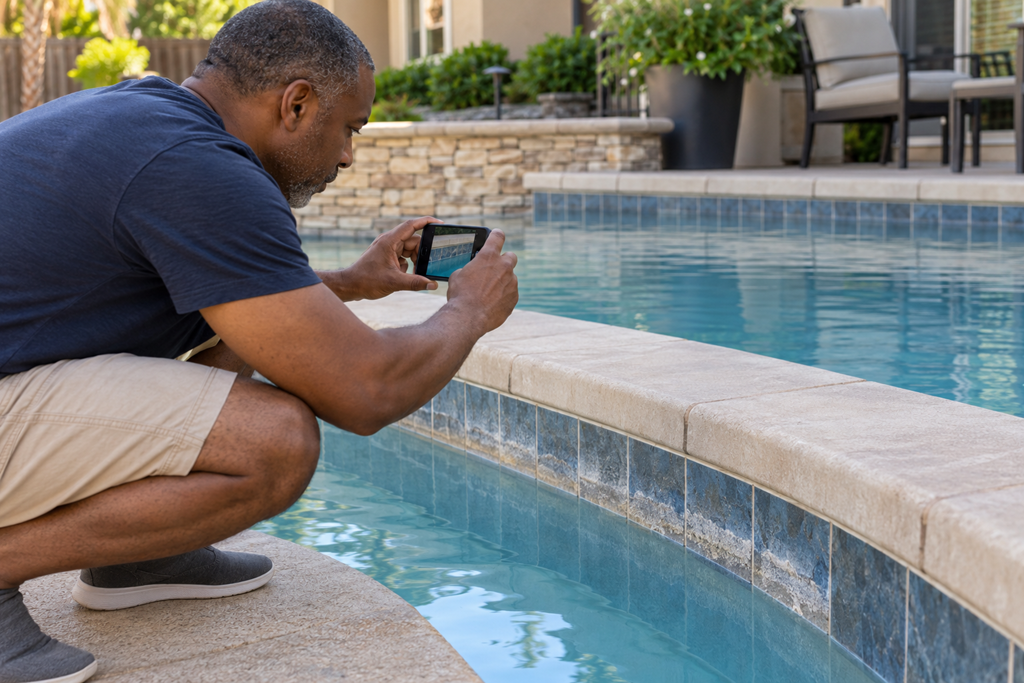
Photographs can be particularly helpful.
Take clear pictures of the waterline from a normal viewing distance and closer photographs of representative deposits. Include any unusual tile features or visibly damaged sections.
A few observations can also help:
- Whether the buildup appears white, chalky, dark, greasy, or otherwise discolored
- Whether it affects the entire waterline or only certain sections
- Whether the condition developed gradually or appeared more recently
- Whether ordinary maintenance has improved it
- Whether similar deposits returned after a previous cleaning
- Whether the pool has delicate decorative tile, natural stone, or other specialized finishes
- Whether other pool work is being planned
You do not need to diagnose the buildup yourself.
Avoid using harsh chemicals, abrasive tools, or unfamiliar cleaning techniques to test whether the deposits will come off. Such attempts can damage susceptible surfaces or create chemical exposure risks.
If your existing pool service maintains the water chemistry, you can also ask whether they have noticed recurring scale or other water-related conditions.
This preparation gives a provider more context while keeping the actual cleaning-method assessment in professional hands.
Make the scheduling decision based on the likely outcome
After reviewing the condition and gathering professional input, the decision generally falls into one of four paths.
Your situation | A reasonable next step |
|---|---|
Light, manageable residue with little effect on appearance | Continue ordinary maintenance and monitor the condition. |
Persistent, visible deposits on otherwise sound tile | Request an assessment or estimate for specialized pool tile cleaning. |
Recurring scale after previous cleaning | Discuss both deposit removal and ongoing water-maintenance conditions. |
Cracked tile, failing grout, or suspected permanent surface damage | Seek the appropriate repair or surface evaluation before authorizing cleaning. |
This framework is not a substitute for examining the actual pool. It helps organize the decision so you are not scheduling a service based only on the appearance of a stain.
Before approving a quote, you should be able to explain, in ordinary language, what the provider expects to remove, what might remain, what the service includes, and why the proposed method suits the surface.
If those points remain uncertain, an additional assessment may be worthwhile.
Choose cleaning when the expected benefit justifies the work
Pool tile cleaning is most worthwhile when it addresses a clearly identified buildup problem, offers a meaningful improvement, and can be performed using an approach appropriate for the tile and surrounding materials.
A visibly dirty waterline does not always require specialized cleaning, and a professional cleaning appointment cannot correct every type of tile discoloration or deterioration.
For Sacramento-area homeowners, the strongest decision is usually based on three things: the condition of the tile, the realistic improvement available, and the full scope of the proposed service.
When those points are understood, it becomes easier to decide whether to schedule cleaning now, continue routine maintenance, investigate recurring deposits, or seek a different type of professional evaluation.