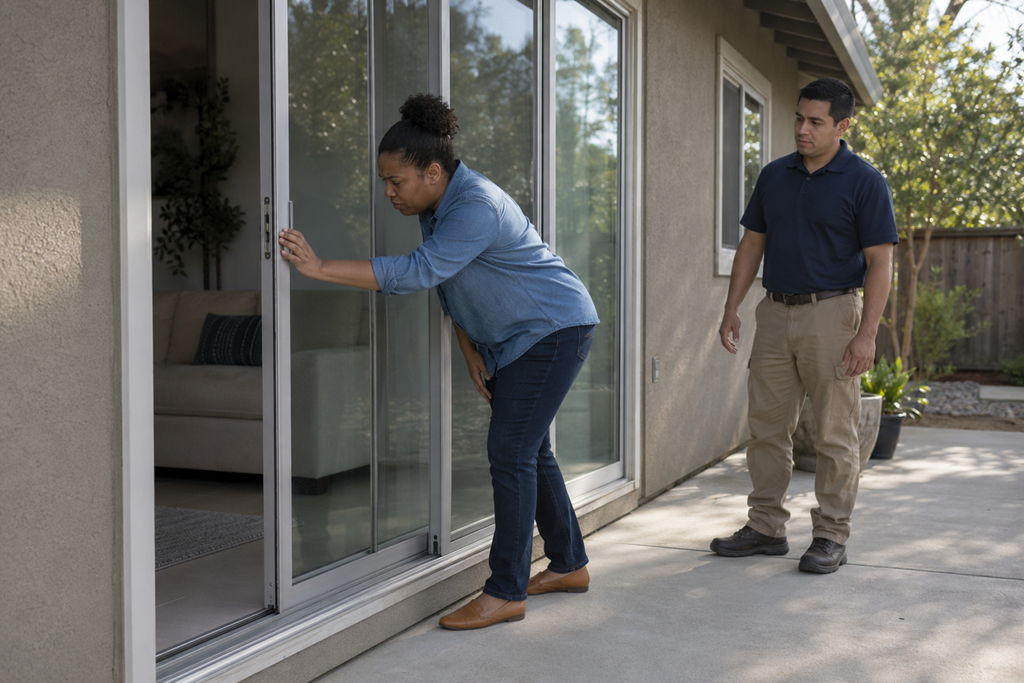
A sliding door likely needs repair when opening, closing, locking, or staying on its track becomes noticeably harder than it used to be. Occasional stiffness after dirt builds up may not point to a major problem, but repeated dragging, grinding, sticking, loose movement, visible gaps, or a lock that no longer lines up usually means the door should be evaluated before the strain causes additional wear.
In everyday use, the first warning is often a small change rather than a complete failure. You may need two hands instead of one, lift the door slightly as you move it, push harder at one point in the track, or pull the panel toward the frame before the lock will engage. These changes can become so familiar that they start to feel normal, even though the door is no longer operating as intended.
A Door Does Not Have To Be Stuck To Have a Repair Problem
Many people wait until a sliding door will barely move before discussing repair. By that point, the original issue may have placed added strain on the rollers, track, handle, latch, or frame.
A more useful comparison is how the door operates now versus how it operated before. A heavy door is not automatically defective, but a door that has become progressively harder to move deserves attention. The same is true when a door that once closed smoothly now needs a final shove, lift, or sideways pull.
Changes that appear suddenly after an impact may be easier to recognize. Gradual wear is more difficult because household members naturally adjust their technique without realizing it. They push harder, avoid opening the door fully, or warn visitors that the lock is “a little tricky.”
Those workarounds are often signs that the door’s normal movement or alignment has changed.
Changes in Movement Usually Provide the Clearest Clue
A properly functioning sliding door should move along its track with consistent resistance. It does not have to feel weightless, but it should not repeatedly scrape, jump, grind, wobble, or stop at the same point.
Resistance can come from several places. Debris may be interfering with the track, rollers may be worn or damaged, the panel may have shifted out of alignment, or part of the track may be bent. Because similar symptoms can have different causes, the way the door feels does not always identify the exact repair needed.
What matters most is whether the symptom continues after ordinary surface cleaning or repeatedly returns.
For example, a small piece of debris can briefly make a door feel rough. If the track is visibly clear but the door still catches at the same location, the issue may involve more than routine cleaning. A Sacramento-area sliding door professional can examine how the panel sits, how the rollers travel, and whether the track has been damaged.
Scraping and Grinding Should Not Become the New Normal
A scraping sound can indicate that part of the door is rubbing against the track or frame instead of rolling correctly. Grinding may point to roller wear, debris inside the moving components, or damage along the track surface.
The sound may be accompanied by physical evidence. You might notice a shiny scrape line, small metal particles, worn track edges, or resistance concentrated in one area.
Continuing to force the door may not make it fail immediately, but it can increase wear on the parts that are already under strain. A professional evaluation can help determine whether the problem is limited to an adjustable or replaceable component or whether a larger section has been affected.
Locking Problems Often Begin With an Alignment Change
A lock that no longer engages easily is another common sign that a sliding door may need repair. The latch and its receiving point must line up closely. When the panel shifts, sags, or no longer closes evenly, the lock may miss its intended position.
You may notice that the door locks only when you:
- Lift the panel slightly.
- Pull the door tightly toward the frame.
- Move the handle repeatedly.
- Push against the glass or frame while turning the lock.
A loose handle can sometimes be an isolated hardware issue, but repeated difficulty locking the door may also reflect a movement or alignment problem. Repair should address the reason the lock is not lining up, not simply make the locking motion temporarily easier.
If a door cannot be secured reliably, avoid treating it as a minor annoyance. The locking system and the way the panel fits in the frame should be evaluated together.
Visible Gaps Can Reveal That the Door Is No Longer Sitting Correctly
A sliding door can still open and close while fitting poorly inside its frame. Look at the edges when the door is fully closed. An uneven gap, a strip of daylight, compressed weatherstripping on one side, or a panel that appears slightly tilted may indicate an alignment or sealing problem.
You may also notice:
- Warm or cool air near one section of the closed door.
- Outdoor noise becoming more noticeable.
- Dust or insects entering near the frame.
- Moisture appearing near the threshold after rain.
- One corner touching the frame before the rest of the door.
Sacramento’s heat, sun exposure, dry periods, and seasonal rain can make sealing problems more noticeable, but weather alone does not identify the cause. The issue may involve worn weatherstripping, panel alignment, threshold condition, frame movement, or more than one contributing factor.
A visible gap is especially useful information to share when requesting an evaluation because it shows where the fit has changed.
Temporary Improvement Does Not Always Mean the Problem Is Solved
A door may move better immediately after the exposed track is cleaned. That improvement is useful, but it does not always rule out a repair issue.
If the same drag, scrape, or hesitation returns quickly, the debris may be a result of abnormal wear rather than the only cause. Worn rollers can create particles, and a damaged track can continue interfering with movement even when its surface looks clean.
The same pattern applies to locks. Repeatedly lifting or pulling the door into position may allow the latch to engage, but the workaround does not correct the alignment problem.
The difference between maintenance and repair often becomes clearer through recurrence. A one-time obstruction may be routine. A symptom that repeatedly returns, becomes more pronounced, or requires a special technique is more likely to justify professional evaluation.
Glass and Frame Conditions Can Change the Repair Decision
Movement and locking are not the only concerns. The condition of the glass and surrounding frame can affect whether a localized repair is appropriate.
Cracked glass, loose glazing components, fogging or moisture trapped between panes, bent frame sections, damaged corners, or signs of water entering around the assembly should be discussed with a qualified professional. These issues may require a different scope than replacing rollers or adjusting a latch.
Do not continue operating a panel that appears unstable, partially off its track, or damaged around the glass. A large sliding panel is heavy, and attempting to lift, remove, or reposition it without the proper equipment and experience can create unnecessary risk.
Repair May Be Reasonable When the Problem Is Isolated
A difficult sliding door does not automatically need complete replacement. Repair may be worth discussing when the frame and glass remain in serviceable condition and the problem appears limited to components such as rollers, track sections, handles, latches, or weatherstripping.
Replacement may enter the conversation when damage is extensive, the frame no longer fits properly, the glass assembly has failed, water intrusion continues, or several major components are deteriorating at the same time.
The useful question is not simply, “Can this door be made to move again?” It is whether the proposed work addresses the actual cause and is appropriate for the overall condition of the door.
A clear provider should be able to explain what is causing the symptom, which components are affected, and why repair or replacement is being recommended.
Notice the Pattern Before Scheduling an Evaluation
You do not need to diagnose the door yourself, but a few observations can make a service conversation more useful.
Notice whether the problem occurs throughout the entire movement or only at one point. Pay attention to whether the door must be lifted, whether the panel wobbles, and whether the sound comes from the top, bottom, handle side, or closing edge.
Also note whether the lock aligns, whether gaps remain when the door is closed, and whether moisture or air seems to enter from a particular location. Mention any previous repairs and whether the current problem developed gradually or followed an impact.
Photos of the track, latch, frame gaps, or visible wear may also help a local professional understand the concern before the appointment, although an on-site evaluation may still be needed to determine the cause.
A Useful Repair Conversation Should Explain More Than the Symptom
Before agreeing to work, ask the provider to explain what appears to be causing the problem and what the proposed repair includes.
Useful questions may include:
- Is the resistance coming from the rollers, track, alignment, or another component?
- Does the lock problem result from damaged hardware or from the way the panel sits?
- Is the frame still in suitable condition for a localized repair?
- Are parts being adjusted, repaired, or replaced?
- What signs would make replacement a more practical option?
- What should the door feel and look like after the work is completed?
Clear answers can help Sacramento-area homeowners compare recommendations without relying only on price or broad statements that the door is “old” or “worn.”
The Practical Sign Is a Persistent Change in Normal Use
A sliding door may need repair when it no longer moves, closes, locks, or seals the way it previously did. The strongest clues are recurring resistance, scraping, wobbling, misalignment, difficult locking, visible gaps, or temporary improvements that do not last.
You do not need to wait until the door is completely stuck. Paying attention to consistent changes can help you describe the problem clearly, ask better questions, and understand whether an adjustment, component repair, or broader replacement discussion makes sense before hiring a local pro.