A tree may need professional attention when something about its structure, canopy, roots, or position has changed in a way that is new, worsening, or difficult to explain. A single fallen twig or a few discolored leaves usually do not tell the whole story. The more useful question is whether you are seeing a pattern—such as a new lean, repeated branch loss, cracks, thinning foliage, exposed roots, or movement in the surrounding soil—that deserves a closer look from a qualified tree professional.
For Sacramento-area homeowners, it can be difficult to separate normal seasonal changes from signs that a tree is experiencing structural or health-related problems. Heat, dry conditions, seasonal rain, pruning history, nearby construction, irrigation changes, and ordinary aging can all affect how a tree looks. Recognizing a concern does not require diagnosing the cause yourself. It simply means noticing when the tree is no longer behaving or appearing as it normally does.
A Developing Change Usually Matters More Than One Imperfection
Most mature trees are not perfectly straight, evenly shaped, or free of old scars. A leaning trunk may have grown that way for many years. A hollow, knot, or missing branch may be part of an old injury that has remained stable.
What deserves more attention is a noticeable change.
A tree that has always leaned slightly is different from one that appears to be leaning farther than it did before. An old, dry scar is different from a fresh split with newly exposed wood. A few scattered leaves are different from an entire section of the canopy becoming thin or discolored.
Looking at the tree as a whole can be more useful than focusing on one isolated mark. The location, size, timing, and progression of a change all help determine whether a professional evaluation may be worthwhile.
Changes in the Tree’s Shape Can Be an Early Clue
A tree’s overall shape can reveal concerns that are difficult to notice when looking only at the trunk.
You may notice that one side of the canopy has become unusually sparse, a major limb appears lower than before, or the tree looks less balanced following wind or branch loss. A hanging branch, partially separated limb, or large broken section may also justify professional attention, especially when it is above a driveway, patio, walkway, roof, or frequently used part of the property.
A tree professional can examine whether the change is related to ordinary growth, previous pruning, branch attachment, damage, or another condition. That assessment is different from assuming that every uneven tree needs to be heavily pruned or removed.
Homeowners should avoid climbing the tree, pulling on questionable branches, or standing beneath damaged limbs to inspect them more closely.
Fresh Trunk Changes Deserve Context
Tree trunks naturally develop texture, scars, knots, and variations in bark. Not every unusual surface is evidence of a serious problem.
However, a new crack, widening split, opening between major trunks, expanding cavity, or section of recently loosened bark may deserve a closer look. Darkened areas, recurring moisture, sawdust-like material, or fungal growth near the trunk can also provide useful information, although none of these signs identifies the cause by itself.
The location of the change matters. A small surface injury on one side of a trunk is different from a split where two large stems meet. An old cavity that has remained unchanged is different from an opening that appears to be expanding.
Rather than trying to determine the tree’s condition from one visible symptom, a qualified professional can consider how the trunk, canopy, branch structure, and roots relate to one another.
The Ground Around the Tree Can Reveal Movement
Some important changes appear at ground level rather than in the branches.
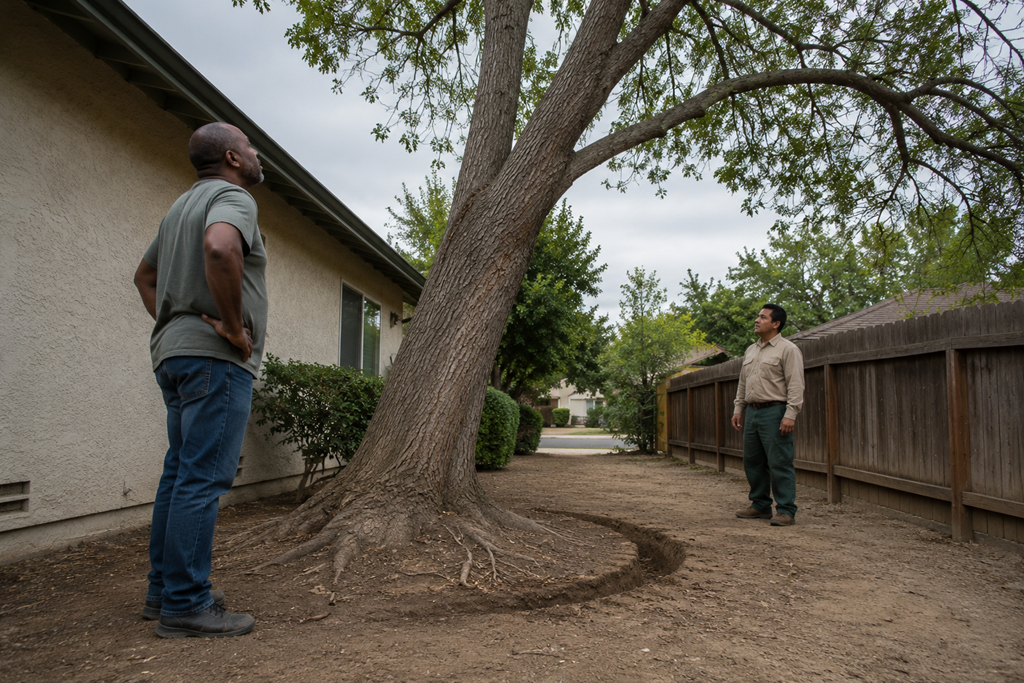
Raised soil, a widening gap near the base, newly exposed roots, or a visible mound forming on one side of the tree may indicate that something has shifted. Roots may also be affected by trenching, paving, soil removal, vehicle traffic, construction, or changes to the surrounding landscape.
Surface roots are common around many mature trees and do not automatically signal instability. The more useful question is whether the roots or surrounding soil look different from their usual condition.
Avoid cutting, digging around, covering, or attempting to reposition major roots based only on what is visible. Root systems can be extensive, and changes made near the base of a tree may have effects that are not immediately obvious.
Repeated Branch Loss Is Different From an Occasional Twig
Trees naturally shed small twigs, leaves, flowers, seeds, and minor deadwood. Finding a few small pieces beneath a tree is not unusual.
Repeatedly finding larger branches, however, may be worth discussing with a professional. The pattern becomes more meaningful when branches fall from the same section of the canopy, break without an obvious weather event, or show cracks, cavities, decay, or weak attachment points.
Branch size and location also affect the decision. A questionable limb over an unused corner of a yard presents a different concern from one over a roof, parked vehicle, play area, customer entrance, or outdoor seating space.
A professional evaluation can help distinguish routine maintenance needs from a branch condition that deserves more focused attention.
Leaf Changes Do Not Always Point to One Cause
Thinning leaves, premature discoloration, bare branches, or delayed growth may make a tree look unhealthy, but appearance alone rarely explains why the change is happening.
Possible influences can include watering patterns, root disturbance, insects, disease, pruning, soil conditions, weather exposure, or the tree’s natural growth cycle. Different parts of the same tree may also respond differently.
Before drawing conclusions, consider the pattern. Is the change limited to one branch, one side of the canopy, or the entire tree? Did it appear suddenly, or has it progressed gradually? Are nearby trees showing similar changes?
These observations can help a tree professional understand the concern, but homeowners do not need to identify the underlying cause before requesting an evaluation.
A Tree’s Location Affects How Much a Concern Matters
The same visible condition can carry different practical consequences depending on where the tree stands.
A damaged branch over an open planting bed is not the same as one over a bedroom, sidewalk, driveway, neighboring property, or frequently used entrance. A tree leaning into open yard space presents a different decision than one leaning toward a structure.
This does not mean that every tree near a home is unsafe. It means that location should be part of the evaluation rather than treated as an afterthought.
Trees growing close to utility lines require additional caution. Homeowners should not approach, trim, or attempt to move branches that are contacting or close to electrical lines. The appropriate utility provider or a qualified professional experienced with that type of work should be contacted instead.
Professional Attention Does Not Automatically Mean Removal
One reason homeowners delay asking about a tree is the fear that an evaluation will immediately lead to a recommendation for removal.
That is not always the case.
Depending on the tree and the condition being evaluated, the discussion may involve monitoring, selective pruning, addressing a damaged branch, changing surrounding conditions, obtaining a more specialized assessment, or considering removal when other reasonable options are limited.
A useful evaluation should help explain what was observed, why it matters, and what options are available. The recommendation should connect to the actual condition of the tree and its surroundings rather than relying on a vague statement that the tree simply “looks bad.”
Useful Questions to Ask During an Evaluation
A few direct questions can make it easier to understand recommendations and compare local tree service providers:
- What visible conditions are causing concern?
- Is the recommendation based on the whole tree or one specific branch or area?
- Are there reasonable alternatives to removal?
- Can the condition be monitored, and what changes should be watched?
- What work is included in the estimate, including debris handling and cleanup?
- Does the proposed work account for nearby structures, access limitations, and utility lines?
Clear answers should help you understand the purpose and scope of the recommended service without requiring you to become a tree-care expert.
The Most Helpful Sign Is Often a Pattern You Can Describe
You do not need to know the name of a tree condition before contacting a professional. Being able to describe what changed, where it appeared, and whether it seems to be progressing is often enough to begin a useful conversation.
A new lean, repeated limb loss, widening crack, shifting soil, thinning canopy, or major branch over a frequently used area may justify a professional evaluation. At the same time, one imperfect feature does not automatically mean a tree is failing or must be removed.
The goal is to notice meaningful changes early enough to ask better questions, understand the available options, and make a considered decision before authorizing pruning, treatment, or removal.