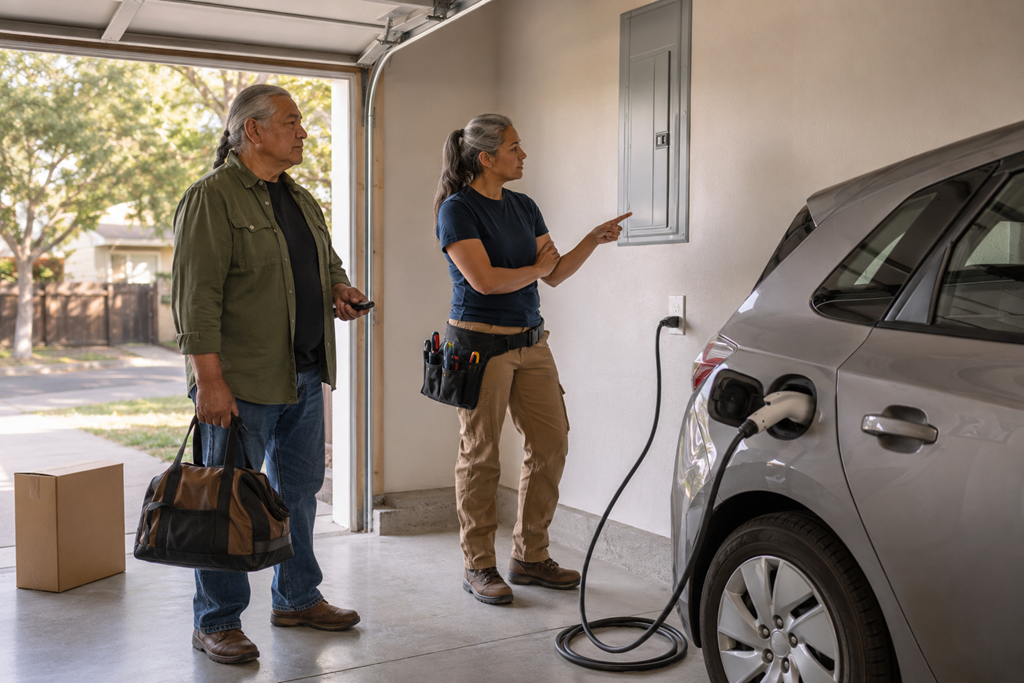
Level 1 and Level 2 charging are not simply “slow” and “fast” versions of the same home upgrade. Level 1 uses a standard 120-volt household outlet and may be enough when daily driving is modest and the vehicle can remain plugged in for long stretches. Level 2 uses 240-volt service and restores range much faster, but it usually calls for a closer look at the home’s electrical capacity, parking setup, equipment, and installation needs.
For Sacramento-area homeowners, the better option is not automatically the most powerful charger available. It is the charging setup that can reliably replace the energy the household uses without creating unnecessary expense, inconvenience, or electrical complications.
The Main Difference Is How Quickly You Can Recover Your Driving Range
Level 1 charging commonly uses a portable charging cord connected to a standard 120-volt outlet. Level 2 charging uses 240-volt electrical service and delivers substantially more power to the vehicle.
Official guidance commonly estimates that Level 1 may add roughly 2 to 5 miles of driving range for each hour of charging. Level 2 equipment may add approximately 10 to 30 miles per hour, depending on the vehicle, charger output, electrical service, battery condition, and environmental factors. These figures are general ranges rather than promises for every vehicle.
That difference matters most when a vehicle needs to recover a significant amount of range during a limited overnight window.
A homeowner who drives 20 miles on an ordinary day and leaves the vehicle plugged in for 12 hours may find that Level 1 keeps up comfortably. Someone who regularly drives much farther, arrives home with a low battery, or needs the vehicle again within a few hours may find Level 1 increasingly restrictive.
The useful question is therefore not simply, “Which level is faster?”
It is, “How much driving range does this household need to restore before the vehicle is needed again?”
Level 1 Can Be Practical When Time Is on Your Side
Level 1 is sometimes dismissed as temporary or inadequate, but it can be a reasonable long-term arrangement for the right driving pattern.
It may work well when:
- Daily mileage is relatively modest.
- The vehicle remains parked for long periods.
- The household has access to other charging when needed.
- The vehicle is a plug-in hybrid with a smaller battery.
- The driver does not need to refill most of the battery every night.
- A suitable dedicated 120-volt circuit is already available near the parking location.
The important phrase is suitable dedicated circuit. A garage outlet may look ordinary while sharing power with a refrigerator, freezer, tools, lighting, or other equipment. Homeowners should not assume that any nearby receptacle is appropriate for sustained vehicle charging merely because the charging cord fits.
Federal guidance recommends having a licensed electrician confirm that a Level 1 charging location has a circuit capable of supporting the ongoing load. It also advises against using an extension cord for EV charging because of overheating, fire, and electrical-shock risks.
In other words, Level 1 may require less installation work, but it should not be treated casually.
Level 2 Is Most Valuable When Charging Time Becomes a Constraint
Level 2 charging is often chosen because it can restore a larger amount of range overnight or during a shorter parking period.
That faster recovery may be useful for households with:
- Longer or unpredictable daily travel.
- A fully electric vehicle with a larger battery.
- More than one electric vehicle.
- Limited time between driving periods.
- Frequent evening activities followed by early departures.
- Less convenient access to workplace or public charging.
Level 2 can also provide more flexibility. A driver may not need to plug in every evening, and an unexpected longer trip may be easier to recover from at home.
However, faster charging is not automatically valuable if the household rarely needs it. Installing more capacity than the vehicle and driving pattern require may add cost without noticeably improving everyday life.
A homeowner who routinely parks for 10 or 12 hours should evaluate the entire overnight window rather than focusing only on the maximum advertised charging speed.
The Vehicle Determines Part of the Charging Speed
A high-output home charger cannot force every vehicle to accept power at the equipment’s maximum rate.
Actual charging time is influenced by several factors, including:
- The vehicle’s internal charging capacity.
- The charging equipment’s output.
- The available electrical service.
- The battery’s size and current charge level.
- Battery and environmental conditions.
The vehicle and charging equipment effectively work together, and the slower limitation can determine the real charging rate.
This is why homeowners should identify the vehicle’s maximum AC charging capability before choosing equipment. Purchasing a more powerful unit does not necessarily make the current vehicle charge faster.
There may still be reasons to plan for a future vehicle, but that should be a deliberate choice rather than an assumption that the largest charger will always provide the best result.
The Home’s Electrical Readiness Matters as Much as the Charger
Choosing Level 2 is not only a product decision. It is also a home-electrical and installation decision.
A qualified electrician may need to evaluate:
- The electrical panel and available capacity.
- The proposed circuit and charger output.
- The distance between the panel and parking space.
- Whether the vehicle is parked in a garage, driveway, or side area.
- The charging cable’s route and reach.
- Whether the equipment will be installed indoors or outdoors.
- Applicable permitting and inspection requirements.
Some homes can accommodate Level 2 charging with relatively straightforward work. Others may require additional planning or electrical changes. Outdoor charging can be appropriate when properly rated equipment is selected for the location. Local code and permit requirements can also affect the installation approach.
This is one reason two homeowners purchasing the same charger can receive very different installation estimates. The equipment may be identical while the electrical capacity, wiring route, parking arrangement, and required site work are not.
A 240-Volt Outlet Does Not Automatically Mean the Home Is Ready
Homeowners sometimes discover an existing 240-volt receptacle in the garage and assume that Level 2 charging can begin immediately.
The outlet’s presence does not answer every important question.
A qualified electrician may still need to determine whether the receptacle, wiring, circuit, breaker, location, and condition are appropriate for sustained vehicle charging. The charger’s requirements must also match the circuit that serves the outlet.
Federal consumer guidance recommends having an electrician evaluate existing 240-volt outlets before they are used for vehicle charging.
The same principle applies when comparing charger installation quotes. One provider may be pricing only the most visible work, while another may be accounting for circuit capacity, cable routing, protection, permitting, and final inspection.
A lower estimate is not necessarily wrong, but homeowners should understand what each estimate includes.
More Features Do Not Necessarily Mean Better Charging
Some Level 2 chargers include scheduling, remote monitoring, energy tracking, connectivity, access controls, or other smart features. Other units primarily supply power without extensive controls.
A feature is useful only when it solves a real household need.
A homeowner may value scheduling because the vehicle is charged during preferred hours. Another may appreciate energy-use information. Someone else may prefer simpler equipment with fewer connected features.
The essential questions remain more basic:
- Is the equipment compatible with the vehicle?
- Can the home safely support it?
- Is it appropriate for the installation location?
- Will the charging speed meet the household’s routine?
- Has the equipment been independently safety tested?
ENERGY STAR advises consumers to look for chargers evaluated by a nationally recognized testing laboratory rather than assuming every unit sold online or in stores has meaningful safety certification.
Questions to Ask Before Comparing Installation Quotes
A short conversation about actual driving habits can make charger estimates more useful.
Consider asking a qualified provider:
- Would Level 1 reliably replace my typical daily driving?
- Is the nearby 120-volt outlet on a suitable dedicated circuit?
- What is my vehicle’s maximum Level 2 AC charging rate?
- How much Level 2 output can my home reasonably support?
- Does the proposed installation account for my usual parking position?
- Is the equipment suitable for indoor or outdoor use?
- What electrical work is included in the estimate?
- Are permit and inspection responsibilities clearly identified?
- Would a lower-output Level 2 setup still meet my needs?
- How would the plan change if the household adds another EV?
These questions keep the discussion focused on the household’s actual use rather than on selling the largest charger.
The Right Choice Should Fit an Ordinary Week
The easiest way to misunderstand Level 1 and Level 2 charging is to compare only their maximum speeds.
The better comparison considers how far the vehicle is normally driven, how long it remains parked, how much range must be restored, what the vehicle can accept, and what the home can safely support.
Level 1 may be entirely adequate for a lightly driven vehicle with long overnight parking. Level 2 may be worthwhile when a household regularly needs to replace more range within a shorter window. Neither option is automatically right for every Sacramento-area home.
Before purchasing equipment or accepting an installation quote, homeowners should make sure the proposed charging level solves a real daily problem. That creates a more useful conversation with a qualified local professional and helps prevent paying for capacity that the household may never use—or choosing a setup that consistently falls behind.