Before hot weather settles in, Sacramento homeowners should focus on whether their trees are entering the season with enough structural stability, healthy foliage, and access to water. The goal is not to perform risky pruning or diagnose every concern on your own. It is to notice meaningful changes early, understand what may deserve professional attention, and avoid waiting until heat, dry soil, or heavy limbs make an existing weakness harder to manage.
For many homeowners, tree care before hot weather feels uncertain because the tree may still look mostly normal. It may have green leaves, cast plenty of shade, and show no obvious sign of failure. At the same time, one section of the canopy may appear thinner, a branch may remain bare, or the soil around the tree may seem unusually dry.
Those small observations do not automatically mean that major work is needed. They do provide useful information before speaking with a local tree professional.
Hot Weather Can Reveal Problems That Were Already Developing
Seasonal preparation is not simply about making a tree look neat before summer. It is about understanding whether the tree is already dealing with conditions that may become more noticeable during prolonged heat and dry weather.
A tree with limited access to water, damaged roots, declining branches, or an unusually thin canopy may have less ability to adjust when conditions become demanding. The hot weather did not necessarily create the original concern. It may simply make the existing pattern easier to see.
This is why an early evaluation can be more useful than waiting for a dramatic symptom. A qualified tree professional may be able to distinguish between normal seasonal change, a condition worth monitoring, and a concern that deserves attention before the hottest part of the season.
Pay Attention to Changes Rather Than Expecting Perfection
Trees are not perfectly symmetrical structures. One side may naturally grow more densely because of sunlight, nearby buildings, past pruning, or competition from other plants.
The more useful question is whether something has changed.
A branch that has always grown at an unusual angle may not carry the same meaning as a branch that recently dropped, cracked, or stopped producing foliage. A canopy that has gradually developed an uneven shape over many years may be less concerning than a section that has thinned noticeably since the previous season.
Homeowners may find it helpful to think about:
- whether a bare branch is new
- whether leaf coverage has changed noticeably
- whether the trunk or major limbs look different
- whether soil around the root area has shifted
- whether the tree’s lean appears different than before
- whether fallen branches or twigs are becoming more frequent
These observations are not a diagnosis. They give a tree professional a clearer starting point when evaluating the property.
Green Leaves Do Not Tell the Whole Story
A tree can have plenty of green foliage and still have a localized structural or health concern. One dead branch, a damaged limb connection, or a compromised root area may not immediately affect the appearance of the entire canopy.
The opposite is also true. Browning leaves or early leaf drop do not automatically mean that a tree is dying or must be removed. Heat exposure, watering patterns, soil conditions, species characteristics, insects, disease, and other factors may produce similar visible symptoms.
This is one reason homeowners should be cautious about making a major decision based on a single sign.
A useful professional evaluation should consider the entire tree, including its canopy, branch structure, trunk, root area, growing environment, and proximity to places people regularly use.
Watering the Lawn Is Not Always the Same as Watering the Tree
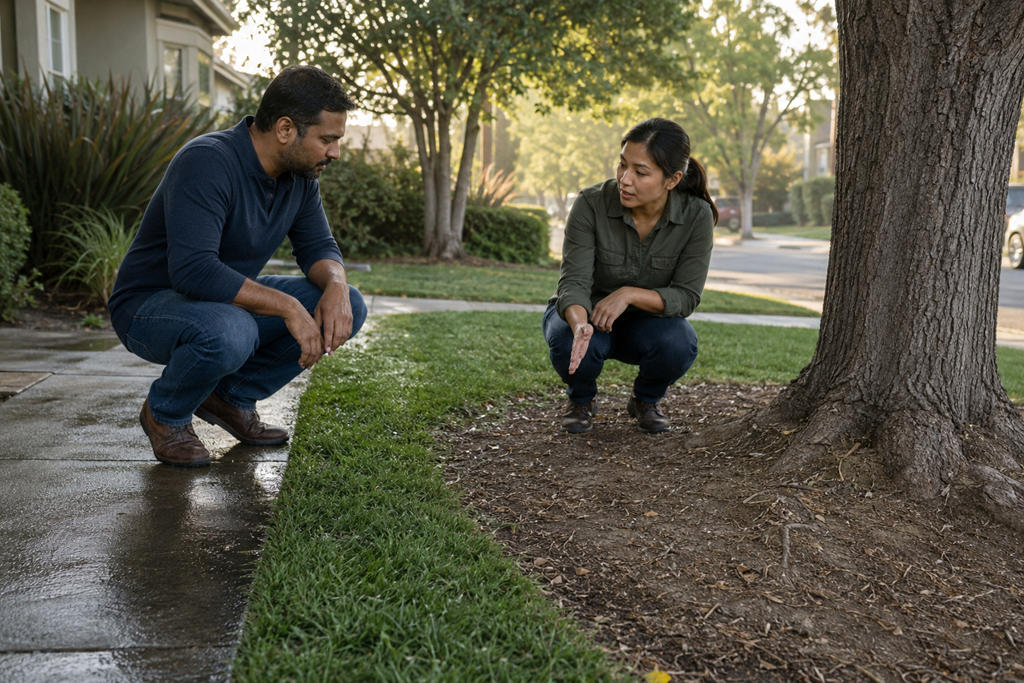
A green lawn can create the impression that nearby trees are receiving enough water. However, lawn irrigation and tree needs are not always the same.
Sprinklers may concentrate water near the surface or direct it toward grass rather than the broader area where tree roots are growing. Soil compaction, grading, pavement, drainage patterns, and changes to the landscape can also affect how water reaches the root zone.
Adding more water without understanding the cause of a problem is not always the best response. Excess moisture can create its own concerns, particularly when water repeatedly collects against the trunk or remains in poorly draining soil.
Before changing an irrigation routine, homeowners can ask a qualified professional whether the tree’s species, age, soil conditions, and surrounding landscape should influence the approach. The goal is to understand the situation rather than assume that every stressed-looking tree simply needs more water.
Soil Conditions Often Matter More Than Homeowners Realize
The ground around a tree is easy to overlook because most visible attention goes to the trunk and branches.
Compacted soil can make it harder for air and water to move through the root area. Construction activity, parked vehicles, repeated foot traffic, landscape changes, and heavy objects placed beneath the canopy may gradually alter soil conditions.
Changes near the tree can also matter. New paving, raised planting beds, irrigation work, trenching, or changes in drainage may affect roots even when the canopy still looks healthy.
Homeowners do not need to dig around the tree or expose roots themselves. It is enough to note whether the surrounding ground has recently changed and mention that history during an evaluation.
Pruning Should Have a Clear Purpose
Tree care before hot weather does not necessarily mean removing a large amount of growth.
Pruning may be considered for reasons such as damaged branches, deadwood, clearance, structural concerns, or reducing a specific conflict with the property. The appropriate timing and amount can depend on the tree, its condition, and the reason for the work.
Removing too much foliage can affect shade and change how the remaining branches respond to sun and wind. Aggressive cutting can also leave homeowners with a tree that looks dramatically different without addressing the original concern.
A trustworthy recommendation should explain why particular branches are being considered, what the work is intended to accomplish, and whether the proposed pruning is routine, preventative, or related to a specific risk.
Be cautious when a recommendation centers on removing large portions of the canopy without a clear explanation.
The Location of a Branch Can Matter as Much as Its Appearance
A bare or weakened branch above an unused corner of the yard presents a different practical concern than a similar branch above a driveway, roof, walkway, patio, play area, or frequently occupied space.
This does not mean every branch over a structure needs to be removed. It means that tree evaluation should include what is located beneath and around the tree.
Before hot weather, homeowners may begin spending more time in shaded outdoor areas or parking vehicles beneath mature trees. That change in everyday property use can make an existing branch more important to evaluate.
When speaking with a tree professional, point out the areas that receive regular foot traffic, vehicle use, seating, or family activity. That context can help the professional explain priorities more clearly.
Recent Property Work Can Affect the Conversation
Tree concerns sometimes appear after a seemingly unrelated property project.
Changes to irrigation, fencing, patios, driveways, drainage, soil level, landscaping, or underground utilities may affect the environment around a tree. The project may not have caused the concern, but the timing is still worth mentioning.
A tree professional may ask when the work occurred, where digging took place, or whether equipment traveled beneath the canopy. Photos taken before and after the project can sometimes provide useful context even when they were not originally intended for tree evaluation.
This information helps the professional look beyond the most obvious symptom and consider what may have changed around the tree.
Questions Worth Asking Before Scheduling Tree Work
A brief conversation can reveal whether a provider is prepared to explain the tree’s condition rather than simply recommend a service.
Consider asking:
- What visible change appears most important?
- Is the concern related to health, structure, watering, location, or a combination?
- Which work is recommended before hot weather, and which work can be monitored?
- How would the proposed pruning or treatment help?
- Are there parts of the tree that should be left alone?
- What changes should the homeowner continue watching after the visit?
Clear answers should connect the recommended service to a specific observation. Vague statements that every mature tree needs the same seasonal treatment may not provide enough information for an informed decision.
A Good Evaluation Should Separate Priorities
Not every tree concern carries the same level of importance.
Some conditions may only need observation. Others may justify routine maintenance. A smaller number may require more timely professional attention because of a branch location, visible damage, changing lean, root disturbance, or another property-specific factor.
A useful provider should be able to separate these categories and explain the reasoning behind them.
This helps homeowners avoid two common extremes: ignoring every change until the situation becomes harder to manage, or agreeing to extensive work simply because hot weather is approaching.
The purpose of an evaluation is not to create pressure. It is to help the homeowner understand what the tree appears to need, what can wait, and what information should guide the next decision.
Early Tree Care Is Really About Better Information
Preparing trees for hot weather does not require homeowners to become tree experts. It requires noticing changes, understanding how the surrounding property affects the tree, and asking for a clear explanation before approving work.
A tree that looks different deserves observation, not an automatic conclusion. A watering concern deserves context, not an immediate assumption. A pruning recommendation should have a specific purpose rather than being presented as routine seasonal cutting.
By paying attention before hot weather becomes intense, Sacramento homeowners can have a more useful conversation with a local tree professional and make decisions based on the tree’s actual condition, location, and role on the property.