Solar screens can help reduce heat and glare, but their value depends on where, when, and how strongly sunlight reaches each window. A west-facing family room may become uncomfortable late in the day, while a shaded window on the same wall may have little need for screening. The exposure matters. A useful solar-screen plan starts with how the home actually receives sun, not with the assumption that every window needs identical coverage.
This distinction is easy to miss. Homeowners often experience one hot room, notice harsh light across a floor or countertop, and begin considering solar screens for an entire side of the house. The more useful question is not simply whether the home gets hot. It is which windows receive direct sun when the discomfort, glare, or fading actually occurs.
Sun Exposure Is a Window-by-Window Condition
Outdoor temperature affects the entire property, but direct sunlight does not reach every window in the same way.
One window may receive strong afternoon sun for several hours. Another may be protected by a roof overhang, mature tree, neighboring structure, patio cover, or recessed wall. Even windows that appear to face the same direction can experience different conditions because of their height, placement, and surrounding shade.
This is why solar screens are often better evaluated as a targeted response rather than a standard whole-house upgrade. The purpose is to address meaningful exposure where it occurs without unnecessarily darkening windows that are already comfortable.
A local professional should be able to explain why a particular window is being recommended for screening. “It faces west” may be part of the answer, but it should not be the entire answer. The actual amount and timing of direct sunlight matter.
The Time of Day Often Reveals the Real Problem
A room can feel comfortable during a morning consultation and become difficult to use several hours later.
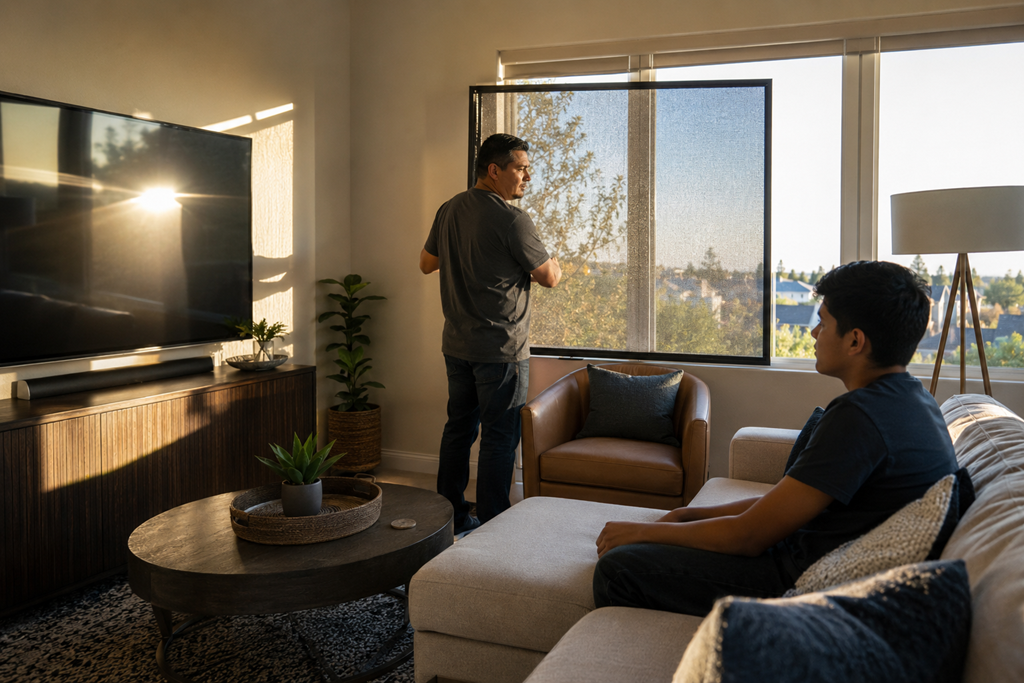
Late-day sunlight may create glare across a television, heat a seating area, reflect from a stone countertop, or make one side of a bedroom noticeably warmer. Morning exposure can cause a different pattern, especially in rooms used early in the day.
Before comparing solar-screen options, observe the room when the problem is most noticeable. Consider where the sunlight falls, how long it remains, and whether blinds or curtains are routinely closed to manage it.
This does not require technical measurements. The goal is to describe the experience accurately enough that a professional can evaluate the right windows under the right conditions.
Useful observations might include:
- The room becomes uncomfortable between the middle and end of the afternoon.
- Glare reaches the television even when the blinds are partly closed.
- A dining area remains comfortable, but the nearby kitchen counter receives intense reflected light.
- One bedroom needs its curtains closed during the day while the adjacent bedroom does not.
- The view is important, so reducing light without making the room feel enclosed is a priority.
These details are often more useful than simply saying that the house gets a lot of sun.
Heat, Glare, and Brightness Are Related but Not Identical
Homeowners may use the word “heat” to describe several different problems.
A room may feel physically warmer because sunlight is entering through the glass. It may also feel uncomfortable because of glare, intense brightness, or reflected light from floors, counters, screens, or furniture. In some cases, the main concern is fading on flooring, artwork, or furnishings rather than room temperature.
Solar screens can affect all of these experiences, but the desired result should be clear before choosing coverage.
A homeowner primarily concerned about television glare may make a different decision from someone trying to reduce afternoon heat in a nursery. A person who values a bright room and a clear backyard view may prefer a more selective approach than someone who keeps the blinds closed most of the day.
Defining the main problem helps prevent a solution that improves one condition while creating another unwanted tradeoff.
Existing Shade Can Change the Value of a Screen
Shade should be evaluated before assuming that a window needs additional protection.
Trees, fences, awnings, patio covers, rooflines, and nearby buildings can reduce direct exposure. Their effect may also change throughout the day. A window that appears shaded in the morning may receive intense sun later, while another may be exposed briefly without causing a meaningful comfort problem.
Seasonal changes can matter as well. Tree coverage and the sun’s angle do not remain identical throughout the year. The goal is not to predict every possible condition, but to avoid making a permanent decision based on one convenient observation.
A useful evaluation looks at the window during the period when the room is normally difficult to use. When that is not possible during an appointment, photos taken at different times can help show how sunlight moves across the room.
Every Reduction in Sunlight Affects the Indoor Experience
Solar screens do more than influence heat and glare. They also affect daylight, exterior visibility, and the way a room feels from inside.
A stronger screening effect may soften intense sunlight more noticeably, but it may also make the outdoor view appear darker or less distinct. Colors in a yard may look more muted. A room that already receives limited natural light may feel dimmer.
These changes are not automatically negative. Some homeowners prefer softer light and less visual exposure. Others place a higher value on a bright interior or an unobstructed view.
The important point is that solar-screen performance should not be discussed only in terms of blocking sunlight. The indoor experience matters too.
Whenever possible, ask to see a full-size sample positioned over the actual window rather than relying only on a small mesh swatch. A small sample can show color and texture, but it may not communicate how an entire screened window will affect the room.
Stand several feet back and observe the window from the places where the room is normally used. Look toward the outdoor view, the floor, the walls, and any reflective surfaces. This makes it easier to judge the combined effect on comfort, light, and visibility.
A Whole-House Package May Not Match a Selective Problem
Uniform coverage can make sense in some situations, but it should not be treated as the automatic starting point.
If two rooms experience strong direct exposure and the remaining windows stay shaded, screening every window may provide little additional benefit while reducing daylight elsewhere. A selective installation may address the actual problem more directly.
This is also useful when comparing estimates. One provider may recommend a large package, while another proposes screens only for the most exposed windows. The lower or higher total alone does not reveal which recommendation is more appropriate.
Ask each provider to explain the purpose of every proposed screen. The explanation should connect the window’s exposure to a specific concern such as glare, afternoon heat, furniture protection, or privacy preferences.
Be cautious when every window receives the same recommendation without discussion of orientation, shade, room use, or visibility. A professional evaluation should reflect the property rather than apply a generic package to every home.
Solar Screens May Be Only One Part of the Comfort Question
A hot room does not always mean the window is the only cause.
Room orientation, air circulation, window condition, insulation, ceiling height, roofing exposure, and the performance of the home’s cooling system can all affect comfort. Solar screens may still be useful, but they should not be presented as a guaranteed answer to every temperature problem.
This is especially important when a room stays uncomfortable after direct sunlight has passed or when several rooms with very different window exposure feel equally warm.
A responsible provider should be willing to discuss what solar screens are intended to address and what they may not change. Clear limits are usually more helpful than broad promises.
Questions That Make a Solar-Screen Estimate More Useful
A few focused questions can reveal whether a recommendation is based on actual exposure:
- Which windows receive the strongest direct sunlight when the room is uncomfortable?
- What specific problem is each proposed screen intended to address?
- How might the screen affect daylight and the outdoor view from inside?
- Can a full-size sample be tested on one of the actual windows?
- Would screening only the most exposed windows address the main concern?
- Are any recommended windows already protected by substantial shade?
The answers do not need to be highly technical. They should simply show that the recommendation is connected to the way the home is used and the way sunlight reaches it.
Match the Screen Plan to the Exposure You Actually Have
Solar screens are most useful when they respond to a clearly observed problem. Direction matters, but so do time of day, surrounding shade, room use, glare, visibility, and the amount of natural light the homeowner wants to keep.
Before accepting a whole-house recommendation, identify where the discomfort occurs and what improvement would make the greatest difference. Then ask the provider to connect each proposed screen to that goal.
For Sacramento-area homeowners, this window-by-window approach can make estimates easier to compare and help prevent unnecessary coverage. The best decision is not automatically the option that blocks the most sunlight. It is the option that addresses meaningful exposure while preserving the light, view, and everyday experience that matter inside the home.