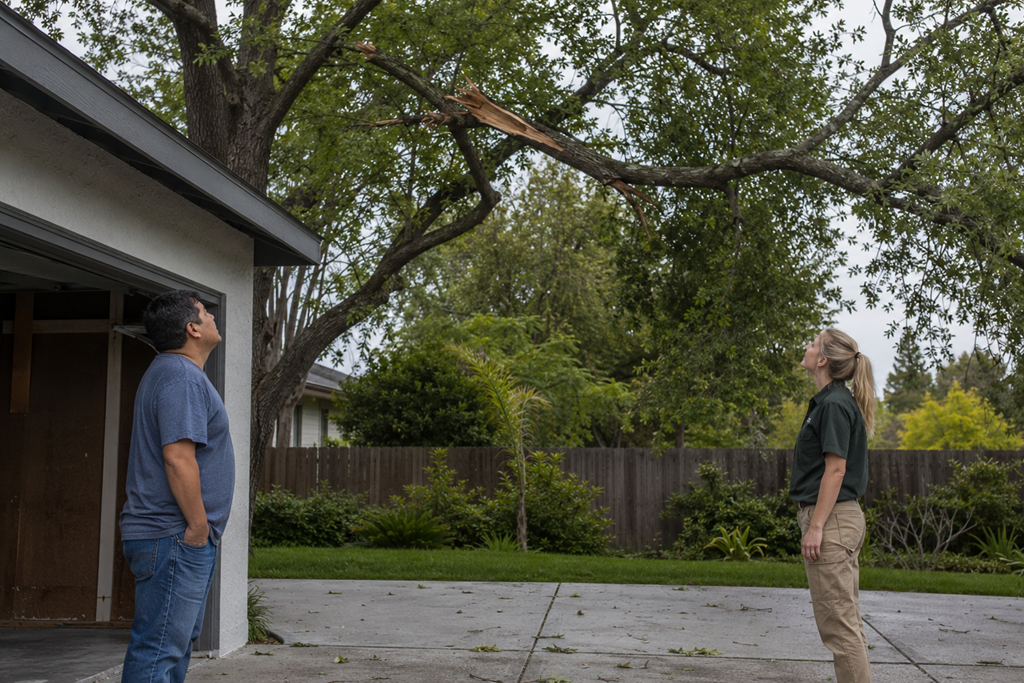
After wind or heavy rain, check the tree from a safe distance for changes that were not visible before the weather moved through. Look for newly broken or hanging branches, a fresh lean, lifted soil near the roots, cracks where large limbs join the trunk, and branches resting on roofs, fences, vehicles, or utility lines. The goal is not to diagnose the tree yourself, but to notice what changed and decide whether a professional evaluation may be appropriate.
A tree may still look upright and leafy even when part of its structure has changed. That is why a quick glance at the canopy may not tell the whole story. The most useful question is not simply, “Does the tree look damaged?” It is, “Is anything different from how it looked before?”
Start With Changes, Not General Messiness
Wind and rain can leave leaves, twigs, seed pods, and small branches scattered across a Sacramento-area yard. That debris may look concerning, but the amount of material on the ground does not always show whether the tree has developed a larger problem.
Instead of focusing only on cleanup, compare the tree with what you normally see. A newly drooping branch, an unfamiliar opening in the canopy, or a limb sitting lower than it did before may deserve more attention than a yard covered with ordinary twigs.
The same principle applies when a tree appears mostly normal. One changed section can matter even when the rest of the canopy remains green and full.
Look for Broken or Suspended Branches
A branch does not have to fall completely to create a concern. It may break near the trunk and remain caught in surrounding branches, or it may split and hang from a strip of wood or bark.
From a protected location, look for branches that:
- Hang at an unusual angle
- Show freshly exposed, lighter-colored wood
- Rest against another branch rather than growing naturally from it
- Have dropped lower over a driveway, patio, walkway, or roof
- Move differently from the surrounding canopy
Do not stand beneath a questionable branch to get a closer look. A partially broken limb may appear stable while being supported by only a small connection or by neighboring growth.
Pay Attention to Where Large Limbs Join the Tree
Wind can place added force on branch unions, especially where multiple large limbs grow from the same area. After the weather passes, a fresh opening, separation, or crack near one of these connections may indicate that movement occurred.
The crack may be easy to see when fresh wood is exposed. In other cases, the signs are subtler: bark may look newly stretched, a seam may appear wider, or one side of the canopy may sit lower than before.
Older marks are not necessarily evidence of a recent change. What matters is whether the area looks different after the wind or rain. Photos taken previously from the same part of the yard can sometimes help establish that comparison without requiring anyone to approach the tree.
Check the Trunk From More Than One Safe Viewpoint
A tree trunk can look normal from one side while showing a significant change on another. Without circling beneath unstable branches, view the trunk from whichever open areas of the property are safely accessible.
Look for a new split, loosened bark, fresh impact damage, or a visible separation extending into a major branch connection. Also notice whether the trunk appears to have shifted relative to nearby fences, rooflines, or other fixed features.
A natural curve or long-standing lean is not automatically a sign that the tree is failing. The more useful concern is whether the angle recently changed or whether the lean is accompanied by movement in the surrounding soil.
Changes at Ground Level Can Be Easy to Miss
Heavy rain can soften or saturate soil around a tree. Wind may then move the trunk and root system enough to disturb the surface near the base.
From a safe distance, look for:
- A fresh crescent-shaped ridge in the soil
- Newly exposed roots
- Soil that has pulled away from one side of the trunk
- Cracking or lifting around the root area
- A tree that appears newly tilted
These signs can be more meaningful than standing water alone. Wet soil after rain is expected, but displaced soil may suggest that the tree moved within the ground.
Avoid walking onto freshly lifted soil or pressing on exposed roots to test them. A qualified tree professional can evaluate the relationship between the trunk, roots, soil movement, and overall tree structure.
Consider What Is Beneath the Tree
The location of a changed branch or leaning tree can affect how the situation should be handled. A questionable limb above an unused corner of a large yard presents a different decision than a similar limb above a bedroom, driveway, entrance, play area, parking space, or frequently used patio.
This does not mean that every branch over a structure needs to be removed. It means the area beneath the branch is part of the evaluation.
Notice whether people, pets, vehicles, buildings, fences, or neighboring property could be affected if the weakened section moved further. Until the situation is understood, it may be reasonable to keep normal activity away from that particular area.
Do Not Overlook Contact With Buildings or Fences
A branch may move during a storm without breaking. It can begin rubbing against roofing, gutters, siding, windows, fences, or other parts of the property.
Look for a branch that now rests on a structure, a fresh scrape on a surface, or leaves and smaller growth pressed into an area that was previously open. The tree and the affected structure may both need to be considered when deciding what type of professional should evaluate the situation.
Avoid pulling the branch away or attempting to cut the portion that appears to be touching the property. Moving one section can change the balance of the remaining limb.
Utility Lines Require a Different Response
Do not approach a tree or branch that is touching, resting on, or hanging near a utility line. Do not attempt to move the branch, use a pole tool, climb the tree, or ask an unqualified person to cut it.
Contact the appropriate utility provider or emergency service for direction based on the situation. Tree work around utility lines requires specialized procedures and should not be treated like ordinary yard maintenance.
Even a branch that appears small can be unsafe when electrical equipment is involved.
A Clean-Looking Tree Can Still Deserve Attention
One common misunderstanding is that significant tree damage will always be dramatic. Homeowners may expect to see a fallen trunk, a completely detached limb, or a large amount of debris before considering an evaluation.
Storm-related changes can be much quieter. A branch may remain suspended in the canopy. A trunk may shift only slightly. A crack may open at a major union while the leaves above it remain healthy.
The absence of dramatic damage does not prove that the tree has no concerns. At the same time, scattered leaves and twigs do not automatically mean professional work is needed. The distinction usually comes from identifying structural changes rather than judging the yard by how messy it looks.
Photographs Can Make a Professional Conversation More Useful
When photographs can be taken without entering the area beneath a questionable tree, they may help a tree professional understand what has changed before an on-site evaluation.
Useful images may include a full view of the tree, the trunk and surrounding soil, the affected branch in relation to the rest of the canopy, and any nearby roof, walkway, fence, or parking area.
A wide photograph often provides context that a close-up cannot. A tightly framed image may show a crack but not reveal the branch’s size, height, attachment, or what is located beneath it.
Photos do not replace an in-person assessment, but they can help explain the concern and support a more focused conversation when scheduling service.
When a Professional Evaluation May Be Worth Discussing
Consider contacting a qualified tree professional when you notice a new lean, displaced soil near the roots, a large broken or suspended branch, fresh cracking at a major connection, or a branch resting on a structure.
An evaluation may also be appropriate when multiple branches failed during the same weather event or when you cannot determine whether a visible condition is new.
The purpose of an evaluation is not automatically to recommend removal. Depending on the tree and the condition found, the conversation may involve monitoring, pruning, restricting access temporarily, further assessment, or discussing other options.
A useful professional should be able to explain what changed, why it matters, what area is affected, and how the proposed work addresses the specific concern.
Questions to Ask Before Authorizing Tree Work
When speaking with a Sacramento-area tree professional, consider asking:
- Which visible condition is the main concern?
- Does the issue involve one branch or the tree’s larger structure?
- Is there an area people should avoid before work begins?
- What work is being proposed, and what is it intended to accomplish?
- Are there reasonable alternatives to the recommended work?
- Will the written estimate identify the affected tree, branches, cleanup, and access needs?
Clear answers can help you distinguish a focused evaluation from a vague recommendation based only on the fact that a storm occurred.
Focus on What Changed and What Could Be Affected
Checking trees after wind or heavy rain is less about performing a technical inspection and more about noticing meaningful differences. Broken or hanging branches, new trunk movement, disturbed soil, fresh cracks, and contact with structures provide more useful information than leaves and twigs alone.
Observe from a safe location, keep people away from questionable areas, and avoid handling damaged branches yourself. When something appears newly changed or difficult to interpret, a qualified tree professional can help explain the condition and the available next steps before you commit to tree work.