Before choosing window treatments, decide what each window needs to do before deciding how it should look. A covering that works beautifully in one room may create glare, reduce privacy, trap heat, block a view, or feel awkward to operate in another. The better starting point is the room’s daily use, the direction and strength of sunlight, the level of privacy needed, and how often the treatment will be opened or adjusted.
It is easy to begin with colors, fabrics, or product styles because those are the most visible parts of the decision. The confusion often comes later, when an attractive treatment does not provide enough privacy, darkens the room more than expected, interferes with furniture, or becomes inconvenient to use every day.
Choosing well is less about finding one universally superior product and more about matching each window treatment to the conditions around that particular window.
Begin With the Problem the Window Treatment Needs to Solve
Before comparing blinds, shades, shutters, or fabric panels, think about what is currently uncomfortable or inconvenient.
Perhaps afternoon sunlight creates glare across a television or computer screen. A bedroom may feel too bright early in the morning. A street-facing window may leave the room feeling exposed after interior lights are turned on. Another window may already provide a pleasant view, making complete coverage unnecessary.
These situations point to different priorities. A treatment designed mainly for privacy may behave differently from one selected for glare control, insulation, room darkening, or preserving an outdoor view.
Naming the primary problem helps prevent the selection process from becoming a comparison of appearances alone.
One Window May Need to Perform Several Jobs
Many windows create more than one concern.
A Sacramento-area living room may receive strong sunlight during part of the day while still benefiting from natural light at other times. A bedroom window may need privacy at night without feeling closed off throughout the morning. A kitchen window may need glare control while remaining easy to operate around counters, faucets, or cabinets.
These competing needs do not always require a complicated solution, but they should be acknowledged before a product is selected. In some rooms, adjustable slats or vanes may provide useful flexibility. In others, a shade with a specific opacity or a layered treatment may offer a better balance.
The important question is not simply, “Does this cover the window?” It is, “Can this treatment manage the room differently as conditions change?”
The Same Product Can Feel Different From Room to Room
A window treatment that works well in a shaded room may perform very differently on a window receiving direct afternoon sun.
Window direction, nearby trees or buildings, room color, glass size, and the position of furniture can all affect the result. Darker materials may look attractive in a sample but make a small room feel more enclosed. A light-filtering shade may soften sunlight beautifully in one room while providing less privacy than expected in another.
This is why selecting one treatment for every window solely for consistency can lead to compromises. A coordinated home does not necessarily require every window to function in exactly the same way.
Different products, materials, or opacity levels can still appear intentional when their colors, proportions, or design details relate to one another.
Privacy Depends on Time, Distance, and Viewing Angle
Privacy is not always an all-or-nothing condition.
A window may feel private during daylight because the outdoors is brighter than the room. That can change after sunset when interior lights make the room more visible from outside. A second-story window may need less coverage than a ground-level window facing a sidewalk, neighboring property, or shared outdoor area.
The viewing angle also matters. A treatment may block a direct view while leaving portions of the room visible from the side or from a lower elevation.
Before choosing a privacy-focused product, consider when privacy is most important and where an outside viewer could realistically be positioned. That provides a more useful basis for comparison than relying only on a small material sample.
Everyday Operation Can Matter as Much as Appearance
A treatment that is difficult to reach or adjust may eventually remain in one position, even if it was designed to be flexible.
Consider whether a window sits behind a sofa, desk, bathtub, kitchen counter, or tall piece of furniture. Notice whether nearby doors, cabinet fronts, or window handles could interfere with the treatment. For wide or frequently used windows, the weight and movement of the product may also affect how convenient it feels.
Manual, cordless, and motorized options can each make sense in different situations. The right choice depends on window placement, household needs, frequency of use, and the level of convenience the homeowner expects.
Homes with children or pets may also require additional attention to operating cords, hanging components, and accessible hardware. A window treatment professional can explain which operating systems are appropriate for the household and installation area.
Measuring Is Part of Choosing, Not Just Installing
Measurements do more than determine product width and height. They can also reveal which mounting styles are practical.
An inside-mounted treatment may create a clean, recessed appearance, but it requires enough usable depth inside the window opening. Handles, locks, trim, uneven frames, or shallow casings may affect the available space. An outside-mounted treatment can provide broader coverage, but it may change how the window looks and how much wall or trim remains visible.
The shape of the opening matters as well. Windows that appear square at first glance may have small variations that affect fit, light gaps, or movement.
For custom products, professional measuring can help connect the design choice to the actual window conditions before an order is placed.
Material and Opacity Change the Experience of the Room
Two treatments with similar colors can produce very different results depending on their materials.
A sheer or light-filtering material may soften incoming light while preserving a brighter atmosphere. A more opaque material can provide stronger privacy or room darkening but may reduce the connection to the outdoors when closed. Textured fabrics can add visual warmth, while smooth materials may feel more streamlined and easier to coordinate with other finishes.
Material selection may also affect cleaning, durability, moisture suitability, and how the treatment responds to repeated sun exposure.
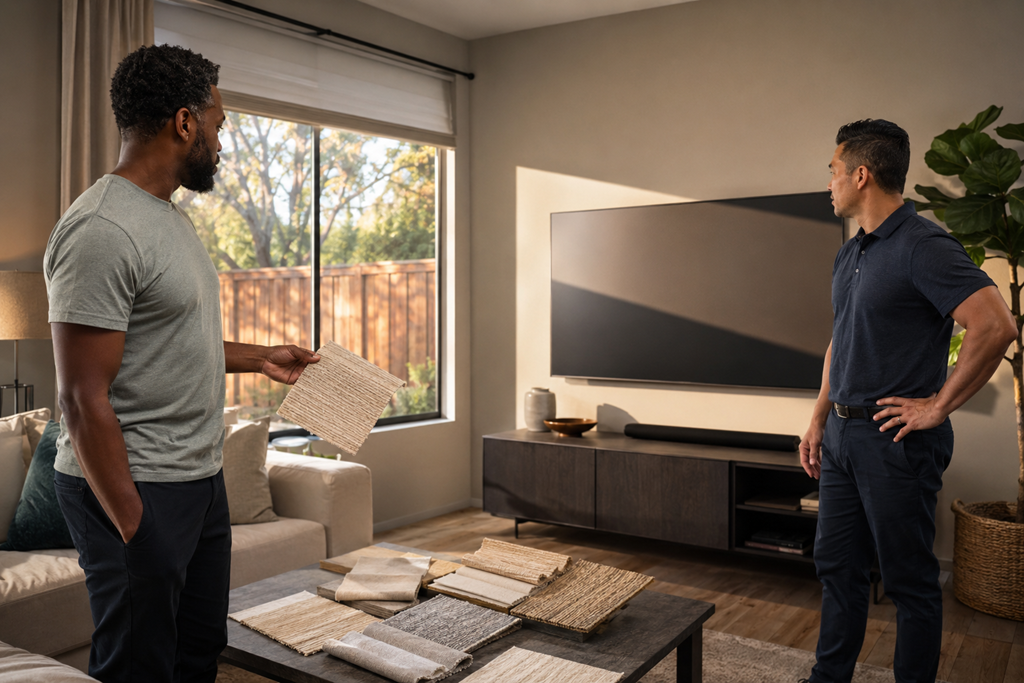
Small samples are useful, but they should be viewed near the actual window when possible. A material can look different when backlit by daylight than it does under showroom or interior lighting.
Look at the Treatment in Both Positions
Window treatments are often judged while fully closed, even though they may spend much of the day open.
When open, curtains and vertical treatments require stacking space. Shades may create a visible roll or folded stack above the glass. Shutters and certain panels need clearance to swing or slide. These positions can affect the view, available daylight, nearby furniture, and access to handles.
When closed, the treatment changes the room’s color balance, scale, and sense of enclosure.
Evaluating both positions helps reveal whether the product will complement the room throughout the day rather than only in a single display arrangement.
Useful Questions to Ask During a Consultation
A few focused questions can make a window treatment consultation more productive:
- What level of privacy will this provide during both daylight and nighttime conditions?
- How much natural light will remain when the treatment is closed?
- Will the proposed mount work with the window depth, trim, and hardware?
- How will the treatment look and function when fully open?
- Are there furniture, door, cabinet, child-safety, or pet considerations?
- What cleaning and maintenance does the material require?
- Which parts of the proposal include measuring, installation, adjustments, and product coverage?
Clear answers should connect the recommendation to the actual room rather than simply describe the product.
Be Cautious of Recommendations That Feel Too Universal
A recommendation may deserve a closer look when the same product is suggested for every window without discussing sunlight, privacy, room use, mounting conditions, or operating access.
Other signs of an incomplete conversation include vague explanations about material opacity, no discussion of how the treatment looks when open, or an assumption that measurements can be finalized without checking trim, depth, or window hardware.
This does not automatically mean the product is unsuitable. It may mean the reasoning behind the recommendation has not been explained clearly enough.
A helpful professional should be able to describe why a particular treatment fits the window, the room, and the homeowner’s priorities.
Compare the Complete Result, Not Just the Product Name
When reviewing options from window treatment professionals, compare what the finished proposal includes.
One quote may include custom measuring, mounting hardware, installation, adjustments, and product coverage, while another may separate some of those items. Products with similar names may also differ in material quality, opacity, control systems, construction, or customization.
Ask for enough detail to understand what will be installed, how it will operate, and what problem it is expected to solve.
The most useful proposal is not necessarily the one with the longest product description. It is the one that clearly connects the treatment to the way the room is actually used.
Choose for Daily Life Before Choosing for Display
Window treatments influence privacy, light, glare, heat, views, movement, and the overall atmosphere of a room. Their appearance matters, but appearance is only one part of the decision.
Before comparing styles, identify what each window needs to accomplish and which tradeoffs would be acceptable. That gives a Sacramento-area window treatment professional a clearer starting point and makes product recommendations easier to evaluate.
A well-matched treatment should not merely look appropriate on installation day. It should continue to make sense when the sun shifts, the room is occupied, the treatment is opened and closed, and everyday life happens around it.