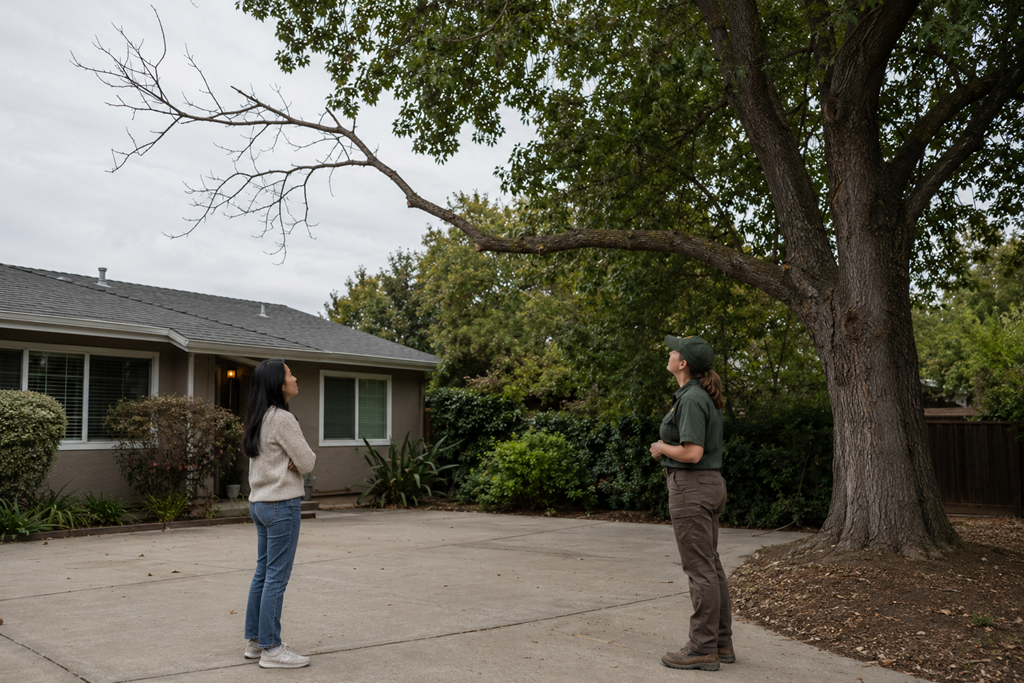
Dead branches should not be ignored because wood that is no longer living can weaken, break, and fall without the same warning signs as a healthy limb. A dead branch does not automatically mean the entire tree is failing, but it does mean the tree deserves a closer look—especially when the branch hangs over a roof, driveway, walkway, play area, or neighboring property.
In everyday life, a dead branch can be surprisingly easy to overlook. It may remain attached for months, blend into the canopy, or appear stable whenever the weather is quiet. Homeowners often notice it only after smaller pieces begin falling, leaves fail to return, or someone points out a bare section above an area the household regularly uses.
A Branch Can Look Stable After It Has Died
One reason dead branches are underestimated is that they do not always fall immediately. A branch may remain in place even after the living tissue has stopped supporting new growth.
That delay can create a false sense of security. The fact that a branch survived the last windy day does not confirm that it remains securely attached. Dead wood may become more brittle as it dries and deteriorates, while movement at the connection point can gradually weaken what is holding it to the tree.
This does not mean every bare branch is about to fall. It means appearance alone may not provide enough information to judge its condition safely from the ground.
The Area Beneath the Branch Matters
The practical concern is not only whether a branch is dead. Its size, height, attachment, and location all influence how the situation should be viewed.
A small dead branch over an unused corner of a large yard presents a different concern from a heavy limb extending over:
- A driveway or parked vehicle
- A frequently used entrance
- A patio, play area, or pool deck
- A roof or utility connection
- A sidewalk or neighboring property
This is why two homeowners with similar-looking dead branches may receive different recommendations. The potential path of the branch matters alongside the condition of the tree.
For Sacramento-area homeowners, periods of heat and dry conditions may be followed by wind or seasonal rain that changes how branches move and carry weight. Weather does not determine whether a branch is safe, but it can expose a weakness that was already present.
Deadwood Does Not Automatically Mean the Tree Is Dying
Finding one dead branch can make a homeowner wonder whether the entire tree needs to be removed. That conclusion is often premature.
Trees can develop isolated deadwood for several reasons. A branch may have been shaded out, damaged in the past, affected by stress, or weakened at its attachment. In some cases, removing selected deadwood may be the main issue worth discussing.
A different picture may emerge when dead branches appear throughout the canopy, when a large section stops producing growth, or when other changes are visible around the trunk or root area. Those patterns may justify a broader evaluation of the tree rather than treating the branch as an isolated problem.
A qualified tree professional should be able to explain whether the visible deadwood appears limited to one branch or may be part of a larger concern. The recommendation should follow the condition that is observed, not begin with an assumption that the whole tree must come down.
Small Falling Pieces Can Be an Early Clue
Homeowners sometimes become accustomed to picking up dry twigs beneath a mature tree. Occasional natural shedding can occur, but repeated pieces from the same area deserve attention—particularly when the fragments are larger than ordinary twigs or appear freshly broken.
A branch does not have to fall in one piece. Smaller sections may detach first as the wood deteriorates. This can be a useful clue that a branch overhead is changing, even when the main limb still looks secure from below.
The safest response is not to stand under the branch and pull on it, strike it, climb toward it, or test it from a ladder. Photographing the tree from a safe location and noting where pieces have landed can give a tree professional useful context without requiring the homeowner to approach the branch.
Waiting Can Make the Situation Harder to Evaluate
Not every dead branch requires an emergency response. However, postponing the issue indefinitely can remove the opportunity to evaluate it under controlled conditions.
A branch that falls on its own may damage nearby property, scatter debris, or leave a rough break that changes the work required. It may also become harder to determine whether the branch failed because of isolated deadwood or because another condition is affecting the tree.
Planning an evaluation before the branch creates an immediate obstruction can also make the service decision less pressured. The homeowner has more room to ask questions, compare recommendations, understand access needs, and review what the estimate includes.
What a Tree Professional Should Help You Understand
A useful evaluation should produce more than a statement that a branch is dead. The professional should help you understand what was observed and why a particular response is being recommended.
That discussion may cover:
- Whether the branch is dead, damaged, dormant, or showing limited growth
- How securely it appears to be attached
- What areas or structures are beneath its possible path
- Whether other dead or weakened branches are visible
- Whether the concern appears isolated or connected to a broader tree condition
- What equipment and property access the work would require
- How surrounding landscaping, fences, roofs, or utility areas will be protected
- Whether removal, cleanup, and hauling are included in the estimate
The explanation should be understandable without relying entirely on technical terminology. When a recommendation involves more than removing the visible branch, the provider should be able to explain what additional evidence led to that conclusion.
Questions Worth Asking Before Approving the Work
A few focused questions can make it easier to compare tree service recommendations:
- What indicates that this branch is dead rather than temporarily bare?
- Does the concern appear limited to this branch?
- What could the branch strike if it breaks?
- Are there other branches that should be evaluated during the same visit?
- Does the estimate identify the specific pruning or removal work being proposed?
- Are property protection, debris removal, and final cleanup included?
These questions are not intended to replace professional judgment. They help the homeowner understand the scope of the recommendation and determine whether the estimate addresses the actual concern.
Avoid Assuming That More Cutting Is Always Better
Once deadwood is noticed, it can be tempting to request extensive trimming throughout the canopy. More pruning is not automatically more protective.
Tree work should be based on the condition and structure of the individual tree. Removing unnecessary live branches can change how the canopy is balanced and may create other concerns. A responsible recommendation should distinguish between clearly dead material, damaged branches, and healthy growth.
The opposite assumption can also be misleading. Leaving a dead branch untouched simply because the rest of the tree looks healthy overlooks the location and condition of that specific limb.
The most useful decision usually falls between those extremes: evaluate the branch, understand what is beneath it, and approve only the work that can be clearly explained.
A Visible Dead Branch Is Information Worth Using
A dead branch is not proof that a tree is beyond saving, and it does not automatically call for the most extensive service. It is a visible sign that one part of the tree may no longer have the strength or flexibility it once had.
Sacramento-area property owners can use that sign as an opportunity to make a measured decision before the situation becomes more difficult. A qualified tree professional should help identify whether the concern is isolated, explain what could be affected if the branch fails, and provide a clearly defined recommendation.
The goal is not to react to every bare limb with alarm. It is to avoid mistaking a branch that has remained attached for a branch that has been shown to be safe.