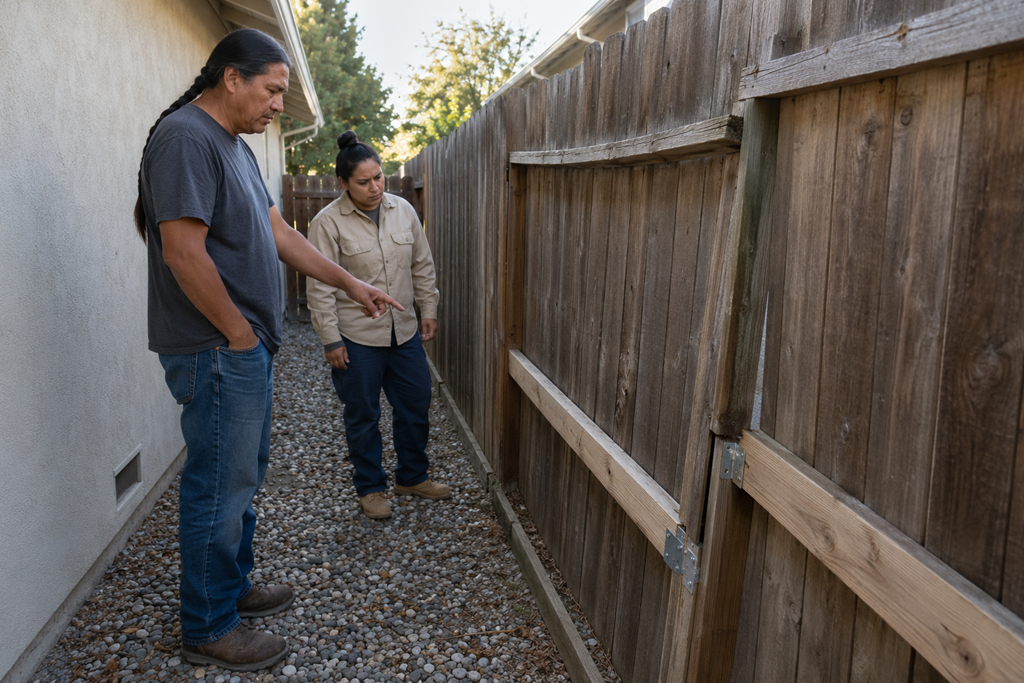
Fence posts matter because they carry and stabilize nearly every visible part of a fence. Boards and panels may attract attention first, but a fence can look worn yet remain functional when its posts are sound—and look fairly intact while becoming unstable when posts begin to loosen, rot, shift, or lose their footing. For Sacramento-area homeowners, understanding the posts often explains whether a problem is cosmetic, localized, or part of a larger structural issue.
When people notice fence damage, they often focus on what is easiest to see: faded boards, missing pickets, peeling paint, or a panel that appears slightly crooked. Those details matter, but they do not always reveal what is happening underneath the surface.
The more important question is often whether the posts are still holding the fence securely in place.
The Post Is the Fence’s Main Support Point
A typical fence is made up of posts, horizontal rails, boards or panels, and hardware. The posts are the parts anchored into the ground. They support the rails, and the rails support the visible boards or panels.
That means a post does more than hold up one narrow section of wood. It helps control the position and stability of everything connected to it.
When one post begins to lean, loosen, or deteriorate, the movement may affect multiple sections. A homeowner may see three connected panels gradually tilting in the same direction even though most of the individual boards are still intact.
This is why replacing a few damaged boards may improve the fence’s appearance without correcting the underlying problem.
Surface Wear and Structural Movement Are Different Problems
A weathered fence is not automatically an unstable fence.
Wood can fade, develop minor cracks, or lose its original finish after years of sun and weather exposure. Those changes may be mostly cosmetic when the posts, rails, and connections remain solid and properly aligned.
Structural movement tends to create a different pattern. Instead of one isolated board looking worn, larger sections may begin to shift together.
Possible signs that the posts deserve closer attention include:
- Several adjoining panels leaning at a similar angle
- A gate that drags, swings unevenly, or no longer meets the latch correctly
- Visible separation where a rail connects to a post
- A post that appears damaged or deteriorated near ground level
- A fence section that keeps moving out of alignment after minor repairs
- A noticeable gap forming around the base of a post
These observations do not confirm the exact cause. They simply help distinguish ordinary surface aging from a support problem that may need professional evaluation.
A Single Post Can Affect More Than One Panel
Fence movement is not always spread evenly along the entire property line.
One weak post may cause the panels on either side of it to lean, pull apart, or place extra stress on nearby connections. If the affected post supports a gate, it may also carry repeated movement and additional weight each time the gate is opened.
This can make the visible problem appear larger than the actual repair area.
For example, two panels may look crooked because the post between them has shifted. In that situation, the panels themselves may still be usable once the support issue is addressed. In another case, the panels, rails, and posts may all be deteriorated enough that a broader replacement discussion makes more sense.
The important point is that the number of crooked boards does not always tell a homeowner how much of the fence needs attention.
The Ground Around a Post Matters Too
Fence posts rely on the surrounding ground and footing for support. Changes near the base of a post can influence how well it remains aligned.
Sacramento-area properties may experience long dry periods, strong sun exposure, irrigation around planting beds, and periods of seasonal rain. These conditions can affect wood, soil, drainage patterns, and the area surrounding a fence line.
A post near a regularly watered planting bed may experience different conditions than a post beside a dry paved area. Runoff, soil movement, roots, and repeated moisture near the base may also contribute to changes over time.
This does not mean every leaning post has the same cause. It means the surrounding area should be considered rather than evaluating only the boards above ground.
Gates Often Reveal Post Problems Early
A gate places different demands on a fence than a stationary panel does.
Its weight is commonly carried by a hinge post, and opening and closing it adds repeated movement. When that support post begins to shift, the gate may sag, rub against the ground, develop an uneven gap, or stop lining up with the latch.
Homeowners sometimes respond by adjusting the latch or trimming the area where the gate rubs. That may temporarily make the gate easier to use, but it does not explain why the alignment changed.
When a gate repeatedly falls out of position, the hinge post and nearby structure are worth discussing during an estimate.
Why Cosmetic Repairs Sometimes Fail to Last
A new board cannot stabilize a loose post.
Similarly, repainting, fastening a panel back into place, or adjusting a gate may not last when the underlying support continues to move. The visible improvement may disappear as the post shifts again.
This is one reason a repair that sounds simple can become frustrating. The homeowner sees the same symptom return and may assume the previous repair was performed poorly, when the real issue is that the structural cause was never included in the work.
Before approving a repair, it helps to understand whether the proposed work addresses:
- The visible damage only
- The connection between the panel and post
- The post itself
- The footing or surrounding conditions
- Several connected sections of the fence
A clear estimate should make that distinction understandable without requiring the homeowner to know construction terminology.
Post Problems Do Not Always Mean Replacing the Whole Fence
Discovering a weak post does not automatically mean every section must be removed.
When damage is limited, a fence professional may be able to focus on one or several posts while preserving usable rails and panels. The practicality of that approach can depend on the condition of the surrounding wood, how the fence was assembled, whether connected sections can be realigned, and how many other posts show similar wear.
A broader replacement conversation may be more reasonable when movement appears throughout the fence line, multiple posts are deteriorated, connections are failing in several places, or the surrounding materials are no longer suitable for reuse.
The decision should be based on the condition of the support system as a whole—not simply on whether the fence looks old.
What to Ask During a Fence Estimate
A homeowner does not need to diagnose the fence before requesting an estimate. A few focused questions can make the proposed scope easier to understand:
- Which posts appear to be causing the movement?
- Are the rails and panels still usable?
- Is the problem limited to one section or repeating along the fence line?
- What surrounding conditions may have contributed to the post shifting?
- Will the proposed work correct the support issue or only improve appearance?
- How will the gate or connected panels be realigned?
- Are there nearby sections that should be watched even if they do not need work now?
The answers should connect the visible symptoms to the recommended work. Be cautious when an estimate recommends replacing a large area without explaining which structural components have failed, or when it proposes only cosmetic work even though several panels are clearly moving together.
Look Beyond the Most Visible Board
Fence boards are what homeowners see, but posts often determine how well the fence performs.
A faded panel with solid support may still have useful life. A clean-looking panel attached to a shifting post may be part of a more important structural concern. Recognizing that difference can help Sacramento-area homeowners ask better questions, understand repair recommendations, and compare estimates based on what is supporting the fence—not only what is visible from the yard.