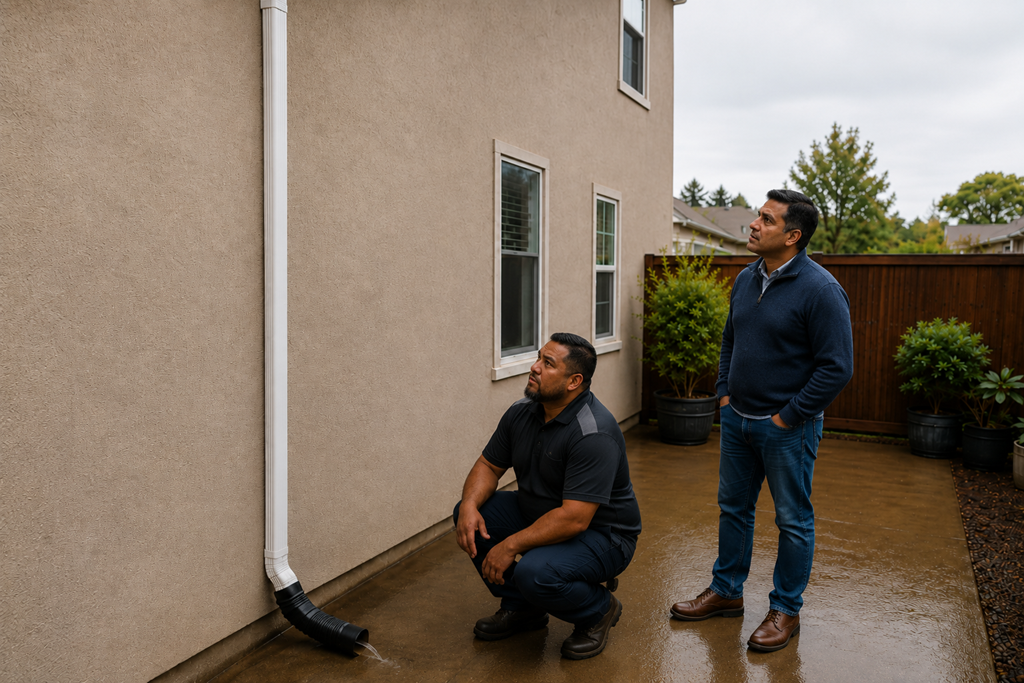
Gutter guards can reduce the amount of leaves, twigs, and other debris that enters a gutter system, but they do not eliminate the need for inspection and occasional cleaning. Fine material can collect on top of the guard, small particles may pass through, and drainage problems can still develop around roof valleys, corners, outlets, and downspouts. For Sacramento-area homeowners, the more useful expectation is reduced maintenance—not a permanently maintenance-free gutter system.
This difference is easy to misunderstand. A homeowner may see that large leaves are no longer filling the gutter and assume the entire drainage system can now be ignored. Months later, water may begin dripping over one section, staining the fascia, or collecting near a downspout even though the guards still appear to be in place.
The guard may be working as designed while the system still needs attention.
Reduced Maintenance Is Not the Same as No Maintenance
The main purpose of most gutter guards is to limit the amount and size of debris entering the gutter. When they perform well, homeowners may spend less time dealing with packed leaves and large blockages.
That benefit does not make the roof drainage system self-maintaining.
Gutter guards remain exposed to wind, dust, plant material, roof runoff, temperature changes, and seasonal rain. The gutter beneath them must still carry water toward the downspout, and the downspout must still discharge that water away from the structure.
A more realistic way to think about gutter guards is that they may change the type and frequency of maintenance required. Instead of repeatedly removing large handfuls of leaves from an open gutter, maintenance may involve checking the guard surface, clearing problem areas, and confirming that water can move through the entire system.
Debris Can Collect on Top of the Guard
Large debris may stay out of the gutter but remain on top of the protective surface.
Leaves, pine needles, seed pods, flower fragments, and small twigs can gather along roof edges or become caught where two guard sections meet. Fine mesh systems may also collect dust, pollen, and roof granules.
A small amount of dry material may not cause an immediate problem. However, debris can become heavier and more compact after rain. It may form a thin mat that slows water from passing through the guard.
This is one reason a gutter may appear protected while water begins flowing over its outer edge. The issue may not be a gutter packed with leaves. It may be a layer of material sitting above the gutter and interfering with the route water is supposed to follow.
Fine Material May Still Enter the Gutter
No guard design blocks every possible particle while allowing unrestricted water flow.
Depending on the guard style, small material may pass through openings or travel into the gutter with roof runoff. This can include dust, grit, roof granules, tiny seeds, and broken pieces of dried vegetation.
The material may settle along the bottom of the gutter rather than creating an obvious blockage. Over time, that sediment can build up around low areas, seams, corners, or downspout openings.
Because this buildup is hidden beneath the guard, it may not be noticeable from the ground. A gutter can look relatively clean from the outside while carrying less water than expected.
Roof Valleys and Corners Can Need Extra Attention
Water does not reach every section of a gutter at the same speed or volume.
A broad roof surface may send a moderate amount of water toward a long gutter run. A roof valley, inside corner, or steep section can concentrate runoff into a much smaller area. During heavier rain, that concentrated flow may move faster than the guard can accept it.
Water may then overshoot the gutter, spill over the edge, or follow the fascia instead of entering the system cleanly.
That does not always mean the entire guard system has failed. It may point to a specific location that needs evaluation, cleaning, adjustment, or a different drainage approach.
When comparing gutter guard options, Sacramento-area homeowners should ask how the proposed system is expected to perform around roof valleys, corners, and other high-flow areas—not only along straight gutter sections.
Downspouts Still Have to Remain Clear
Gutter guards sit above the gutter, but the drainage path continues below them.
Water must still reach the outlet, travel through the downspout, pass through any elbows or extensions, and discharge at the intended location. Fine debris can collect near the outlet or inside a bend even when larger leaves remain outside the gutter.
Preexisting debris can also remain in the system if the gutters and downspouts are not properly evaluated before guard installation.
A protected gutter with a restricted downspout may still overflow. The visible guard can make the source of the problem less obvious because the homeowner naturally looks at the covered gutter first.
A thorough maintenance plan should therefore address the full drainage route rather than focusing only on the guard surface.
The Property Affects How Much Attention Is Needed
There is no single maintenance schedule that fits every home.
The amount and type of attention a gutter guard needs can be influenced by:
- Nearby trees and the material they release
- Roof shape, slope, and the number of valleys
- Wind exposure around the property
- The guard design and opening size
- The condition and slope of the existing gutters
- The number and placement of downspouts
- Areas where debris naturally becomes trapped
A home beneath broad-leaf trees may create different maintenance demands than one exposed to fine needles, seed pods, or windblown dust. A simple roofline may also drain differently from a roof with several intersecting sections.
Sacramento’s long dry periods can allow light debris and dust to remain unnoticed until seasonal rain reveals a slow-draining or overflowing section. The first visible symptom may be water spilling over an edge rather than a large pile of leaves.
Maintenance May Be Smaller and More Predictable
Saying that gutter guards need maintenance does not mean they provide no value.
A well-matched and properly installed system may substantially reduce the amount of large debris that reaches the gutter. It may also make routine upkeep more manageable, depending on the property and guard design.
The key is to understand what the remaining maintenance is likely to involve.
For some homes, attention may be limited to occasional inspection and removal of material from a few collection points. Other properties may need more frequent service because of tree coverage, roof design, or concentrated runoff.
The practical question is not whether maintenance disappears. It is whether the guard system makes maintenance less frequent, less extensive, or easier to anticipate.
Watch the Water, Not Just the Leaves
One of the most useful ways to understand gutter guard performance is to focus on water movement.
A gutter system may need attention when homeowners notice:
- Water spilling over one section during rain
- Dripping behind or beneath the gutter
- Dark streaks on the fascia or siding
- Water concentrating near the foundation
- A downspout producing noticeably less flow
- Debris remaining on the guard after surrounding surfaces have cleared
- A guard section that appears lifted, separated, or out of alignment
These observations do not identify the exact cause on their own. They simply show that the drainage path may need to be evaluated.
Homeowners should avoid climbing onto roofs or working from unsafe ladders to investigate covered gutters. A qualified local professional can inspect areas that cannot be safely or clearly viewed from the ground.
Ask What Maintenance the Proposed System Requires
Before choosing a gutter guard installer or comparing estimates, ask for a direct explanation of the maintenance expectations.
Useful questions include:
- What types of debris is this guard designed to handle?
- What material may still collect on top or enter through the guard?
- How are roof valleys and high-flow areas addressed?
- Can the gutter beneath the guard be inspected and cleaned later?
- Does routine service require removing part of the system?
- Are downspouts checked before and after installation?
- What maintenance responsibilities belong to the homeowner?
- Does the warranty depend on periodic cleaning or inspection?
Clear answers are more useful than a general promise that the system will eliminate gutter cleaning forever.
A provider should be able to explain both the benefits and the limitations of the recommended design. Be cautious when maintenance questions are dismissed or when the proposed system is described as completely immune to debris and drainage problems.
A Better Expectation Leads to a Better Decision
Gutter guards are best viewed as a debris-management tool rather than a permanent substitute for gutter care.
They may keep out large leaves, reduce major buildup, and make maintenance more manageable. They do not prevent every particle from entering the system, keep every guard surface clear, or guarantee that water will move correctly through every corner and downspout.
Before hiring a Sacramento-area gutter guard professional, ask what the system is expected to reduce, what it cannot prevent, and how future inspection or cleaning will be handled. Understanding those details makes it easier to compare options based on realistic performance instead of a maintenance-free promise that no gutter system can fully deliver.