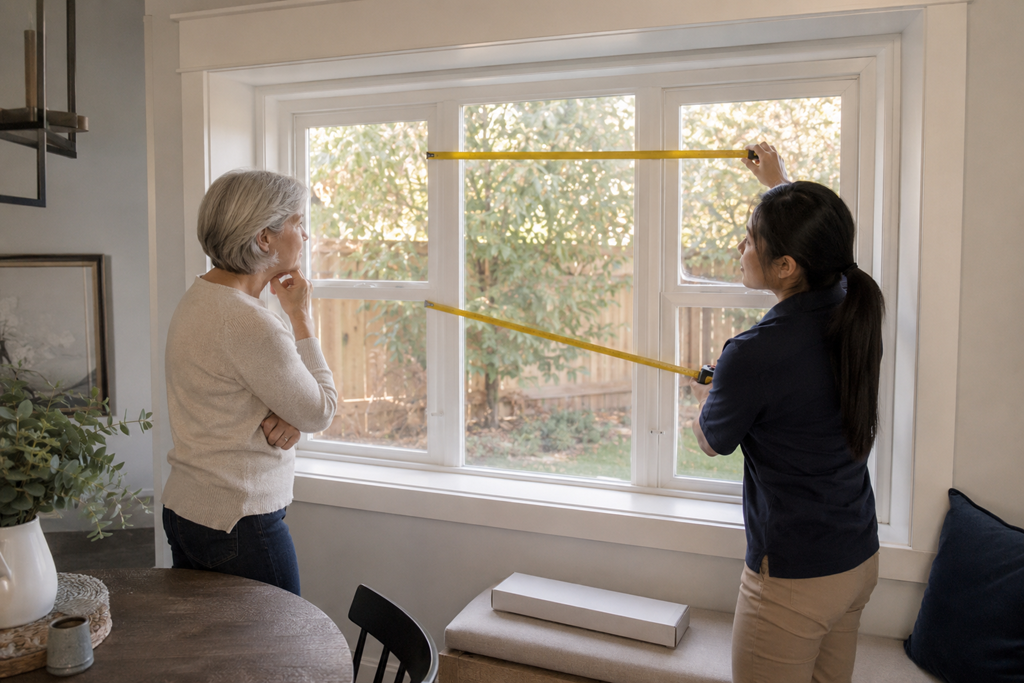
Measuring matters before window treatment installation because a shade, blind, or shutter must fit the actual opening—not the opening as it appears from across the room. A difference that seems minor on a tape measure can affect whether the treatment mounts securely, clears handles, hangs evenly, blocks light as expected, and operates without rubbing against the frame.
Window measuring can seem like one of the simplest parts of the project. The opening looks rectangular, the windows appear to be the same size, and a quick width-and-height measurement may seem sufficient. The difficulty is that window treatments are not fitted only to the visible glass. They must work with the frame, trim, mounting surface, depth, nearby hardware, and the way the window opens.
That is why careful measuring is less about producing two numbers and more about confirming how the chosen treatment will fit and function in the real space.
A Window Opening May Not Be as Uniform as It Looks
Many window openings are not perfectly square, even when the difference is difficult to see.
The width near the top may differ slightly from the width near the bottom. One side of the frame may lean inward. Decorative trim may project farther on one side, or a previous renovation may have changed the depth of the opening.
These differences do not necessarily indicate a serious problem with the window. They simply mean the treatment needs to be sized for the opening that exists rather than an assumed standard size.
This is especially important when several windows appear identical. Two openings beside each other can still have slightly different dimensions, frame depths, or mounting conditions. Ordering every treatment from a single measurement may create uneven edges, inconsistent gaps, or installation complications that become noticeable only after the products arrive.
The Treatment Must Fit More Than the Glass
One of the most useful ways to understand window measuring is to stop thinking only about the glass.
A window treatment may need to fit:
- inside the recessed opening
- across the outer trim
- above the window frame
- around handles, locks, cranks, or sensors
- near a sill, backsplash, cabinet, or adjoining wall
- within enough depth to accommodate brackets and moving components
A measurement can be numerically accurate while still leaving out one of these conditions.
For example, the width and height might appear suitable for an inside-mounted shade, but the recess may not be deep enough for the selected headrail. A window crank may project into the treatment’s path. Thick trim may affect where an outside-mounted product can sit.
The central question is not simply, “How wide is this window?” It is, “What space does this particular product need in order to be mounted and operated properly?”
Inside and Outside Mounts Create Different Measuring Decisions
The intended mounting position changes what must be evaluated.
An inside-mounted treatment sits within the window opening. This can create a clean, built-in appearance, but it depends on having enough usable width, height, depth, and mounting surface inside the frame.
An outside-mounted treatment is installed over or around the opening. It may offer more flexibility when a recess is shallow or uneven, but its placement must account for trim, wall space, coverage, nearby fixtures, and the amount of overlap needed around the opening.
Neither mounting style is automatically better. The appropriate choice depends on the window, the selected product, and what the homeowner wants the treatment to accomplish.
A Sacramento-area homeowner focused on reducing visible light gaps may make a different mounting decision than someone primarily trying to preserve decorative trim. Measuring helps reveal those tradeoffs before the product is ordered.
Small Measurement Differences Can Change Everyday Performance
The consequences of an inaccurate measurement are not always dramatic. More often, they show up as small frustrations during normal use.
A treatment may:
- scrape against one side of the frame
- hang slightly unevenly
- leave a wider light gap than expected
- interfere with a window handle
- stop short of the sill
- overlap trim awkwardly
- feel difficult to raise, lower, tilt, or slide
- require a different mounting approach during installation
These issues can be disappointing because the product itself may be well made. The problem is the relationship between the product and the opening.
Accurate measuring cannot guarantee that every preference will be achieved, but it allows the homeowner and installer to discuss likely fit, coverage, and operating conditions before committing to a product.
Product Type Changes What Needs to Be Considered
Blinds, roller shades, cellular shades, shutters, woven shades, and other treatments do not all occupy the same amount of space.
They may use different brackets, headrails, frames, control systems, or stacking areas. Some treatments sit close to the glass, while others project farther into the room. Shutters may require room for panels to swing. Sliding treatments may need clear wall space beside the opening.
This means measuring too early—before narrowing down the product and mounting style—can create false certainty.
A rough measurement can help with early planning. Final measurements, however, should reflect the actual treatment being considered. The provider should know whether the goal is an inside or outside mount, how the window operates, and whether any nearby objects could interfere with the finished installation.
Light Control and Privacy Depend on Placement
Measuring also influences how the treatment manages light and privacy.
Even a correctly manufactured shade normally has some space around its edges. The visibility of that space depends on the product, mounting method, window shape, and viewing angle.
A narrow inside-mounted shade may preserve the appearance of the trim but allow more light at the sides. A wider outside-mounted treatment may provide greater overlap, although it will cover more of the surrounding wall or trim.
The right decision depends on the room.
A small side gap may be unimportant in a bright kitchen but more noticeable in a bedroom, media room, nursery, or street-facing bathroom. Measuring helps connect the physical opening to the room’s actual privacy and light-control needs.
Common Assumptions Can Lead to Ordering Problems
Several reasonable-sounding assumptions can make measuring less reliable.
Assuming matching windows have matching dimensions
Windows that look identical should still be evaluated individually. Small differences can affect alignment when treatments are installed side by side.
Using only one width and one height
A single measurement may not reveal that the frame narrows, widens, or shifts across the opening.
Measuring before choosing the mounting approach
The correct measuring area depends on whether the treatment will sit inside the opening or extend beyond it.
Ignoring handles and surrounding objects
Locks, cranks, sills, tile, cabinets, furniture, and adjoining walls can influence placement and operation.
Treating the ordered size as the finished product size
Manufacturers may make product-specific allowances depending on the mounting style and treatment type. A homeowner should understand whether the provider wants the opening dimensions or a finished-product size before submitting measurements.
These misunderstandings are common because windows usually appear simpler than they are. Taking time to confirm the measuring method is not unnecessary caution. It is part of matching the product to the space.
When Professional Measuring May Be Worth Discussing
Some homeowners feel comfortable providing measurements for simple replacement treatments. Others prefer a window-treatment professional to measure before ordering.
Professional measuring may be especially useful when:
- the product is custom made
- several treatments need to align
- the opening appears uneven
- the window has unusual trim or limited depth
- shutters or large treatments are being considered
- the treatment must work around cranks, doors, tile, cabinetry, or other obstacles
- privacy or room-darkening expectations are important
- the cost of reordering would be significant
The purpose of professional measuring is not merely to operate a tape measure. It is to connect the dimensions with the product specifications, mounting conditions, and desired result.
Homeowners should also ask who is responsible for the measurements. A company may treat customer-provided measurements differently from measurements collected by its own representative. Understanding that responsibility before ordering can prevent confusion later.
Useful Questions to Ask Before Ordering
A few focused questions can make the measuring process easier to understand:
- Will you measure each window individually?
- Are these measurements for an inside mount or an outside mount?
- Is the opening deep enough for the treatment being considered?
- Could handles, trim, tile, or nearby furniture affect installation?
- What light gaps or overlaps should I reasonably expect?
- Who is responsible if the treatment does not fit the recorded measurements?
Clear answers should connect the dimensions to the actual product and installation plan rather than offering only general reassurance.
Measuring Creates a More Realistic Plan
Careful measuring helps turn a visual preference into a workable installation plan.
It can reveal that a different mounting position would improve coverage, that two similar-looking windows need separate sizes, or that a product requiring less depth may fit the opening more comfortably. It can also help set realistic expectations about side gaps, trim coverage, and everyday operation.
For Sacramento-area homeowners comparing window-treatment providers, the quality of the measuring conversation can be informative. A thoughtful professional should be willing to explain what is being measured, what could affect the fit, and how the selected product is expected to function in the room.
The most important takeaway is simple: window treatments are fitted to real openings, and real openings contain small variations. Measuring carefully before ordering makes it easier to choose a treatment that fits the window, supports the room’s needs, and operates as expected after installation.