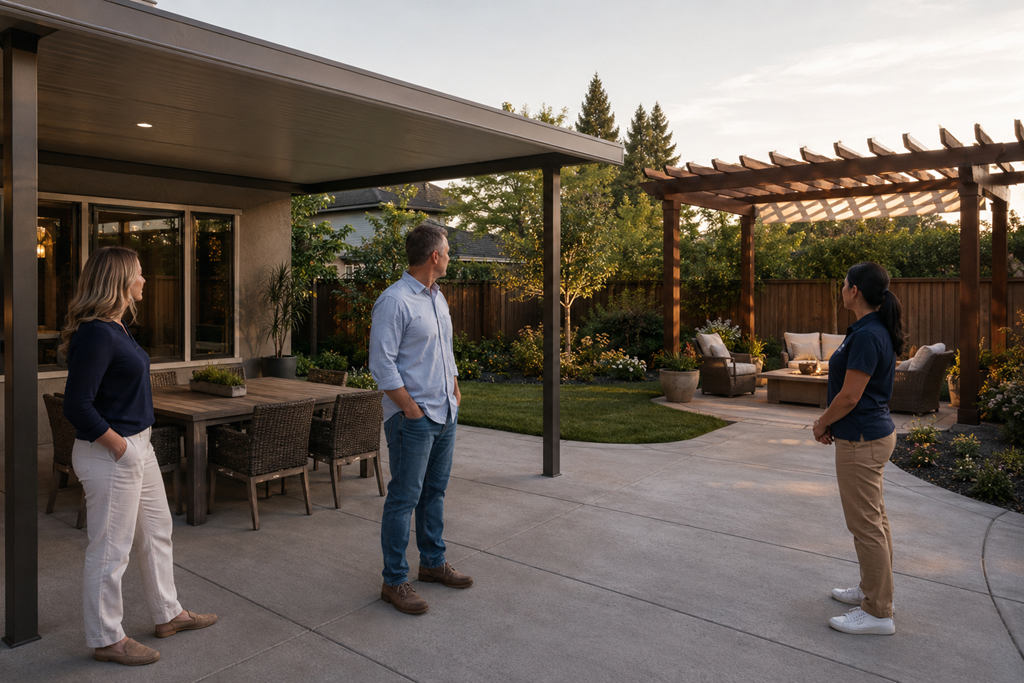
Patio covers, awnings, and pergolas can all make an outdoor space more usable, but they are not interchangeable. A patio cover is usually chosen for broader, more permanent overhead protection; an awning is often used for targeted shade near a wall, window, or doorway; and a pergola creates partial shade while preserving a more open-air feeling. The right choice depends less on which structure looks best in isolation and more on the specific problem the space needs to solve.
That distinction is easy to miss. Homeowners often begin by comparing appearance, materials, or price without first deciding what they expect the structure to accomplish. The result can be an attractive installation that provides shade in the wrong place, leaves furniture exposed, darkens the interior more than expected, or offers less rain protection than the homeowner assumed.
Similar Structures Can Create Very Different Outdoor Experiences
From a distance, patio covers, awnings, and pergolas may seem like variations of the same idea. Each places something above an outdoor area, and each can reduce at least some direct sunlight.
The experience underneath them can be very different.
A homeowner who wants a dependable outdoor dining area may value broad overhead coverage. Someone trying to reduce afternoon sun through a sliding glass door may only need a smaller projection near the house. Another homeowner may want architectural definition and filtered light around a garden seating area without making the patio feel enclosed.
Those are three separate problems, even though all three involve shade.
Understanding the difference before requesting estimates helps Sacramento-area homeowners explain what they actually need. It also makes it easier to recognize when a proposed structure does not match the intended use of the space.
Patio Covers Are Usually Chosen For Broader Coverage
A patio cover generally makes the most sense when the goal is to protect a larger, established outdoor activity area.
That could include a dining table, sectional sofa, outdoor kitchen area, children’s play space, or a combination of furniture that needs consistent overhead coverage. Depending on the design and roofing system, a patio cover may provide substantial shade and more protection from seasonal rain than an open-roof structure.
The key word is coverage.
A patio cover is often planned around the complete usable area rather than one window or doorway. This makes its size, position, roof design, posts, drainage approach, and relationship to the home especially important.
A larger structure can also affect how much natural light reaches nearby rooms. A cover that feels comfortable outdoors may cast a deeper shadow through windows or sliding doors. That does not automatically make it the wrong choice, but it is something to evaluate before the dimensions are finalized.
For homeowners who want a dependable sheltered zone rather than occasional or filtered shade, a patio cover is often the clearest structure to discuss with a qualified local professional.
Awnings Work Best When The Problem Is Concentrated
An awning is usually better suited to a specific area close to the building.
It may project above a window, exterior door, storefront entrance, or compact seating area. Some awnings are fixed, while others can be extended and retracted. Their usefulness often comes from placing shade exactly where it is needed without covering the entire patio.
For example, a Sacramento-area homeowner may be comfortable with an open backyard but struggle with direct afternoon sun entering through one sliding glass door. A properly considered awning may address that concentrated exposure without creating a large permanent roof over the rest of the yard.
Awnings can also be useful where the available outdoor space is limited or where the homeowner wants shade only at particular times.
However, a small awning should not be expected to perform like a full patio cover. It may protect the doorway while leaving the dining table exposed. It may shade the window but not block low-angle sunlight reaching underneath its outer edge.
An awning solves a narrower problem. That can be an advantage when the problem itself is narrow.
Pergolas Preserve Openness Rather Than Eliminate Exposure
A traditional pergola is often selected for its balance of structure, filtered shade, and open-air character.
Its overhead members may create shifting bands of light and shadow rather than continuous coverage. This can make a seating area feel defined without making it feel fully roofed. Pergolas are frequently used to frame garden spaces, create transitions within a yard, or add visual structure above a patio.
That openness is part of the appeal, but it also creates limitations.
A traditional open-roof pergola does not provide the same shade consistency or rain protection as a solid patio cover. Sunlight can move through the overhead openings, and furniture may remain exposed to weather.
Some products described as pergolas include adjustable louvers, fabric canopies, or solid roof components. Those features may change how the structure performs. This is why the product name alone is not enough to determine whether it will solve the homeowner’s problem.
A homeowner who wants filtered light and an outdoor-room feeling may appreciate a pergola. Someone expecting a reliably dry dining table may need a different design or additional features.
The Same Backyard Can Point To Three Different Answers
Imagine a patio with a sliding glass door, a dining table in the center, and a small garden seating area farther into the yard.
If the main concern is sunlight entering through the door, an awning may deserve consideration.
If the dining table needs broad shade and overhead shelter, a patio cover may be the more direct fit.
If the goal is to visually define the garden seating area while keeping it open to light and air, a pergola may be more appropriate.
The property has not changed. Only the problem being solved has changed.
This is why choosing a structure from photographs alone can be misleading. A design that works well for another home may have been selected for a different sun direction, furniture arrangement, activity zone, or comfort preference.
Appearance Should Follow The Intended Use
Style matters because an outdoor structure becomes part of the home’s appearance. However, appearance should not be the only factor guiding the decision.
A structure can complement the house beautifully while missing the chairs that need shade. Another may provide excellent shelter but feel heavier or darker than the homeowner expected. A third may preserve the desired openness but allow more direct sun than the family finds comfortable.
Before comparing finishes and decorative details, it helps to describe the intended result in everyday language:
Which area needs to be more comfortable?
Identify the complete activity area, not just the nearest piece of furniture. Chairs may be moved, tables may be extended, and people may gather beyond the original furniture footprint.
Is the goal shade, rain protection, or both?
These expectations should be stated directly. “Covered” can mean different things to different homeowners and providers.
Should the space remain visually open?
Some homeowners want an outdoor room with substantial overhead coverage. Others want a lighter structure that defines the space without separating it from the sky and yard.
Is the exposure limited to one part of the home?
A concentrated problem near a door or window may not require a structure covering the entire patio.
How might the structure affect indoor light?
The proposed projection and roof type may influence nearby windows and interior rooms. This is worth discussing before the final design is selected.
Product Names Do Not Always Explain Performance
One provider may use the term patio cover for a structure that another provider describes differently. A pergola may be completely open, partially covered, or equipped with adjustable components. An awning may be fixed or retractable.
Instead of relying only on category names, ask what the proposed structure will actually do.
A useful estimate or consultation should make the expected coverage understandable. The homeowner should be able to see where the roof or shade will begin and end, which activity areas will be protected, how sunlight may enter from the sides, and whether the design is intended to handle rain.
Temporary ground markers, furniture placement, photographs taken at different times of day, and a clear explanation of the intended use can make these conversations more productive without requiring the homeowner to understand technical construction details.
Choose The Problem Before Choosing The Structure
Patio covers, awnings, and pergolas are not simply competing versions of the same product. Each can be useful when it is matched to the right purpose.
A patio cover generally emphasizes broader and more dependable overhead coverage. An awning usually addresses a smaller, concentrated area near the building. A pergola often emphasizes filtered light, architectural definition, and an open-air atmosphere.
Before comparing local providers or reviewing estimates, decide what needs to change about the outdoor space. Knowing whether the priority is shelter, targeted shade, filtered light, indoor sun reduction, or visual definition gives the project a clearer starting point.
The best choice is not automatically the largest, most enclosed, or most decorative structure. It is the one whose real-world performance matches how the homeowner expects to use the space.