Pool algae keeps coming back when the visible growth is removed but the condition allowing it to grow is still present. In many Sacramento-area pools, recurring algae is less about one missed cleaning and more about an imbalance involving circulation, filtration, sanitizer effectiveness, hidden buildup, or inconsistent maintenance. The water may look better for a few days, then green patches, yellow dust, or slippery areas return because the underlying cause was never fully identified.
This cycle can be frustrating because each treatment may appear to work at first. The pool clears, the surfaces look cleaner, and normal use resumes. When the same discoloration returns, homeowners may assume they need a stronger product or another round of cleaning. In reality, the pattern often deserves a closer look before repeating the same response.
Clear Water Does Not Always Mean the Pool Is Stable
A pool can look clear while conditions still favor algae growth.
Visible algae may have been brushed away or temporarily suppressed, but small amounts can remain in shaded corners, narrow seams, steps, ladders, cleaner components, or other areas that receive less circulation. If the water balance, filtration, or sanitizer effectiveness has not been corrected, the remaining growth can become visible again.
This is why a pool that turns blue after treatment is not necessarily a pool whose underlying problem has been resolved. Appearance is one useful sign, but it is not the entire diagnosis.
A qualified pool-service provider should be able to explain what may be causing the repeated growth, not simply point out that algae is present.
Recurring Algae Often Points to a System Problem
Algae does not need every part of a pool to be neglected. One weak area may be enough to keep the cycle going.
Water may not be circulating evenly
Pool water does not always move through every corner at the same rate. Steps, benches, ladders, attached spas, unusual pool shapes, and shaded edges can create areas where circulation is weaker.
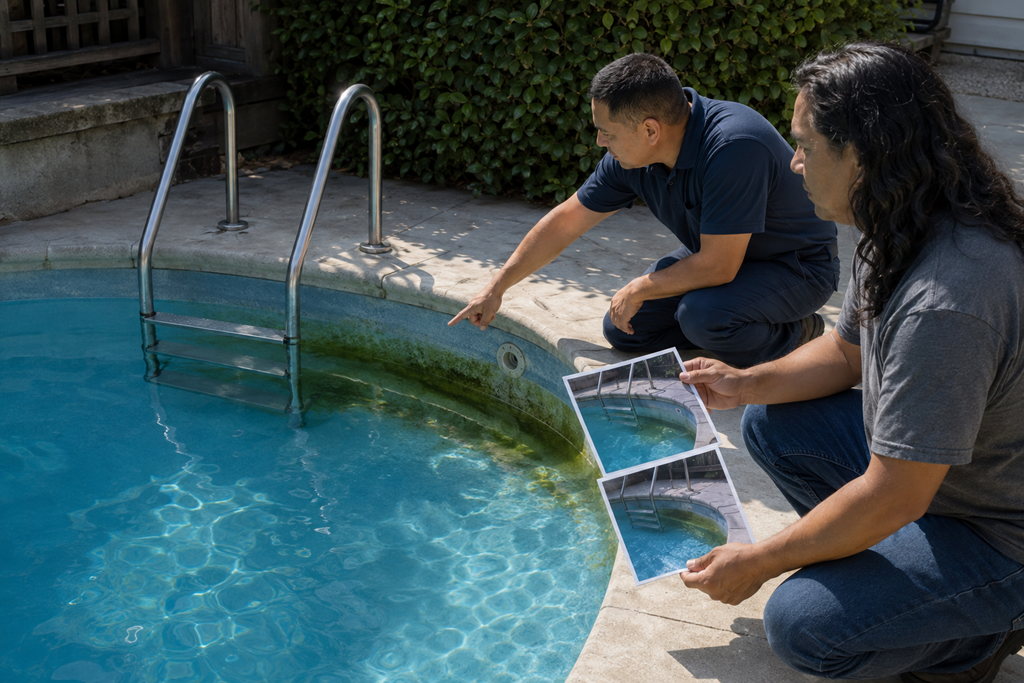
When algae repeatedly appears in the same location, that pattern may be more meaningful than the total amount of growth. A clean center with a recurring green or yellow patch in one corner may suggest that water movement should be evaluated rather than assuming the entire pool needs the same treatment again.
The filtration system may be running without filtering effectively
Hearing the equipment operate does not confirm that the water is being filtered as well as it should be.
A filter may need maintenance, may be operating under conditions that reduce its effectiveness, or may not be running long enough for the pool’s current demands. Debris, fine particles, and remaining algae can continue circulating when filtration is not keeping up.
The useful question is not only, “Is the filter running?” It is also, “Is the entire filtration system performing effectively for this pool?”
Sanitizer can be present without working effectively enough
A basic water test may show that sanitizer is present, but that number alone does not explain how effectively it is controlling algae.
Water balance, stabilizer conditions, organic debris, heavy pool use, strong sun, and other factors can affect sanitizer demand and performance. Sacramento’s heat and extended sun exposure can make a small maintenance issue become visible more quickly, but local weather alone does not explain why the algae repeatedly returns.
A provider should look at how the different water conditions relate to one another rather than relying on one isolated reading.
Hidden surfaces can preserve the problem
Algae may remain in places that are easy to overlook during routine cleaning. Common examples include:
- Behind ladders and removable steps
- Along narrow tile or plaster seams
- Under coping edges
- Inside cleaner parts or vacuum equipment
- On brushes, nets, toys, floats, and other pool accessories
- In shaded features or areas with limited water movement
The main pool surface may look clean while one overlooked area continues contributing to the recurrence.
This does not necessarily mean the pool has been poorly maintained. It means the source may be less obvious than the visible patch that keeps getting cleaned.
The Way the Algae Returns Can Provide Useful Clues
Recurring algae is easier to understand when the pattern is considered, not just the color.
Algae that returns in the same shaded corner may point toward circulation or an overlooked surface. Growth that appears throughout the pool shortly after treatment may raise questions about water balance, filtration, or whether the initial treatment fully addressed the problem.
The timing can also matter. A pool that struggles after heavy use, equipment interruptions, windblown debris, or long periods of heat may be experiencing increased demand that its usual maintenance routine is not meeting.
Homeowners do not need to diagnose these patterns themselves. However, noticing where and when the algae returns can help a local provider evaluate the issue more thoughtfully.
Photographs taken when the growth is visible can be especially useful because the pool may look different by the time a service appointment occurs.
Repeating the Same Treatment May Only Reset the Cycle
Brushing, filtering, and treating the water are common parts of addressing algae, but repeating those actions without identifying the cause may produce only temporary improvement.
Adding stronger or additional products is not automatically the answer. Repeated chemical treatments can increase costs, complicate water balance, and make it harder for a homeowner to understand what is actually changing.
The more useful goal is to determine why the pool keeps returning to algae-friendly conditions.
That may require looking at several connected factors:
- Where the growth begins
- Whether circulation reaches that location
- How effectively the filter is operating
- Whether water conditions support effective sanitation
- Whether accessories or hidden surfaces were overlooked
- Whether the maintenance schedule matches the pool’s actual demands
A good explanation should connect the visible problem to the likely contributing conditions.
What to Ask Before Scheduling Another Algae Treatment
When comparing Sacramento-area pool-service providers, consider asking a few focused questions:
- What do you believe is allowing the algae to return?
- Will you evaluate circulation and filtration as well as the water?
- Does the location of the algae suggest a particular problem?
- Are there hidden surfaces or pool accessories that should be inspected?
- How will we know whether the underlying condition has improved?
- What follow-up should be expected if the algae returns again?
These questions are not about challenging the provider’s expertise. They help establish whether the proposed service addresses the recurring pattern or only the visible growth.
A provider may not know the exact cause before inspecting the pool, but the explanation should become more specific after evaluating the water, surfaces, circulation, and equipment.
Be Cautious of Explanations That Remain Vague
“Pools get algae” may be true in a broad sense, but it does not explain why one pool keeps experiencing the same problem.
An explanation may deserve more scrutiny when a provider repeatedly recommends another treatment without discussing where the algae returns, how the equipment is performing, or whether the water conditions have changed.
Other signs of unclear communication may include:
- Recommending products without explaining their purpose
- Treating every algae recurrence as an identical problem
- Focusing only on the pool’s appearance
- Avoiding questions about circulation or filtration
- Promising that one treatment will permanently prevent algae
- Offering no way to evaluate whether the service corrected the cause
No provider can guarantee that an outdoor pool will never develop algae again. The more reasonable expectation is that the provider can explain the likely contributors, address the current problem, and help reduce the conditions that encourage it to return.
The Better Goal Is More Than Making the Water Blue Again
When pool algae keeps returning, the visible growth is often the symptom rather than the full problem.
Instead of immediately repeating the last treatment, look for an explanation that considers the entire pattern: where the algae appears, how quickly it returns, whether the water is circulating evenly, how well the filter is performing, and whether hidden surfaces have been addressed.
For Sacramento-area homeowners, understanding that distinction can make conversations with local pool-service providers more productive. The goal is not simply another temporary cleanup. It is a clearer understanding of what keeps recreating the problem and whether the proposed service is designed to address it.