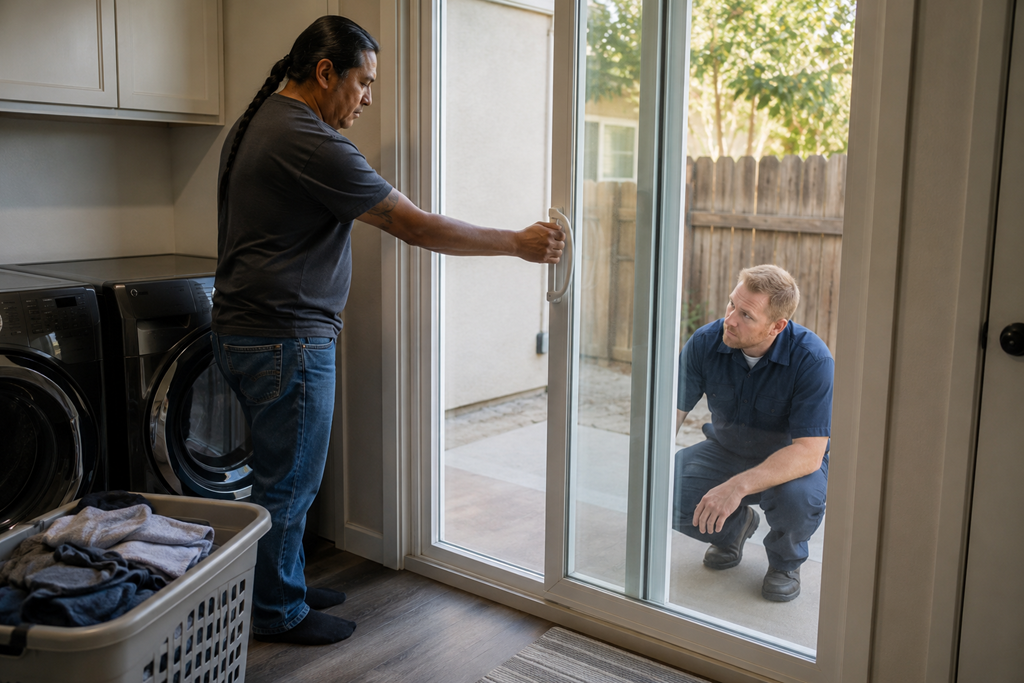
Sliding door rollers have a direct effect on how easily the door moves, how evenly it stays in the track, and how much effort daily use requires. When rollers wear, flatten, loosen, or stop turning smoothly, a door that once moved with one hand may begin to drag, hesitate, wobble, or require extra force even when the track looks clean.
Because the rollers are mostly hidden beneath the door panel, homeowners often focus first on the visible track. Cleaning the track may help when dirt is causing resistance, but recurring difficulty can point to a problem with the parts carrying the weight of the door.
The Rollers Carry More Than Most People Realize
A sliding glass door panel can be large and heavy. The rollers beneath it allow that weight to travel along the lower track instead of scraping across it.
When the rollers are in suitable condition and properly aligned, the panel should move in a controlled and reasonably consistent way. It should not feel as though one section glides while another section drags.
Roller wear can change that experience gradually. The door may become slightly harder to open at first, making the change easy to dismiss. Over time, household members may begin using two hands, pulling harder on the handle, or developing a habit of lifting slightly while sliding the panel.
Those adaptations can make the door seem usable even though its movement has changed.
Daily Resistance Is Often the First Noticeable Sign
Roller problems do not always begin with a door that refuses to move. More commonly, the door becomes inconvenient during ordinary routines.
A homeowner may notice resistance while stepping onto the patio, letting a pet outside, carrying groceries through the doorway, or opening the door for ventilation. The panel may start smoothly and then become harder to move halfway across the opening. It may also hesitate near the same section each time.
Other changes can include:
- A scraping or grinding sound near the lower edge
- Movement that feels rough instead of continuous
- A panel that rocks or wobbles slightly
- A handle that requires more pulling force
- A door that becomes easier or harder depending on where it sits
- A latch that no longer lines up as naturally as it once did
These symptoms do not prove that the rollers are the only problem. They do, however, provide useful details when describing the issue to a sliding door professional.
A Clean Track Does Not Rule Out Roller Wear
One of the most common misunderstandings is assuming that a difficult door must have a dirty track.
Leaves, pet hair, dust, and small debris can certainly interfere with movement. Sacramento-area homes with frequently used patios may collect material near the threshold, especially when the door is opened throughout dry or windy conditions.
However, a visibly clean track does not confirm that the rollers beneath the panel are working correctly. A worn roller may not rotate freely, may sit unevenly, or may no longer support the panel at its intended height.
This explains why some doors remain difficult to move shortly after the track has been cleaned. The visible surface may be clear while the weight-carrying components remain worn or misaligned.
Extra Force Can Affect More Than Convenience
Pulling harder may keep a difficult door moving temporarily, but it does not address the reason the movement changed.
Repeated force can place additional strain on the handle, latch, frame, and lower track. It may also make everyday use less predictable. A door that suddenly releases after resisting can move faster than expected, while a panel that catches abruptly can interrupt someone carrying items through the opening.
Uneven roller support may also affect how the panel sits inside the frame. A slight change in height or angle can contribute to an uneven gap, imperfect latch alignment, or inconsistent contact with the weather seal.
That does not mean every difficult door is creating serious damage. It means the amount of force required is useful information rather than merely an annoyance to work around.
Roller Problems Can Resemble Other Sliding Door Issues
A heavy or uneven door does not automatically mean the rollers need to be replaced.
Similar symptoms can result from debris, track damage, adjustment problems, frame movement, a panel that is no longer square within the opening, or hardware that interferes with normal travel. More than one condition may also be present.
This is why describing the pattern can be more helpful than diagnosing the part yourself. A professional may want to know whether the resistance is constant, whether it occurs at one location, whether the panel appears uneven, and whether the latch has also become harder to use.
The goal of an evaluation should be to identify what is changing the movement before recommending repair work.
The Pattern of Movement Can Help Explain the Problem
A door that feels heavy from beginning to end presents a different pattern from one that catches only at a certain point.
Consistent resistance may suggest that the panel is not rolling freely throughout its travel. Resistance at one location may also involve a damaged area of track, a change in alignment, or a roller reacting differently as the panel moves.
Sounds can provide additional context. Grinding, scraping, clicking, and rumbling describe different experiences, even though they may all be casually described as a noisy door.
Homeowners do not need to identify the mechanical cause. Simply noticing where the problem occurs and how the door behaves can make the service conversation more productive.
What a Roller Evaluation Should Clarify
Before agreeing to repair work, it is reasonable to ask what the professional believes is causing the resistance and how that conclusion was reached.
A useful evaluation should help clarify whether the rollers are worn, damaged, obstructed, or out of adjustment. It should also address whether the track or surrounding frame is contributing to the problem.
Questions that may help include:
- Are the rollers the main cause of the difficult movement?
- Is the lower track also damaged or unusually worn?
- Is the panel sitting evenly within the frame?
- Will the proposed work address the latch or alignment issue as well?
- Does the estimate cover adjustment, replacement parts, and testing afterward?
Clear answers can make it easier to compare recommendations from Sacramento-area sliding door professionals without focusing only on the quoted price.
Why Professional Handling May Be Appropriate
Accessing sliding door rollers commonly involves handling or removing a large glass panel. Even when the repair itself sounds straightforward, the panel’s size, weight, and tempered glass construction can make improper handling unsafe.
A qualified professional can evaluate the movement, panel position, track condition, and related hardware without relying on force or guesswork. The evaluation can also help distinguish between a focused roller repair and a broader problem involving the track, frame, or door assembly.
Homeowners can prepare by explaining when the problem began, whether it has changed over time, and what they have observed during normal use. Photos or a short description of the uneven movement may also help when requesting an estimate.
Smooth Movement Is Part of the Door’s Everyday Function
Sliding door rollers may be small and mostly hidden, but they influence nearly every use of the door. They help carry the panel, guide its movement, maintain its position, and reduce the effort needed to open or close it.
When a door begins requiring more force, the change is worth treating as information rather than simply adjusting to it. Understanding how the rollers affect movement can help Sacramento-area homeowners describe the problem more accurately, ask better questions, and evaluate whether professional repair is appropriate.