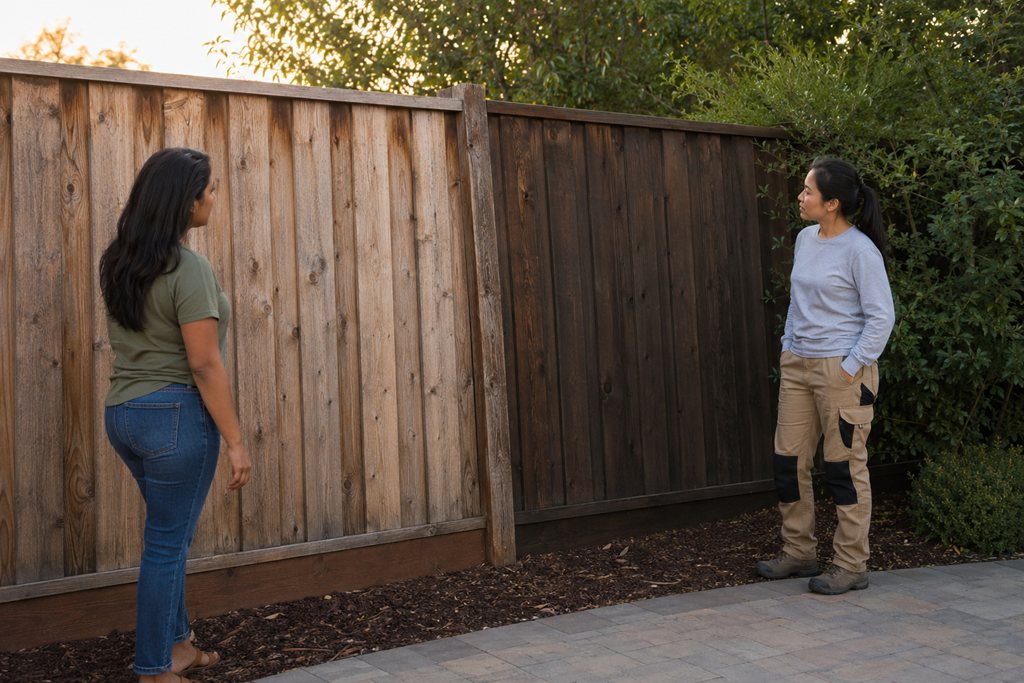
Fence stability is rarely affected by just one thing. Heat and sun can dry exposed wood, rain can soften or shift soil around posts, and repeated pressure from gates, pets, children, yard equipment, or climbing plants can gradually loosen connections. A fence that once looked straight may begin to lean, rack, or move even when no single board appears badly damaged.
For Sacramento-area homeowners, this can be confusing. One section may look weathered but remain solid, while a newer-looking section begins moving. A gate may drag only during certain parts of the year. A gap may reopen after a board or fastener was recently replaced.
These changes often make more sense when the entire fence system is considered instead of focusing on the most visible defect.
A Fence Can Move Before It Looks Seriously Damaged
Fence problems do not always begin with a broken board or a post that is obviously falling over. Early changes may be much less noticeable.
A gate may need a little more pressure to close. The top edge of several panels may no longer form a straight line. A rail connection may open slightly after being refastened. One post may move when the gate is used, even though the surrounding boards still look intact.
This is why appearance alone does not always reveal how stable a fence is. Boards, rails, posts, fasteners, gates, and the soil around the posts all influence one another.
A fence can look acceptable from a distance while movement is gradually developing underneath or between those visible parts.
Sun, Heat, And Rain Affect Different Parts Of The Fence
Weather affects more than the color of fence boards.
Long periods of sun and dry heat can cause exposed wood to dry, shrink, twist, or develop small gaps around connections. Shaded sections may retain moisture longer and age differently from sections receiving direct afternoon sun.
Rain can temporarily increase the moisture in wood and soil. When the surrounding ground becomes softer, a post that was already slightly loose may move more easily. As conditions dry again, the soil may not settle around the post exactly as it did before.
These changes do not automatically mean the fence needs replacement. They do mean that a fence may behave differently during dry weather than it does after rain or irrigation.
A useful evaluation considers whether the visible change is limited to the boards or whether the post and surrounding ground are also moving.
Soil Conditions Can Affect More Than One Panel
Fence posts depend on the ground around them for support. When that support changes, the effects may travel beyond a single post.
Dry soil may contract or pull away from a post. Wet soil may soften, settle, or remain damp longer in one part of the yard than another. Irrigation, downspouts, drainage patterns, nearby planting beds, and differences in grade can cause one section of a fence line to experience different conditions from the rest.
If one post begins shifting, the connected rails may place additional pressure on neighboring posts. Several panels can then develop a repeating lean even though only one area first began moving.
This is one reason replacing a visibly damaged board may not solve a stability problem. The board may be showing the effect of movement rather than causing it.
Gates Create Repeated Pressure In The Same Area
A gate places different demands on a fence than a stationary panel.
Each opening and closing motion transfers force through the hinges, gate post, latch post, and connected fence sections. A heavy gate, frequent use, uneven ground, or repeated slamming can gradually affect alignment.
Daily habits can add other small loads. Trash bins may repeatedly bump the same panel. Yard equipment may be stored against the fence. Pets may push against a familiar section. Climbing plants may add weight and hold moisture against boards and rails.
None of these activities necessarily causes an immediate failure. The concern is repetition. A small amount of pressure applied in the same place over months or years can become more important when the wood, fasteners, post, or soil is already changing.
The Pattern Often Reveals More Than The Worst-Looking Board
When deciding whether to discuss a repair, it helps to notice the pattern of movement rather than only the most damaged-looking piece.
An isolated cracked or loose board may point to a limited repair. A gap that repeatedly opens where a rail meets a post may suggest that the connection is being pulled apart by movement elsewhere.
Several panels leaning in the same direction may indicate that the issue extends along the fence line. A gate that repeatedly falls out of alignment may point toward movement in a gate post, neighboring post, or surrounding soil.
It can also be useful to notice when the change appears. Does the gate drag more after rain? Does the panel move when the gate swings? Is the affected section beside an irrigated planting bed while the remaining fence borders dry soil?
These observations give a fence professional more useful context than simply saying that the fence is old or leaning.
A Recent Repair Can Reopen When The Cause Remains
Homeowners are often surprised when a newer board, screw, or rail connection becomes loose again.
This does not always mean the recent repair was performed poorly. A new fastener may be holding soundly while the older post continues to lean. A replaced board may fit correctly at first but develop another gap as connected sections keep moving.
The visible repair and the underlying stability issue may be two separate problems.
Before approving another limited repair, it is reasonable to ask whether the proposed work addresses the part that is moving or only the part where the movement is showing up.
A qualified fence professional should be able to explain which boards, rails, posts, gates, or ground conditions appear to be contributing to the problem and whether the issue seems isolated or connected to a larger section.
Helpful Questions To Ask During A Fence Evaluation
A fence evaluation should leave you with a clearer understanding of what is moving and why the proposed work may help.
Useful questions may include:
- Does the problem appear limited to the boards and rails, or are the posts moving?
- Is one post affecting the neighboring panels?
- Could gate use, irrigation, drainage, roots, or soil conditions be contributing?
- Would the proposed repair address the source of the movement or mainly improve its appearance?
- Are there other sections showing the same pattern?
- What changes should I watch for after the work is completed?
Clear answers do not require complicated technical language. The provider should be able to connect the recommended repair to the condition you can actually see.
Be cautious when an explanation focuses only on replacing visible boards without addressing an obviously leaning post, recurring gap, dragging gate, or repeated movement along the fence line.
Look At The Fence As A Connected System
Weather, soil, and daily use rarely affect a fence in isolation. Sun may dry the boards while irrigation keeps the soil around one post damp. A frequently used gate may place repeated pressure on a post that is already losing support. A repaired rail may separate again because the connected panel continues to move.
Understanding these relationships can help Sacramento-area homeowners have a more productive conversation before comparing estimates or scheduling work.
The most useful question is not simply, “Which board looks damaged?” It is, “Which part of the fence is moving, and what is causing that movement?”
That distinction can make it easier to determine whether a limited repair is likely to hold or whether a broader section deserves professional evaluation.