Adding a security door is not simply a matter of choosing the strongest-looking model. The right door should fit the existing entry, support the way your household uses the doorway, and provide the level of visibility, ventilation, privacy, and access control you actually want. Before comparing products or estimates, Sacramento-area homeowners should think through those everyday needs and ask how the door, frame, hardware, and installation will work together.
Many homeowners begin shopping with a simple idea: add a metal door outside the main entry for greater protection. Once they start comparing options, however, they may encounter different screen materials, grille patterns, lock configurations, frame requirements, finishes, swing directions, and installation methods.
The decision becomes easier when you stop treating the security door as a separate product and start viewing it as part of the entire entryway.
Start With What You Want the Door to Change
“Security door” can describe several types of exterior doors, and homeowners do not always expect the same benefits from them.
One person may want to open the main door for airflow while keeping an exterior barrier closed. Another may care more about privacy, insect protection, visibility from inside the home, or a stronger-feeling front entrance. Some homeowners mainly want an entry that looks more substantial and coordinates with the home’s exterior.
These goals can overlap, but they are not identical.
A door with an open grille may allow considerable airflow while providing less visual privacy. A denser screen or perforated panel may reduce outside visibility but also affect light and the view from inside. Decorative features may improve appearance without addressing the specific concern that prompted the project.
Before looking at styles, define the practical change you expect to notice after installation. That expectation gives you a better basis for comparing products and discussing options with a local professional.
A Strong Door Still Depends on the Existing Opening
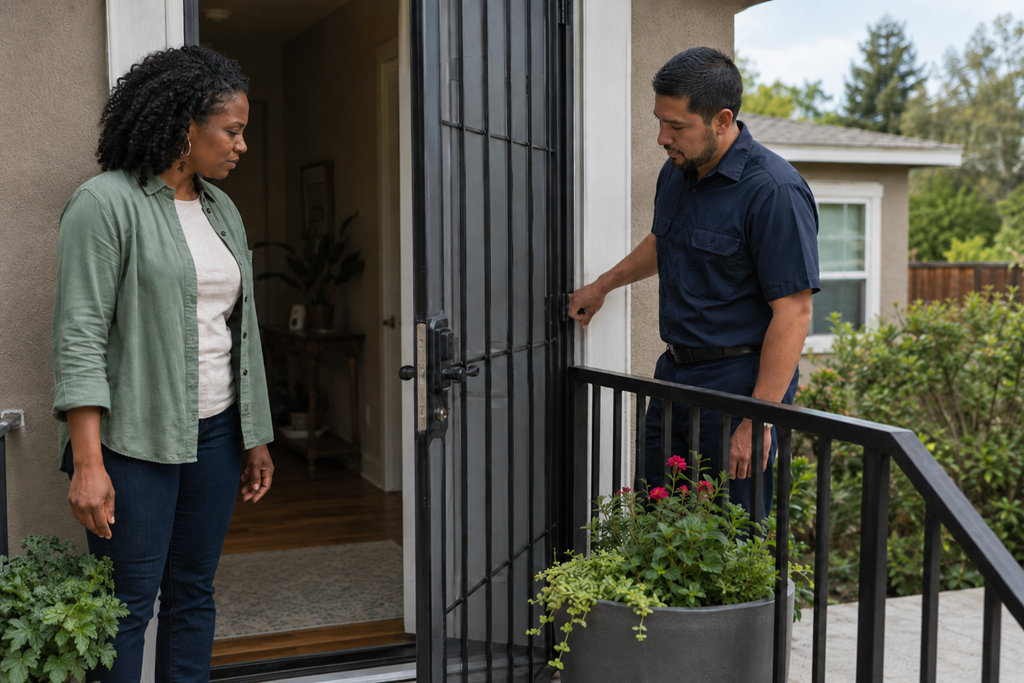
A security door does not perform independently of the doorway around it. The condition, dimensions, shape, and layout of the existing entry can influence what can be installed and how the finished door will operate.
The installer may need to consider:
- The condition of the existing frame and surrounding material
- Whether the opening is square and reasonably even
- The location of trim, siding, masonry, or decorative features
- The threshold and exterior floor surface
- Available space for the door to swing
- Nearby railings, walls, columns, steps, lights, or doorbells
- How the security door will interact with the existing front door
This is especially relevant for older homes or entries that have been altered over time. A door that appears suitable in a catalog may require a different frame configuration, additional preparation, or another product once the opening is evaluated in person.
That does not automatically mean the project is complicated. It means the estimate should be based on the actual entry rather than the appearance of the door alone.
Security, Airflow, Visibility, and Privacy Involve Tradeoffs
One of the easiest misunderstandings is assuming that every security door provides the same combination of protection, ventilation, privacy, and visibility.
The material covering the opening can make a major difference. Widely spaced decorative bars, expanded metal, woven mesh, perforated metal, and more solid panels each create a different experience.
Consider what the doorway will feel like from both directions.
From inside the home, will you be able to see who is approaching? From the exterior, how much of the entry or interior will be visible? Will the door allow the amount of airflow you expect? How much natural light will it block when the main door is open?
Privacy can also change with lighting. A material that limits views during bright daylight may behave differently when the interior is illuminated after dark. Ask to see realistic examples or samples instead of judging privacy from a small photograph.
The most appropriate choice is not necessarily the most open or the most enclosed. It is the one that produces the balance your household actually wants.
Think About How the Entry Works During an Ordinary Day
A security door may look appropriate when it is closed, but daily use often reveals whether the design truly fits the household.
Picture routine moments such as:
- Entering with groceries or packages
- Unlocking both doors in the evening
- Letting a pet into the yard
- Supervising children near the entrance
- Speaking with someone while maintaining a closed barrier
- Moving furniture or larger items through the doorway
- Holding the door while another person enters
- Using the entry during rain, strong sun, or Sacramento’s hotter periods
Handle placement, swing direction, closing speed, threshold height, and the space between the security door and the main door can all affect convenience.
A door that opens into a narrow walkway or toward a railing may feel awkward. A bulky handle may interfere with existing hardware. A door closer that is poorly matched to the household’s needs may make the entry frustrating to use.
These details can seem minor during product selection, but they become part of the homeowner’s routine after installation.
The Lock Is Only One Part of the Entry System
Homeowners often focus heavily on the lock because it is the most recognizable security feature. Lock quality matters, but the completed installation also involves the frame, hinges, attachment points, handle set, closer, surrounding structure, and the way the components work together.
A strong-looking door attached to an unsuitable or deteriorated opening may not provide the experience the homeowner expects. Likewise, upgraded hardware may offer limited value when other parts of the entry have not been considered.
During an estimate, ask the professional to explain the complete proposed installation in plain language. You do not need a technical lesson, but you should understand what is being installed, what existing materials will be used, and whether any preparation or modification is included.
Appearance Should Be Judged From Inside and Outside
Because security doors sit in front of the primary door, they can change the appearance of the home from the street and the feeling of the entry from inside.
Exterior considerations may include the color, grille design, proportions, finish, and relationship to nearby windows, lighting, railings, and architectural details.
Inside the home, the door may affect natural light, shadows, visibility, and how open the entry feels when the main door is open. A dense pattern that looks attractive from the sidewalk may feel visually heavy from the foyer. A highly open design may preserve the view but provide less privacy than expected.
Viewing full-size examples is helpful when possible. At minimum, ask for photographs that show both interior and exterior perspectives rather than relying only on close-up product images.
Ask What the Estimate Actually Includes
Security door estimates may not all describe the same scope of work. Comparing only the total amount can hide meaningful differences.
Useful questions include:
- Does the estimate include the door, frame, hardware, finish, and installation?
- Will the existing entry need preparation or repair?
- How will the door be attached to the opening?
- Which direction will it swing, and why?
- How will the selected screen or panel affect airflow and visibility?
- Are removal, disposal, adjustments, and cleanup included?
- What product and installation warranties apply?
Listen for explanations that connect the recommendation to your doorway and priorities. A clear provider should be able to explain why a particular configuration suits the opening rather than simply stating that it is the strongest or most popular option.
Be Cautious When the Conversation Stays Too General
A security door consultation should become more specific as the provider learns about the home.
It may be worth pausing when someone recommends a door without closely examining the opening, avoids discussing attachment or frame conditions, gives unclear answers about what the estimate includes, or focuses only on appearance and price.
Pressure to choose quickly can also make it harder to compare important details. A measured decision gives you time to review how the door will operate, what materials are included, and whether the proposed installation addresses the reason you started considering the project.
Not every unanswered question signals a serious problem. However, repeated vagueness can make it difficult to know whether you and the provider have the same expectations.
The Best Choice Should Make Sense as a Complete Entry
Before adding a security door, look beyond the door panel itself. Consider the existing opening, the installation method, daily movement through the entry, airflow, privacy, visibility, hardware, and the view from both sides.
For Sacramento-area homeowners, the goal is not simply to choose a door that appears secure. It is to choose an entry solution that fits the property, supports the household’s routines, and comes with a clearly explained installation plan.
Taking time to define those needs before comparing estimates can help you ask more useful questions and recognize which recommendation is genuinely suited to your home.