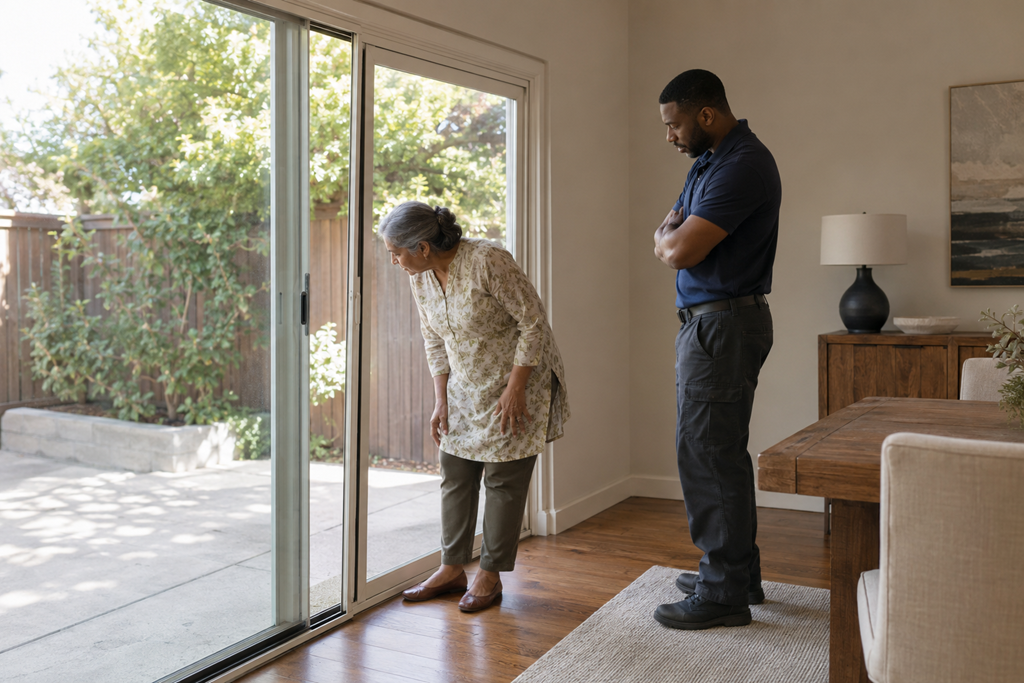
When a sliding door comes off track, the safest response is to stop moving it and avoid trying to force the panel back into place. An off-track door may be tilted, partly lifted from the lower rail, scraping against the frame, or resting unevenly on its rollers. Even when the glass looks intact, the panel may no longer be fully supported, so the real issue is stability and alignment—not simply a door that feels stuck.
For Sacramento-area homeowners and renters, this problem often becomes noticeable during an ordinary moment: opening the door to reach the patio, closing it at night, or trying to engage the lock. The panel may suddenly feel unusually heavy, move at an angle, or refuse to close completely.
Understanding what “off track” can mean helps you avoid making the problem worse and prepares you for a more useful conversation with a sliding door repair professional.
An Off-Track Door Is Not Always Completely Detached
People often picture a door lying loose in its frame when they hear that it has come off track. In practice, the condition can be less obvious.
One end of the panel may still move while the other drags. A lower roller may no longer be seated correctly, or the door may be leaning slightly without appearing close to falling. The panel might also move several inches before stopping at the same point each time.
Common signs include:
- A visible tilt in the door panel
- A gap that is wider at the top or bottom
- Scraping or grinding during movement
- A door that jumps, drops, or shifts when moved
- A latch that no longer lines up
- A panel that feels much heavier than usual
- Fresh marks or metal shavings along the lower track
These signs do not identify the exact cause by themselves. They do indicate that the panel may not be traveling through the frame as intended.
Forcing the Door Can Turn Misalignment Into Damage
A sliding glass door can be large and heavy even when it normally moves with little effort. When its rollers, track, or frame are no longer supporting that weight correctly, pulling harder on the handle may place additional stress on several parts of the assembly.
Continued force can scrape the frame, bend damaged track sections further, strain the handle, or cause the panel to shift unexpectedly. It may also make a repair more complicated if a manageable alignment problem becomes damage to additional components.
This does not mean every off-track door is about to collapse. It means the panel should be treated differently from a door that is merely moving through a little surface dirt.
The practical response is to leave it in the most stable position available and keep children and pets from pushing against it while you arrange an evaluation. Trying to lift or reposition a large glass panel without the right equipment and experience can introduce unnecessary risk.
A Clean Track Does Not Rule Out a Repair Problem
Dirt and debris can interfere with a sliding door, but a visibly clean track does not prove that the door is properly supported.
The problem may involve worn or damaged rollers beneath the panel. A section of the track may be dented, worn, or slightly out of shape. A guide may no longer be holding the panel in the correct position. The frame or door panel may also have shifted enough to affect alignment.
Sometimes several conditions contribute to the same symptom. A worn roller may cause uneven movement, for example, while repeated dragging gradually damages the surface it travels across.
This is why cleaning the visible track may not solve a door that repeatedly jumps, tilts, or comes out of position. The dirt may be incidental rather than the main cause.
The Locking Problem May Be a Symptom, Not the Main Failure
An off-track door often stops latching correctly because the panel is no longer sitting squarely in the opening. The lock may miss its receiving point, require the door to be lifted, or work only when pressure is applied to the panel.
It is easy to assume the lock itself needs adjustment or replacement. However, changing the latch without addressing the panel’s position may only mask the larger issue.
A useful evaluation should consider whether the locking problem began after the door started dragging, leaning, or moving unevenly. That sequence can help distinguish a lock failure from an alignment problem affecting the lock.
A properly completed repair should address more than whether the latch can be made to catch once. The door should move through its normal path, sit evenly in the frame, close securely, and engage the lock without unusual lifting or force.
Repositioning the Panel Is Only Part of the Repair
Putting a panel back into its intended position may restore movement temporarily, but it does not necessarily explain why the door came off track.
A sliding door professional should look for the condition that allowed the displacement to happen. Depending on the door, that may include evaluating the rollers, lower rail, upper guide, frame alignment, panel condition, and locking position.
This distinction matters when comparing repair recommendations. One provider may propose simply reseating the panel, while another may identify a worn component or damaged surface that could cause the problem to return.
Before authorizing work, ask what caused the panel to leave its normal path and whether any damaged or worn parts are contributing to the problem. A clear explanation should connect the recommended repair to the symptoms you have observed.
Repair or Replacement Depends on More Than the Door’s Age
An off-track sliding door does not automatically need to be replaced. Many alignment, roller, guide, and localized track problems may be repairable after the door is properly evaluated.
Replacement may become part of the discussion when the panel or frame has significant damage, compatible components are difficult to obtain, the glass or frame presents a safety concern, or the door repeatedly fails despite previous repairs.
Age can influence that decision, but it should not be the only factor. The condition of the full assembly, the availability of suitable parts, the expected durability of the repair, and the door’s ability to close and lock properly are usually more informative than age alone.
A helpful provider should be able to explain what can be repaired, what cannot, and why a larger recommendation is being made.
Questions That Can Make a Repair Estimate More Useful
When speaking with a Sacramento-area sliding door professional, a few focused questions can help you understand the proposed work:
- What caused the panel to come off track?
- Are the rollers, track, guides, frame, and lock all being evaluated?
- Is the recommendation expected to correct the cause or only reposition the door?
- Will the door be tested through its full range of movement after the repair?
- Are there signs that replacement should be considered instead?
The answers should be specific to your door rather than based only on a brief description over the phone. Photos may help a provider understand the situation initially, but the condition of the rollers and supporting components may not be visible until the assembly is inspected.
A Stable, Evenly Moving Door Is the Real Goal
When a sliding door comes off track, the most important point is that the problem involves support and alignment. The door may look mostly normal while still resting unevenly or placing stress on parts that were not designed to carry the panel that way.
Avoiding repeated force protects the existing assembly while you decide what to do next. A professional evaluation should identify why the door shifted, explain whether the problem is localized or more extensive, and confirm that the finished door moves, closes, and locks as intended.
That understanding gives you a better basis for comparing repair recommendations and deciding whether a repair or replacement discussion makes sense for your Sacramento-area property.