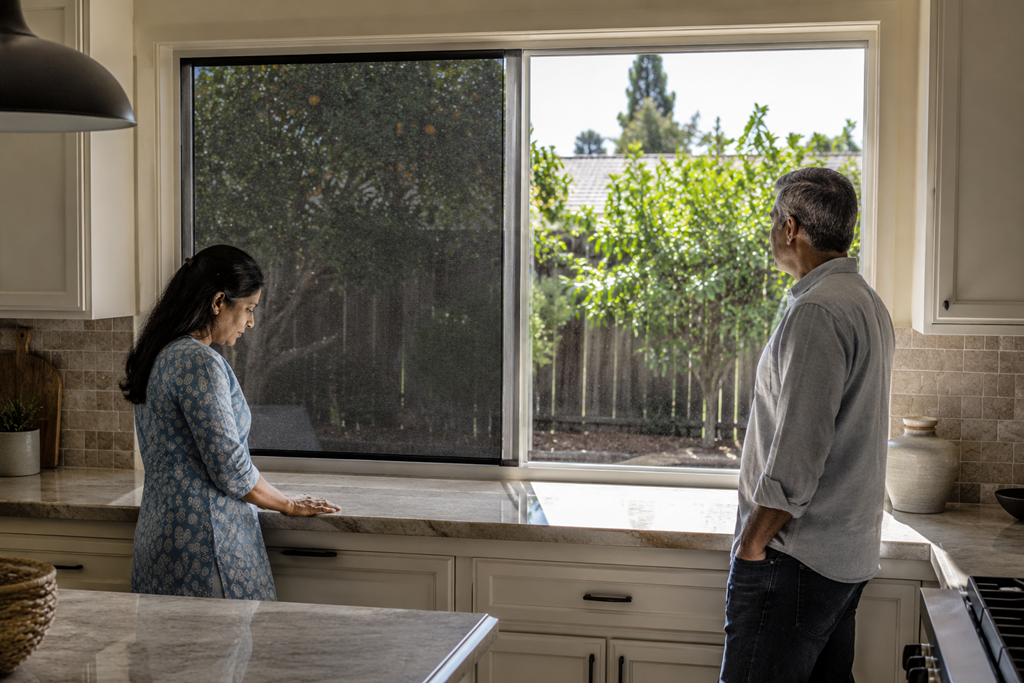
Solar screens can make a room feel more comfortable by reducing the amount of direct sun reaching the glass, but that same change can also make the room look dimmer and alter how clearly you see outside. The result depends on the screen material, its openness, its color, the direction the window faces, nearby shade, and how much daylight the room normally receives. That is why the best choice is usually not “the darkest screen available,” but the option that solves the heat or glare problem without creating a new lighting or visibility problem.
A Solar Screen Changes More Than the Temperature
Homeowners often start considering solar screens because one or two rooms become uncomfortable during part of the day. A west-facing family room may develop intense afternoon glare. A home office may become difficult to use when sunlight reflects from a monitor. A bedroom may feel noticeably warmer near the window even when the rest of the home feels comfortable.
Solar screens can help by intercepting part of that sunlight before it reaches the glass. This may reduce glare, lessen the warming effect around the window, and make nearby seating or work areas more usable.
However, sunlight also provides natural illumination and helps maintain a clear outdoor view. Reducing it involves a tradeoff. The goal is to find a useful balance among comfort, daylight, and visibility rather than maximizing only one of those qualities.
Comfort Can Improve Before the Room Feels Cooler
A room does not always need a dramatic temperature change to feel better.
Direct sunlight can create a bright visual hotspot, warm nearby flooring or furniture, and make a person sitting near the window feel exposed to radiant heat. Reducing that direct exposure may make the room feel more comfortable even when the thermostat reading changes very little.
This distinction matters when discussing expectations with a solar-screen professional. One homeowner may be trying to reduce glare at a desk, while another may be concerned about a room that remains uncomfortable throughout the afternoon. Those are related problems, but they are not identical.
Explaining when the discomfort occurs, where it is strongest, and how the room is normally used can help a provider recommend an option suited to the actual problem.
Natural Light Does Not Change Evenly Throughout a Home
A solar screen that works well on one window may feel too dark on another.
A large west-facing window receiving direct afternoon sun may still provide useful daylight after a solar screen is installed. A smaller window beneath a porch roof or mature tree may already receive limited light. Placing the same screen on that shaded window could make the adjoining room feel dim without providing much additional comfort.
Interior finishes also influence the result. Light-colored walls and reflective surfaces may distribute reduced daylight more effectively. Dark flooring, deep paint colors, heavy curtains, and limited secondary windows may make the same screen feel more noticeable.
For Sacramento-area homeowners, the useful question is not simply, “How much sunlight does this material block?” It is also, “How much usable daylight will remain in this particular room?”
Visibility Depends on Which Side Is Brighter
Solar screens can change how clearly occupants see outside, but the effect is not fixed throughout the day.
During bright daylight, the exterior may remain reasonably visible from a darker interior, although fine details can appear softened or muted through the mesh. The screen’s color, weave, openness, viewing distance, and outdoor lighting all affect the experience.
The balance can change after sunset or whenever the interior becomes brighter than the exterior. A solar screen should not automatically be treated as a permanent privacy barrier. Interior lighting, viewing angle, distance, and surrounding conditions can all influence what is visible from either side.
This is why privacy claims deserve careful discussion. A provider should be able to explain how the proposed material affects daytime outward visibility without implying that it will create complete privacy under every lighting condition.
More Sun Blockage Is Not Automatically Better
It can be tempting to choose the option described as providing the greatest reduction in solar exposure. That may be reasonable for a severely affected window, but it is not always the best choice for every room.
A den used mainly for television viewing may benefit from stronger glare reduction. A kitchen, reading area, craft room, or home office may depend more heavily on natural light and a clear view. The right balance can differ even between two windows on the same side of the house.
Choosing solely from a performance percentage or small material sample can make the decision seem simpler than it really is. Those details are useful, but they do not show how a full-size screen will affect the room from the places where people normally sit, work, cook, or relax.
The practical question is whether the screen improves the room’s everyday use.
Full-Size Comparisons Reveal What Small Samples Cannot
A small mesh sample can show color and texture, but it may not accurately communicate the overall effect of a complete panel.
When possible, evaluate a larger sample or temporarily positioned screen from several feet away. Look through it from the chair, desk, bed, or counter where the window is normally experienced. Notice both the outside view and the amount of light reaching deeper into the room.
It is also useful to compare the window during the time of day when the original problem is most noticeable. A screen evaluated in soft morning light may appear very different when direct afternoon sun reaches the glass.
The objective is not to conduct a technical test. It is to see whether the proposed screen changes the room in a way that feels useful rather than excessive.
Different Windows May Need Different Decisions
Solar-screen planning does not have to be an all-or-nothing project.
One side of a Sacramento-area home may receive strong direct sun, while another side is protected by an overhang, nearby structure, or established landscaping. Even along the same exterior wall, one window may be exposed while another remains shaded for most of the day.
Installing the same screen on every window may create a consistent exterior appearance, but consistency alone does not guarantee the best interior result. Selective placement may sometimes address the strongest heat and glare problems while preserving daylight and visibility elsewhere.
A provider recommending whole-home coverage should be able to explain why each window would benefit, not merely why matching panels look uniform from outside.
Questions That Keep the Conversation Focused
Before choosing a material or approving an estimate, consider asking:
- Which windows appear to be causing the actual heat or glare problem?
- How will this material affect daylight from normal seating and working positions?
- Can I view a full-size sample rather than relying only on a small swatch?
- How much will the mesh soften or darken the outdoor view?
- Are different openness levels or screen choices appropriate for different windows?
- What should I realistically expect from the screen during daytime and after interior lights are turned on?
- Why is the same material being recommended for every proposed window?
Clear answers should connect the recommendation to the home’s exposure and the way each room is used.
Common Assumptions Can Lead to the Wrong Balance
One common misunderstanding is that a darker-looking screen must always provide the best comfort. Appearance alone does not explain how a full panel will perform in a particular window.
Another is assuming that solar screens preserve the outdoor view exactly as it appears through uncovered glass. Most mesh changes the view to some degree, even when visibility remains useful.
Homeowners may also expect the same result in every room. Differences in window size, direction, shade, interior lighting, wall color, and room layout can produce noticeably different experiences.
Finally, solar screens are sometimes discussed as though they provide fixed privacy. Privacy depends heavily on the lighting relationship between the interior and exterior, so it should be evaluated separately from heat and glare reduction.
The Best Choice Supports the Way the Room Is Used
A solar screen is most useful when it addresses a specific comfort problem without unnecessarily reducing the qualities that make the room pleasant.
For one room, that may mean stronger glare control. For another, it may mean choosing a more open material to preserve daylight. A shaded window may not need a screen at all, even when nearby sun-exposed windows do.
Before hiring a local solar-screen installer, describe the problem in everyday terms: when the room becomes uncomfortable, where glare appears, how important the view is, and how much natural light the room needs. That information can lead to a more thoughtful recommendation than choosing a screen based only on its darkest appearance or strongest performance claim.
The most suitable solar-screen plan is not necessarily the one that blocks the most sun. It is the one that creates a workable balance among comfort, light, and visibility in the rooms where the screens will actually be used.